
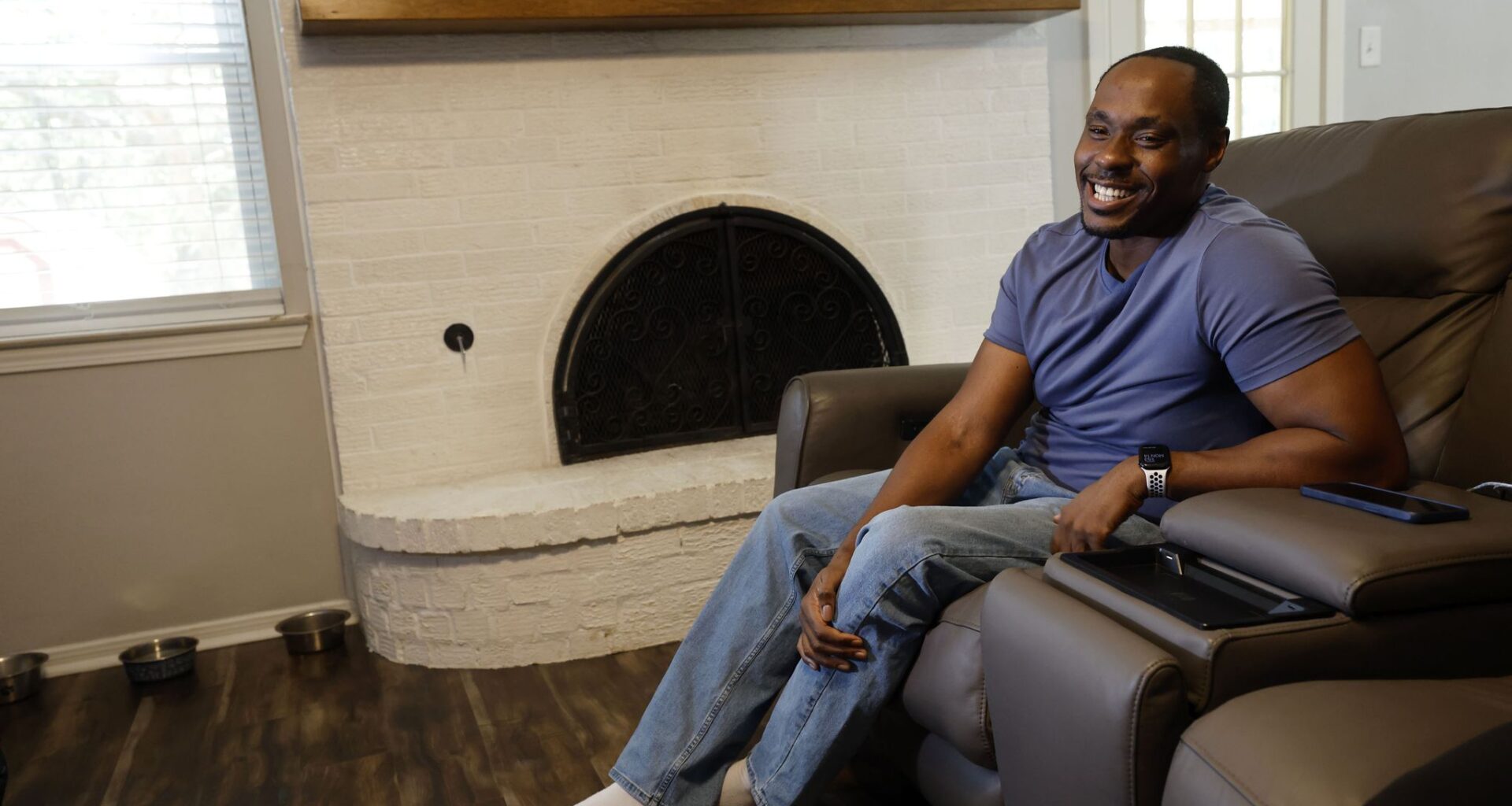
Dallas ISD officer Justin Jones, who was shot in the leg, speaks to The Dallas Morning News, Monday, Sept. 14, 2026, at his house in Bedford.
Chitose Suzuki/The Dallas Morning News
Dallas ISD officer Justin Jones, who was shot in the leg, pauses as speaking to The Dallas Morning News, Monday, Sept. 14, 2026, at his house in Bedford.
Chitose Suzuki/The Dallas Morning News
Dallas ISD officer Justin Jones, who was shot in the leg, pauses as speaking to The Dallas Morning News, Monday, Sept. 14, 2026, at his house in Bedford.
Chitose Suzuki/The Dallas Morning News
Dallas ISD officer Justin Jones, who was shot in the leg, speaks to The Dallas Morning News as his dog Boo walks by, Monday, Sept. 14, 2026, at his house in Bedford.
Chitose Suzuki/The Dallas Morning News
Dallas ISD officer Justin Jones, who was shot in the leg, pauses as speaking to The Dallas Morning News, Monday, Sept. 14, 2026, at his house in Bedford.
Chitose Suzuki/The Dallas Morning News
A Dallas police crime scene technician photographs the a hat and evidence marker in the back of a Dallas ISD patrol car where a Dallas ISD police officer was shot and wounded in the parking lot of a Sam’s Club in northwest Dallas on Thursday, Aug. 6, 2026.
Elías Valverde II/The Dallas Morning News
A unit of blood is depleted as a patient is moved for more tests in trauma center at John Peter Smith Hospital.
Smiley N. Pool/Staff Photographer
A Parker County Hospital District Life Care EMS ambulance headed for the Medical City Weatherford emergency room in 2022. Weatherford does not have a trauma center to treat badly injured patients who need medical care as soon as possible.
Smiley N. Pool/Staff Photographer
Austin-Travis County EMS Commander Craig Smith (left) works in the back of an ambulance in May. (Smiley N. Pool/Staff Photographer)
Smiley N. Pool/Staff Photographer
Fort Worth Fire Department Capt. Trent Robinson works to transfuse a gunshot victim with a unit of blood in the back of an ambulance in Fort Worth on a late fall evening in 2025. The department has initiated a mobile blood program, which has delivered blood to hemorrhaging patients in the field since April.
Smiley N. Pool/Staff Photographer
A Fort Worth Fire Department paramedic holds a unit of blood as a team works to transfuse a gunshot victim in the back of an ambulance.
Smiley N. Pool/Staff Photographer
Fort Worth Fire Department Capt. Trent Robinson works to transfuse a gunshot victim with a unit of blood in the back of a moving ambulance in Fort Worth.
Smiley N. Pool/Staff Photographer
Fort Worth firefighter Michael Thornell repacks the Medic 1 bag next to a portable cooler used to transport blood after a gunshot victim was transfused with a unit of blood while being transported to the emergency room.
Smiley N. Pool/Staff Photographer
Fort Worth Fire Department paramedic Noah Burson removes a unit of blood from a cooler in the back of a moving ambulance to transfuse a gunshot victim with a unit of blood. The department has initiated a mobile blood program, which has delivered blood to hemorrhaging patients in the field since April.
Smiley N. Pool/Staff Photographer
Justin Jones was walking back to his squad car when he realized he was wounded — badly.

Jones, a police officer for the Dallas Independent School District, had been transporting a man to safety who had been acting erratically on a highway in northwest Dallas. The man had been walking on the center median of Lyndon B Johnson Freeway as mid-morning traffic rushed past him.
Jones noticed the man rifling through the personal bag he had left in the back seat. He grew uneasy. He decided to pull his patrol vehicle over to secure the items and conduct another search for weapons. He chose the parking lot of a Sam’s Club, where his car and their interactions would be highly visible.
Article continues below this ad
Jones began to pat down the man again. A struggle ensued. They fell to the ground. The man grabbed for Jones’ service weapon. A single gunshot rang out. The man ran. Jones tried to chase after him.
Then he noticed the blood. It was everywhere.
Jones made it to his patrol car, but he couldn’t find his tourniquet. He tried to remain calm, but the thought struck him. He might not survive this.
He didn’t feel pain, but there was an odd sensation on his upper right thigh. Something strange was happening with his vision, too. It was as if the lights were being slowly turned down.
Article continues below this ad
His view of the parking lot dimmed. Darkness took over.
A Dallas police crime scene technician photographs the scene where a Dallas ISD police officer was shot and wounded in the parking lot of a Sam’s Club in northwest Dallas on Thursday, Aug. 6, 2026.
Elías Valverde II/The Dallas Morning News
Losing blood
When Joseph Rider, a lieutenant and EMS supervisor with Dallas Fire-Rescue, arrived at the scene that morning in early August, he could tell that Jones had lost a significant amount of blood.
Blood was splattered on the seat and floor of Jones’ police car, and on the ground outside. Jones’ pants were soaked in it.
Article continues below this ad
Jones seemed to be in the early stages of shock. He was conscious and could answer questions, but he was lethargic. It was a demeanor Rider had observed before in patients with life-threatening blood loss — a listlessness, often combined with a glassy stare, that suggested the patient was not all there.
Medics from a fire engine who had been shopping nearby had already begun administering intravenous fluids and oxygen to Jones. Another Dallas ISD police officer who had responded to the scene had placed a tourniquet, which was stanching the flow of blood. The bullet had struck Jones high up on his leg, just below the hip.
Related: Thirty-four lives saved: One year later, Dallas Fire-Rescue blood program marks successes
As Rider climbed into the ambulance, he brought the two units of blood he carried on his vehicle. He might need them.
When Rider measured Jones’ vitals, they were on the edge of the department’s criteria for giving blood. His blood pressure was low, but not yet critically so, and his heart rate was elevated. At 39, Jones was young and strong. His body was likely compensating well for the blood loss.
Article continues below this ad
Those measures would likely worsen soon. Jones was progressing into hemorrhagic shock — the body’s physiologic response to massive blood loss. If blood continues to be lost without replacement, it causes severe, sometimes permanent, damage to tissues and vital organs. And Rider could see, visually, how much blood Jones already had lost.
Rider had made his decision. Jones would receive the transfusions as the ambulance raced toward a trauma center.
Related: Fort Worth paramedics join Dallas in providing mobile blood transfusions
Jones still couldn’t see, but he could hear the medics discussing what they were about to do. For a moment, Jones was bemused. He didn’t realize that was something paramedics could do.
He felt the pinch of a needle entering his arm.
Article continues below this ad
So much blood had coursed out of Jones’ body that morning. Now, it was flowing back in.
‘Night and day’
Not so long ago, that wouldn’t have been an option for Jones, and for other critically injured patients like him.
Dallas paramedics have only been carrying blood in the field for less than two years. In February 2025, the city launched a pilot program that later became a permanent part of the care provided to bleeding patients across the city.
Kate Krause whose life was saved by a transfusion shares her story with Marshal Isaacs, medical director for the Dallas Fire-Rescue, left, and Interim Assistant Chief Scott Pacot, right, during a Dallas City Council meeting, Wednesday, Aug. 20, 2025, in Dallas. Dallas Fire-Rescue paramedics, Marcus Toop, background from left, Joshua Mihalyi and Justin Lovvorn help to save the life of Krause, who is an emergency medicine physician, with an on-scene blood transfusion.
Chitose Suzuki/Staff Photographer
In that time, city officials say, more than 75 patients in Dallas, Jones included, have received blood before reaching a hospital. They have credited the program with saving dozens of lives, including that of a Dallas emergency room physician who suffered a postpartum hemorrhage.
Article continues below this ad
Dallas’ blood program was created in response to “Bleeding Out,” a 2023 investigation by The Dallas Morning News and the San Antonio Express-News that identified a national epidemic with local implications. Patients were routinely bleeding to death from injuries they could have otherwise survived, the investigation showed, because transfusions were simply taking too long. For patients with severe blood loss, research has found, mortality rises every minute they spend waiting for their blood to be replaced.
Read “Bleeding Out,” a new series examining how gaps in the American health system fail to address preventable deaths. This series was produced in partnership with the San Antonio Express-News and with support from the USC Annenberg Center for Health Journalism.
michael-hogue
Too often, the reporting found, paramedics were unequipped to treat major blood loss, leaving them to watch helplessly as patients succumbed to their bleeding.
In the years since The News published its investigation, North Texas has begun to catch up to other parts of the state, where transfusions on ambulances were already standard practice. In addition to Dallas, EMS providers in Fort Worth, Arlington, McKinney and Plano are now carrying blood products in the field.
In the past several years, prehospital blood programs have proliferated across Dallas-Fort Worth.
Rider, who responds to calls in northwest Dallas, has only administered blood in the field to a handful of patients. Blood is more frequently needed elsewhere in the city, including southern Dallas, where gun violence is more prevalent.
Each time he has given blood, he has witnessed the “night and day” effect it has on patients with severe hemorrhage. Within the span of an ambulance ride, the color returns to patients’ skin. So too does their ability to think and speak. Their vital signs stabilize.
Related: Paramedics in North Texas want to carry blood. Who’s going to pay for it?
In the ambulance with Jones, Rider observed the same effect as two units of blood were pumped back into his body. The medics also administered tranexamic acid, also known as TXA, a medication that encourages blood to clot. Jones’ blood pressure, in particular, improved dramatically, as did his level of alertness.
The ambulance pulled up to the trauma bay at Parkland Health.
Rider and his colleagues had done their part. Now Jones’ care, and his life, were in the hands of the doctors.
A gaping wound
Inside the hospital, Dr. Caroline Park and Dr. Sean Clayton had prepared the hospital’s staff for Jones’ arrival. As the ambulance headed their way, they had been notified their incoming patient was a police officer, who had been badly wounded.
From their handoff with the paramedics, the doctors learned that Jones had already been stabilized by a number of interventions — the tourniquet, the blood-clotting medication, and, critically, the blood transfusions.
As Park helped triage Jones, she observed he was remarkably calm and collected. The same thought occurred to Clayton; Jones seemed to be in surprisingly good shape for someone with a gaping wound on his thigh.
Related: Trauma deserts in rural America: Where you live can determine whether you live
While the 10 miles between the scene of the shooting and the hospital might seem like a short distance on a map, both doctors knew that the tourniquet and transfusions by the paramedics had bought Jones valuable time. He was awake, and alert, because of them.
Brief removal of the tourniquet confirmed what the doctors already suspected: A vein or artery had been damaged. Initially, they couldn’t tell which. The bullet had torn through the musculature of Jones’ thigh, burying itself deep in his leg.
Either way, he would need surgery.
Jones was anxious. He dreaded being put under for the surgery. He was afraid.
He was afraid that if he went to sleep, he would never wake up.
A life saved
Jones did wake up, in a hospital bed in the intensive care unit.
He would learn that, over the course of less than two hours, the surgery had revealed severe damage to the deep femoral vein, a blood vessel that is one of the main suppliers of blood to the right thigh. The bullet had shredded through the vein, tearing it completely open.
The doctors had worked quickly, tying off the damaged vein. They administered antibiotics and additional units of blood to Jones, replacing more of what his body had lost. The doctors left the bullet fragments alone. Their job was to stabilize the bleeding and, to the extent possible, spare Jones’ leg from further damage.
Justin Jones, a police officer for Dallas ISD, recovers at Parkland Health after being shot while on duty. The injury to his leg resulted in life-threatening blood loss.
Courtesy of Taylor Durand
Two days later, Jones underwent another surgery.
Due to swelling, the surgeons did not fully close Jones’ wound. Instead, they covered it with a wound vac, a device that provided pressure to the wound and helped drain fluid as it healed.
The wound wasn’t the most painful part of Jones’ initial recovery. It was the incredibly tight compression bandages that the hospital wrapped around his leg to control the ongoing swelling and prevent the need for additional surgeries.
Related: A North Texas man nearly died after a horrific, head-on crash. Here’s what saved him
Jones spent nearly two weeks in the hospital.
Soon after Jones was shot, Dallas police arrested Jose Pantoja-Morales, charging him with aggravated assault of a public servant.
At home, Jones has had to adjust to a new routine and limitations. He can walk, but his leg perpetually feels as though it has fallen asleep. He cannot bend his knee while walking, and lifting his leg remains difficult.
Dallas ISD officer Justin Jones, who was shot in the leg, speaks to The Dallas Morning News as his girlfriend Taylor Durand looks on, Monday, Sept. 14, 2026, at their house in Bedford.
Chitose Suzuki/The Dallas Morning News
His girlfriend, Taylor Durand, has been supporting him through his recovery. In the weeks after the shooting, Jones’ family remained anxious. Jones’ brother was shot by a stray bullet while sitting in his home several years ago. He survived the initial injury but later died from a blood clot.
Jones, who used to spend five days a week in the gym, can’t start physical therapy until the wound vac is removed. He is unsure when he will be fit to return to work.
As far as the Parkland doctors are concerned, Jones is an example of how initiatives to control major bleeding as soon as possible can provide patients with the best possible chance of survival.
“Each step in how he was cared for,” Clayton said, “allowed him to get to the operating room.”
Jones’ doctors encouraged members of the community to donate blood. Patients like Jones, they said, need it.
In conversations with his fellow police officers, Jones learned about what the Dallas paramedics had done for him that day, and the fact that blood is not available on ambulances everywhere.
Related: In Fort Worth, mobile blood transfusion program has saved lives
Across Texas and the rest of the country, its availability remains patchwork. It depends on where a patient is located and whether the responding agency has a blood program in place. Trauma physicians and paramedics, many from Texas, have advocated at the Texas Legislature and in Washington, D.C., for support for these programs and the EMS providers who administer them.
Justin Jones, a police officer with Dallas ISD, survived a shooting after receiving transfusions through Dallas’ prehospital blood program.
Jones believes if he had been wounded in the same manner in another city — one that didn’t equip its ambulances with blood products — his fate would have been different.
Instead of a story of survival and recovery, it might have been one of tragedy and heartbreak.
These programs, he said, should be available to all patients. They should be everywhere.