
Dallas City Council Member Maxie Johnson speaks, Thursday, June 4, 2026 at Dallas City Hall, with other city leaders and pastors about the “importance of keeping the Dallas Mavericks in downtown”. He does not want the move to see southern Dallas left behind.
Steve Nurenberg/The Dallas Morning News
In the flag room of City Hall, southern Dallas leaders pleaded with the Dallas Mavericks.
“We’re asking the Dallas Mavericks, don’t turn your backs on southern Dallas,” Deputy Mayor Pro Tem Maxie Johnson said that day. “We want you here. We need you here.”
It was June, and after the NBA team’s plans for moving to the former Valley View Mall in Far North Dallas became public, Johnson, who represents part of Oak Cliff on the City Council, swiftly gathered the group to address a familiar pattern.
Leaders say an unyielding expansion north, both in Dallas and across North Texas, draws resources away from the south. Southern Dallas has a place in the city’s future, the group said, with it having long been called a linchpin in the city’s growth. But Dallas leaders told The Dallas Morning News there’s a cost to overcoming historic disinvestment, and when business moves elsewhere, it only makes it more difficult for the area to reach its full potential.
Related: Vacant lots in southern Dallas could help ease region’s housing crisis
Article continues below this ad
“When the central tax base is systematically starved by capital fleeing north and to the suburbs, the funds available to invest in historically marginalized communities will completely dry up,” said state Rep. Venton Jones at the June news conference.
Leaders say progress in southern Dallas depends on the city’s current success, and the city’s long-term success depends on that progress.

As Dallas confronts budget pressures, corporate departures and continued growth toward its northern suburbs, leaders are making a renewed case for investment south of Interstate 30. Southern Dallas has abundant land and growing development, but decades-old disparities in infrastructure, jobs and amenities remain.
Angela Piazza, The Dallas Morning News
Despite holding around half of the city’s land, southern Dallas holds much less taxable property. Southern Dallas represents less than a fifth of the city’s taxable property value, according to the economic development department. That’s despite roughly 45% of residents, a majority of them Black and Hispanic, living south of Interstate 30.
Residents have advocated for grocery stores and healthcare facilities, which have clustered north. Others have asked for more work opportunities or shops. Even hotly contested, large data centers are being debated far away in suburbs to the north or south, regardless of whether residents want them.
A construction crew works to build a retaining wall and install utility pipeline for a planned mixed-use development in University Hills, Dallas, Friday, Aug. 21, 2026. UNT is seen in the background.
Angela Piazza/The Dallas Morning News
A construction crew works to install a utility pipeline that passes under a creek for a planned mixed-use development in University Hills, Dallas, Friday, Aug. 21, 2026.
Angela Piazza/The Dallas Morning News
A construction crew works to install a utility pipeline that passes under a creek for a planned mixed-use development in University Hills, Dallas, Friday, Aug. 21, 2026.
Angela Piazza/The Dallas Morning News
A construction crew works to build a retaining wall for a planned mixed-use development in University Hills, Dallas, Friday, Aug. 21, 2026.
Angela Piazza/The Dallas Morning News
A construction crew works to build a retaining wall for a planned mixed-use development in University Hills, Dallas, Friday, Aug. 21, 2026. UNT is seen in the background.
Angela Piazza/The Dallas Morning News
UNT Dallas is seen behind University Hills, a planned mixed-use development in southern Dallas, Wednesday, Aug. 27, 2026.
Angela Piazza/The Dallas Morning News
UNT Dallas is seen behind University Hills, a planned mixed-use development in southern Dallas, Wednesday, Aug. 27, 2026.
Angela Piazza/The Dallas Morning News
UNT Dallas is seen behind University Hills, a planned mixed-use development in southern Dallas, Wednesday, Aug. 27, 2026.
Angela Piazza/The Dallas Morning News
UNT Dallas is seen behind University Hills, a planned mixed-use development in southern Dallas, Wednesday, Aug. 27, 2026.
Angela Piazza/The Dallas Morning News
Downtown Dallas seen behind University Hills, a planned mixed-use development in southern Dallas, Wednesday, Aug. 27, 2026.
Angela Piazza/The Dallas Morning News
A demolition crew knocks down the City Inn & Suites hotel along Interstate 35 and Ewing Avenue in Dallas, Friday, Aug. 14, 2026. The site will become parking for the park.
Angela Piazza/The Dallas Morning News
A demolition crew knocks down the City Inn & Suites hotel along Interstate 35 and Ewing Avenue in Dallas, Friday, Aug. 14, 2026. The site will become parking for the park.
Angela Piazza/The Dallas Morning News
A demolition crew knocks down the City Inn & Suites hotel along Interstate 35 and Ewing Avenue in Dallas, Friday, Aug. 14, 2026. The site will become parking for the park.
Angela Piazza/The Dallas Morning News
A demolition crew knocks down the City Inn & Suites hotel near Halperin Park in Dallas, Friday, Aug. 14, 2026. The site will become parking for the park.
Angela Piazza/The Dallas Morning News
Related: Dallas City Council approved a record $6 billion budget, boosting police, saving libraries
Recent citywide budget issues and high-profile talks of corporate departures from the city center have only raised concerns. Leaders hope it won’t impact the funding and attention needed to usher in improvements and overcome a longstanding imbalance.
Article continues below this ad
City investment marks change
Across southern Dallas, growth is showing up around a new $300 million deck park near the Dallas Zoo and at the reimagined Shops at RedBird, which has attracted several healthcare facilities. Entire blocks in some neighborhoods have filled with new houses, with more on the way.
Along Martin Luther King Boulevard in South Dallas, an area near the city’s center, the Forest Theater is undergoing a multimillion-dollar renovation to serve as a cultural hub. Nearby, St. Philip’s School and Community Center and Cornerstone Baptist Church are working on revitalization as well, and there’s been an injection of funding to complete the work.
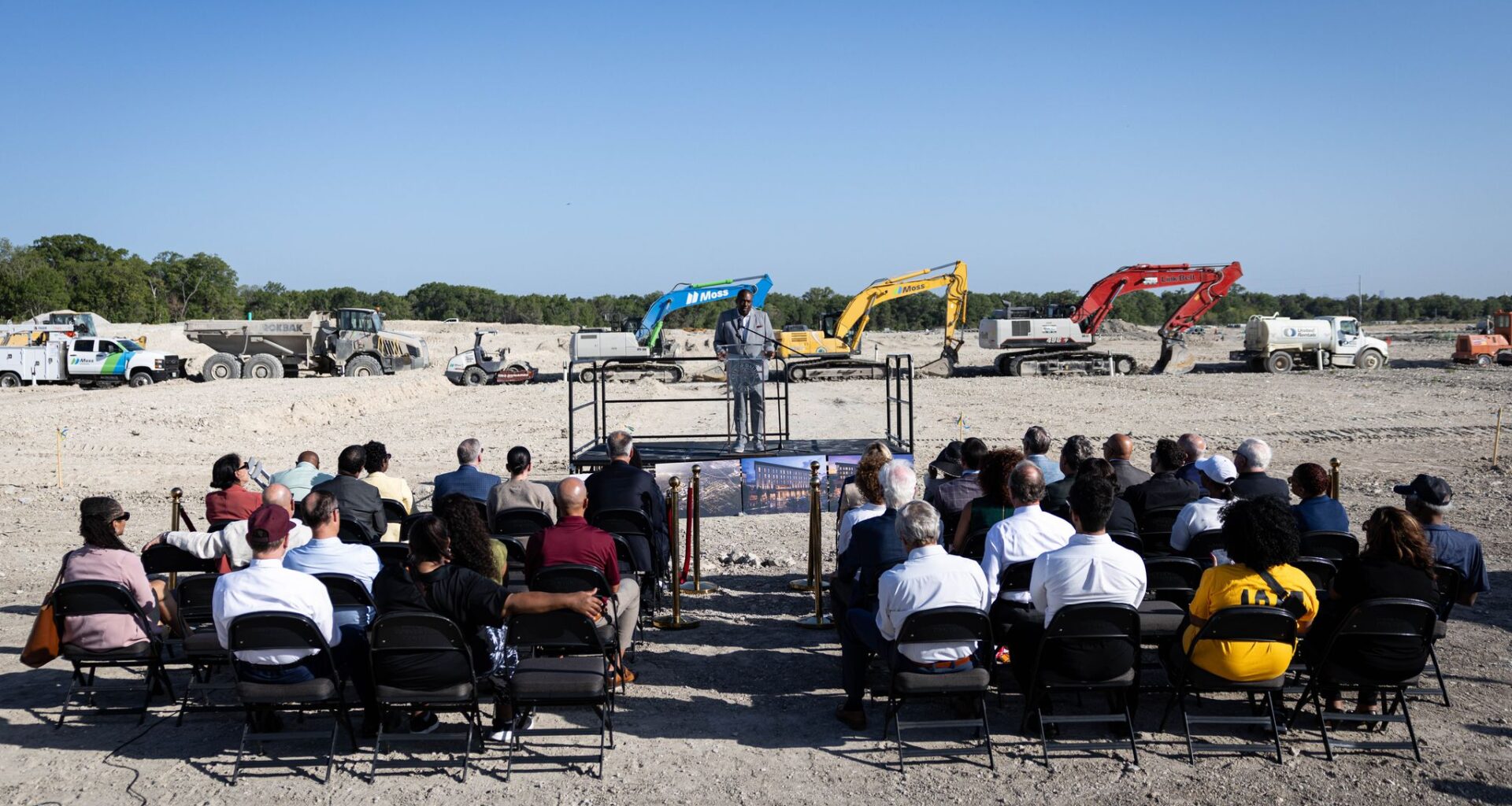
In August, more than 10 miles from City Hall, acres of flat dirt drew city leaders to southeast Oak Cliff to celebrate progress on the billion-dollar, 270-acre University Hills project.
State Sen. Royce West speaks at a ceremony celebrating infrastructure improvements for a planned mixed-use development in University Hills, Dallas, Thursday, Aug. 13, 2026.
Angela Piazza/The Dallas Morning News
It’s one of several projects expected to transform the area near the University of North Texas at Dallas campus, bringing new housing, amenities and hope for a long-desired grocery store to nearby neighborhoods.
Costly infrastructure needs have served as a barrier for developers looking to build in southern areas. Neighborhoods lack sidewalks, street repairs or utility connections that foster growth. But that day in August, leaders celebrated the completion of work that will facilitate the creation of hundreds of single-family homes, commercial space and more.
“Days like this continue to remind me how important it is for us to hold onto our hope for southern Dallas,” City Manager Kimberly Bizor Tolbert told the crowd. “It is also a testament that government can be a positive force in lifting up and strengthening communities, and truly championing goals that allow for us to deliver on our promise to make all parts of this city strong and vibrant.”
Developer Mike Hoque said the work to create a mixed-use district is now 18 months ahead of schedule. It’s part of a strategy to rebalance growth in the north and south.
Article continues below this ad
Related: Vacant lots plague southern Dallas as builders balk at infrastructure costs
Mike Hoque, CEO of Hoque Globals, speaks at a ceremony celebrating infrastructure improvements for a planned mixed-use development in University Hills, Dallas, Thursday, Aug. 13, 2026.
Angela Piazza/The Dallas Morning News
Leaders point to the combination of incentives, city support and private investment as driving change. As that change takes hold, southern Dallas areas are seeing increases in housing, incomes and workers. For all that progress, leaders also said there is still a long way to go.
“The southern sector of Dallas is wonderfully diverse and trending in the right direction, but the work must continue to decrease the long-standing disparity in tax base between historically under-invested neighborhoods and the rest of the city,” said Kevin Spath, director for the city’s economic development office, in a statement.
What do Dallas’ numbers say?
Increasing growth, along with the persistent impact of neglect, are showing up in the numbers. Southern Dallas is growing faster than fuller neighborhoods to the north.
Spath said that in 2025, southern Dallas had 19% — or nearly $37 billion — of the city’s taxable property value. This excludes “business property.” Business property is typically considered personal property, like furniture or equipment, used to produce income.
That’s up from 2011, when southern Dallas had about 13% of the city’s taxable value, or around $10 billion, including business property, Spath said.
Article continues below this ad
The ratio is “unacceptable,” said Tennell Atkins, who represented Dallas’ southernmost areas on the City Council over a span of about 20 years before his term ended in 2025.
“You cannot maintain this [city] trying to grow north,” he added. “You’ve got to go south.”
Related: See how Dallas’ budget has changed in 4 charts
At the same time, Spath said that between 2020 and 2025, the rate of growth for taxable property value was about 94% in southern Dallas. That’s compared to nearly 55% to the north, which includes downtown.
An array of economic tools are being deployed to help facilitate hundreds of millions in private investment. Over the past 20 years, Dallas has seen significant investment to the south, much of it “intentionally stimulated and catalyzed,” Spath said. Investments come from the city, county and state, along with DART.
Spath pointed to demographic changes, along with an increase in housing, to show how areas are changing.
Southern Dallas ZIP codes have increased their labor force participation, along with incomes. Fewer people lack a high school diploma. Commute times have also shortened, Spath said, pointing to workers getting jobs closer to home.
In 2023, the City Council approved a new economic development incentive policy directing resources to areas where the poverty rate is 20% or greater. These communities are spread across Dallas, Spath said, but 78% of target areas are located in southern Dallas.
Article continues below this ad
Still, not every dollar available gets used promptly in Dallas. For example, city officials recently announced millions in 2017 bond money going toward infrastructure repairs. Other times, officials and developers have pointed to delays — bureaucratic or practical — pushing projects back.
The data isn’t fully reflective of the realities of what southern Dallas residents have said they are dealing with: crumbling streets and sidewalks, a housing crisis and a lack of food and healthcare options.
Residents said they drive outside their neighborhoods, or outside the city entirely, to spend on groceries and other amenities they don’t have nearby. When areas do experience growth, displacement worries rise with property values.
“We really have to have a serious conversation about what economic development and economic growth look like for the southern sector of Dallas, and how do we not leave the people behind that have made up those areas for generations,” Jones, the state representative, said.
Dallas’ climate raises worries
When Johnson called the news conference at City Hall, the Mavericks’ exit was only the latest concern for local officials.
Article continues below this ad
The Dallas Stars are planning a move to Plano, along with AT&T. Comerica left its tower. Neiman Marcus, after more than 100 years, plans to close its flagship store. These moves mean a loss of workers and patrons, expected to leave some downtown buildings empty without a new tenant. They also draw potential tax revenue, which could go toward improvements for the city, further away from southern Dallas.
Johnson said his call to action went beyond opinions on sports teams or the City Hall building, though he has said he wanted to keep the teams downtown and supported exploring other options for City Hall. He said in an interview that he’s fighting for “economic equity” in southern Dallas.
“You’re going to start seeing more work being done,” Johnson said, “where we’re cleaning up our communities to bring in strong economic development that creates jobs and creates opportunity instead of more opposition.”
Related: Southern Dallas vacant lots show how redlining still shapes growth
Jones called current events a turning point, with tax revenue that fuels infrastructure, parks, public safety and community development at stake. Dallas has been squeezed by budget woes, looking at where it can make cuts as employees face layoffs and furlough days.
In his role in the Texas House, Jones said he’s looking for ways to bring funding to Dallas. But that’s not enough. Leaders across southern areas will need strong resolve in addressing disparities, he said, adding that the city manager has continued her focus on southern Dallas despite “working against a lot of odds right now.”
Even with anxieties over potential setbacks, every southern Dallas leader who spoke with The Dallas Morning News had hopes for more growth, from reinvigorated efforts at Fair Park in South Dallas to major projects across Oak Cliff.
“This is not nothing new,” Atkins said of current stressors. He noted past city furloughs, layoffs and difficulties during his tenure, adding that the city has made improvements through adversity and opportunity still exists.
“We’ve got land,” Atkins said. “As long as you’ve got land, you can increase. God’s not creating any more land.”
A demolition crew knocks down the City Inn & Suites hotel along Interstate 35 and Ewing Avenue in Dallas, Friday, Aug. 14, 2026. The site will become parking for the park.
Angela Piazza/The Dallas Morning News
Long-term collaboration
At the University Hills event, leaders spoke of how they worked together to make the project a reality. Generations of leadership formed a crowd on the rocky surface, with city department heads, educational leaders, a current and former state lawmaker in the mix.
From left, Tennell Atkins, Dallas City Manager Kimberly Bizor Tolbert and Sen. Royce West speak after a ceremony celebrating infrastructure improvements for a planned mixed-use development in University Hills, Dallas, Thursday, Aug. 13, 2026.
Angela Piazza/The Dallas Morning News
Lorie Blair, who took over Atkins’ seat on the council, credited him for laying the groundwork, adding that “the permit pulled for this project was the largest in southern Dallas in generations, demonstrating the significance of this investment.”
Atkins started the work on infrastructure, which she said is essential for sparking growth. Now, the work is expected to grow from street improvements and utility connections to houses, then neighborhoods and communities.
Hoque, the developer, thanked those who helped expedite the project. The work began before he bought the property from its previous owner, he said, with leadership from the university and elected officials.
He got support from leaders in the economic development department, like Spath, who went beyond facilitating funding and dealing with permitting or planning.
University Hills needed a “full infrastructure foundation” to move forward, including water and wastewater lines, drainage, roadways and utilities. The infrastructure work represented about $62 million in development.
The City Council has authorized tens of millions for the project, Hoque noted. He said the city understood the stakes of his mission — that he wants others to see the progress being made.
“Southern Dallas is central to the city’s future growth and should compete for development at the same level as every other part of Dallas,” Hoque said in a statement.
A construction crew chisels rock for a retaining wall for a planned mixed-use development in University Hills, Dallas, Friday, Aug. 21, 2026.
Angela Piazza/The Dallas Morning News
University Hills should spark more growth, he said, giving other employers, retailers and developers confidence to invest in the area. The project, Hoque said, is in a race to maintain the momentum for southern Dallas and ensure opportunity doesn’t go elsewhere.
“I am just a guy that got the baton now, but this race started a long time ago,” Hoque said. “They gave me lots of heads-up. So, I better not drop the baton and lose this race.”
This reporting is part of the Future of North Texas, a community-funded journalism initiative supported by the Commit Partnership, Communities Foundation of Texas, The Dallas Foundation, the Dallas Mavericks, the Dallas Regional Chamber, Deedie Rose, Lisa and Charles Siegel, the McCune-Losinger Family Fund, The Meadows Foundation, the Perot Foundation, the United Way of Metropolitan Dallas and the University of Texas at Dallas. The News retains full editorial control of this coverage.