
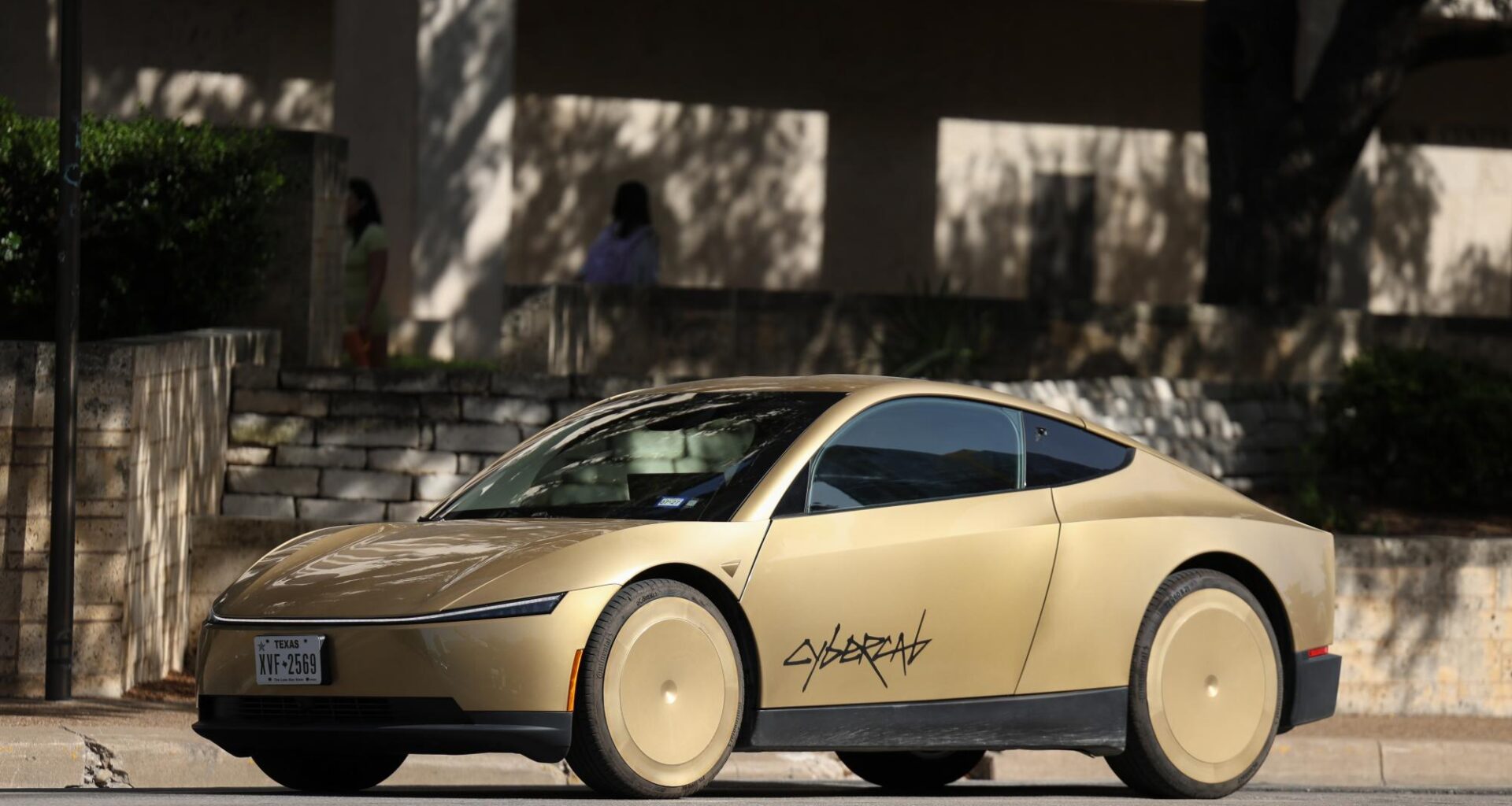
Tesla’s new Cybercab rolled out in Austin for public use earlier this month, raising concerns with the Austin Fire Department because the self-driving car lacks a steering wheel and brake pedals, according to AFD.
The new autonomous vehicles are similar to Tesla’s Model Y, the company’s first robotaxi model that launched last year. Unlike Cybercabs, Model Y cars have steering wheels, brake pedals, back seats and side mirrors, transportation engineering professor Kara Kockelman said.
Usually, first responders are able to gain access to autonomous vehicles and operate them like regular cars in case of an emergency, but when dealing with steering-wheel-free Cybercabs, they will have to utilize the touch screen to drive the vehicle, said Matt Holmes, a battalion chief of the Austin Fire Department.
“Our concern is if we have to move a vehicle like a Cybercab that does not have pedals or (a) steering wheel, what is the process for us to gain access into that vehicle, and then what is the technology in that vehicle that allows us to move it?” Holmes said.
Holmes said as far as he is aware, AFD has not yet interacted with a cybercab in an emergency situation. However, he said Tesla provided first responders three days of training and emergency guidebooks on how to interact with the vehicles in an emergency.
“As we move forward and they increase their fleet or their footprint, we’ll see how they interact with everyday drivers and some emergency scenes,” Holmes said. “We just want to make sure we continue to have open dialogue with Tesla and address any issues that come up, and then look for more opportunities for training.”
Lindsey Levan, an arts and entertainment technologies sophomore, said she recently rode in her first Cybercab, but had to wait over 45 minutes for it to arrive. Although she does like to ride in autonomous vehicles, she said she will probably not order a Cybercab again.
“Not having anything in there but a (screen) and no steering wheel or anything was pretty freaky,” she said. “It was a little bit off-putting, but I wouldn’t say I was super afraid.”
There are 49 Cybercabs currently registered in Austin, while there are roughly 300 Waymos, autonomous vehicles subsidized by Google, according to the Austin American-Statesman. Kockelman said that the smaller Cybercab fleet typically means longer wait times, but Cybercabs have a wider geofence than Waymos — meaning they are available for trips across a larger area of Austin.
Tristan Stout, co-founder and president of urban advocacy group Longhorn Urbanists, said he wonders if this is the right transportation model to invest in, but he appreciates how self-driving cars, like Cybercabs and Waymos, are fully electric.
“There’s a lot of fuel dependence that we have in gas-powered cars, and with gas prices increasing, oil is a finite resource, there’s multiple reasons why we should be making the switch to electric vehicles,” said Stout, an architecture and urban studies senior.
Stout said that as autonomous vehicles continue to become part of the future, people should question how much money is being spent on them and consider the rideshare and taxi drivers whose livelihoods could be affected. However, he appreciates the positive impact they could have on the environment.
“People should have an open mind when it comes to having these alternative transit methods,” Stout said. “I don’t think we should immediately shut them down, as I think they are better than having one person driving their gas vehicle just to go drive 10 minutes downtown.”