
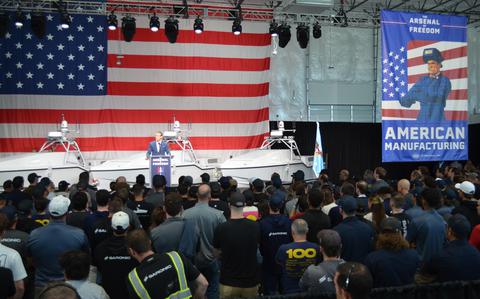
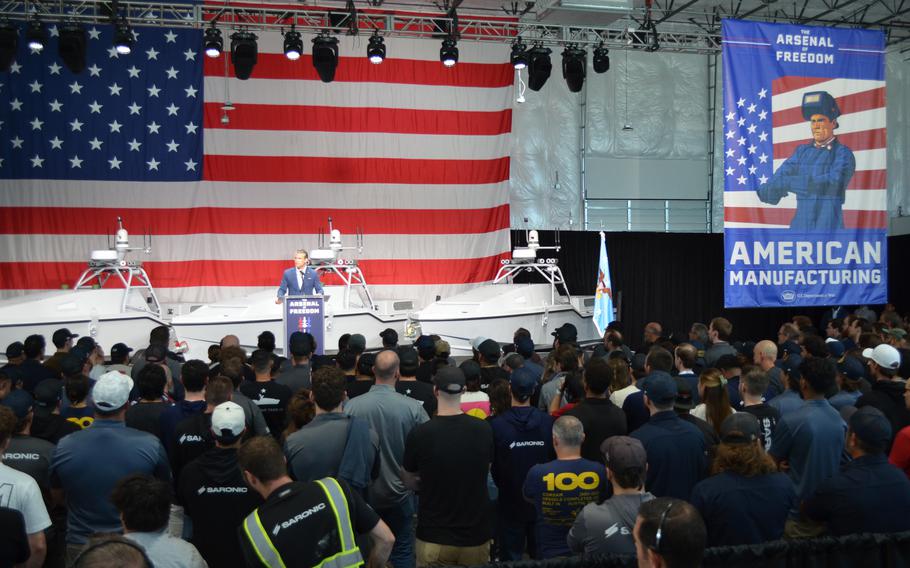
Defense Secretary Pete Hegseth address employees of Saronic Technologies at the company’s headquarters in Austin on Sept. 18, 2026. (Rose L. Thayer/Stars and Stripes)
AUSTIN, Texas — Defense Secretary Pete Hegseth on Friday visited a company that provided the Navy autonomous vessels that generated firsts for the service this year: the first rescue operation of troops in contested waters using a drone and the first combat use of sea drone.
“You did that,” Hegseth told the crowd of roughly 200 employees of Saronic Technologies, which designs and builds sea drones of three sizes from its headquarters in Austin, Texas.
The visit was part of Hegseth’s Arsenal of Freedom tour, which aims to inspire American companies to innovate and build for the military. In return, Hegseth said the Pentagon is breaking down bureaucracy to offer “larger, longer and more predictable contracts.”
Saronic, founded four years ago, has grown to more than 1,900 employees. It has provided the clearest direct line from defense corporate innovation to the front lines, Hegseth said.
Saronic co-founder and CEO Dino Mavrookas served 11 years as a Navy SEAL and deployed on eight combat tours. He introduced Hegseth to workers after the secretary toured the manufacturing area of the company’s facilities.
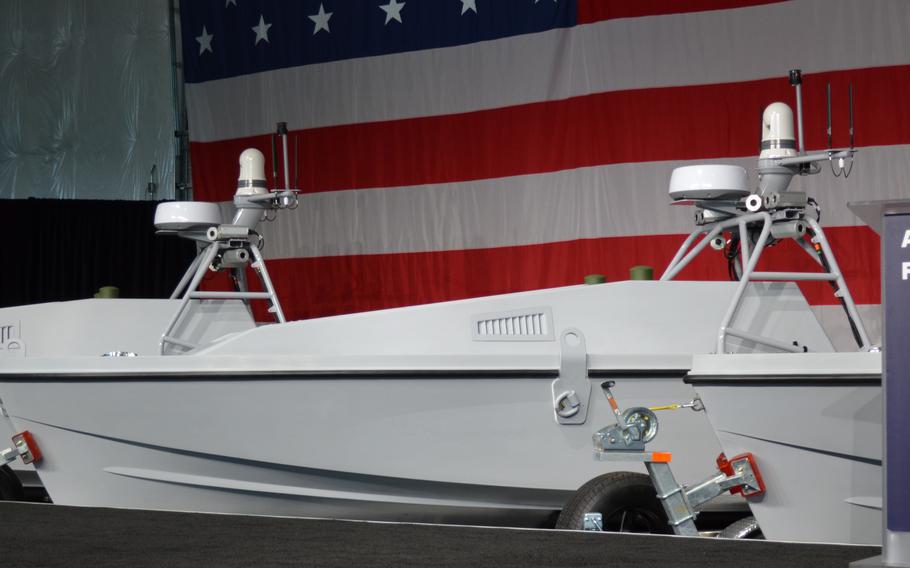
Sea drones made by Saronic Technologies are displayed at the company’s headquarters in Austin on Sept. 18, 2026. (Rose L. Thayer/Stars and Stripes)
The company’s Corsair, an autonomous 24-foot speedboat that can carry 1,000 pounds over 1,000 nautical miles, has been part of Task Force 59 to lead the incorporation of unmanned vessels into Naval operations. In March, it was sent to the U.S. Central Command area of responsibility in the Middle East and by June, it was used to rescue two AH-64 Apache helicopter pilots who went down off the coast of Oman.
“Those pilots are alive today because of the incredible innovation under this very roof. You should be and rightfully are incredibly proud of that feat,” Hegseth said. “I remember on that day thinking what the faces of those pilots must look like. What is this thing? Where are the sailors?”
About a month later, three Corsair vessels were used to strike the port at Bandar Abbas Naval Base in Iran, hitting a submarine and ship maintenance facility situated in the Strait of Hormuz.
While in Austin, the Pentagon said Hegseth also would visit Capital Factory, a technology startup incubator, and then administer the oath of enlistment to new recruits at an Armed Forces Reserve Center. Members of the media were not invited to those engagements.