
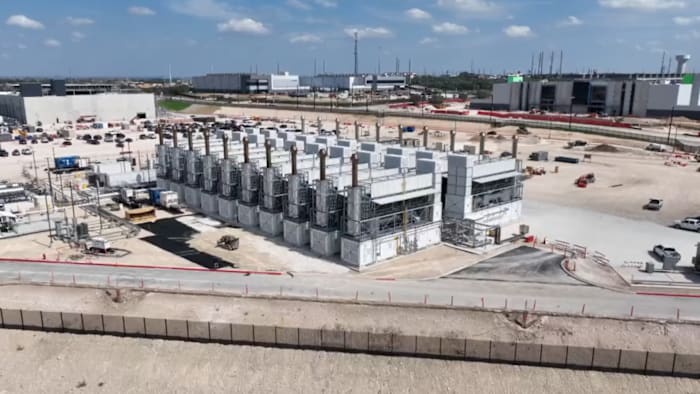
SAN ANTONIO – District 6 councilmember Ric Galvan filed the city’s first policy proposal request to examine the exponential growth of data centers in San Antonio.
Data centers, which house the computer systems that power our online activities and services, have garnered controversy for reports of their extensive use of water and energy resources.
According to Galvan, there are nearly 50 data centers either completed or planned to break ground in the San Antonio region.
With nearly 15 centers in District 6, San Antonio’s far west and northwest sides have the highest concentration of data centers.
“It’s worth the conversation given that we are one of the largest markets for new development of data centers in the state,” Galvan said.
Below is a map that KSAT created to pinpoint San Antonio’s data centers based on a dataset provided by Galvan’s office.
Data Centers Map
Name
Size (acres) ↕
Status/Timeline ↕
Some locations, such as the Microsoft Texas Research Park just west of State Highway 211, are campuses that hold multiple data centers that belong to a single company.
Other smaller “colocation” data centers, like CityNAP downtown, rent space to companies like Netflix or Verizon to share temporary housing and connections for their operations.
Councilmembers want to know how data centers affect resources, quality of life
In Galvan’s Council Consideration Request (CCR), which was filed last month, he cited a policy brief from the Houston Advanced Research Center that predicted Texas data centers would consume 46 billion gallons of water this year.
Sarah Kirkle, director of policy & legislative affairs for the Texas Water Association, said, “It’s been a real challenge to get our arms around how much water data centers use and need from a statewide level.”
“You know, a lot of those (data centers), how much water they use, is often proprietary information that those folks don’t really want to share,” she told KSAT.
Additional tracking by the Electric Reliability Council of Texas (ERCOT) found that approximately 70% of the largest energy requests in the state are from data centers.
In his request, Galvan expressed a need for the City Council to proactively plan and determine the policy tools the city has to keep up with this rapid growth.
“The worst thing we can possibly do here is that as more data centers come online, we’re seeing larger requests for energy or water usage that largely impacts our residents,” he told KSAT.
Galvan said that residents deserve answers to how these developments could impact natural resources and quality of life.
“What can we do to make sure these entities are providing benefits in the area? How do you make sure that they’re reducing impact to the environment overall? How can you make sure that the energy of water usage here be used effectively as possible?,” he asked.
>> WATCH BELOW: The impact of billion-dollar data centers in water-stressed Medina County
The request outlines possible partnerships between municipal utilities and local research institutions to provide greater transparency on the centers’ water and energy use.
“Different companies all communicate differently but what we’ve seen nationally, as well as here in the state, is that there’s been a little bit of secrecy in terms of how much energy intensity their operations are going to be,” he said.
Galvan continued, “I believe that with our municipally owned utilities, we should have the ability to ask those questions.”
The CCR was supported by Councilmembers Edward Mungia (D4), Teri Castillo (D5), Jalen McKee-Rodriguez (D2) and Ivalis Meza Gonzalez (D8).
Read also:
Copyright 2025 by KSAT – All rights reserved.