
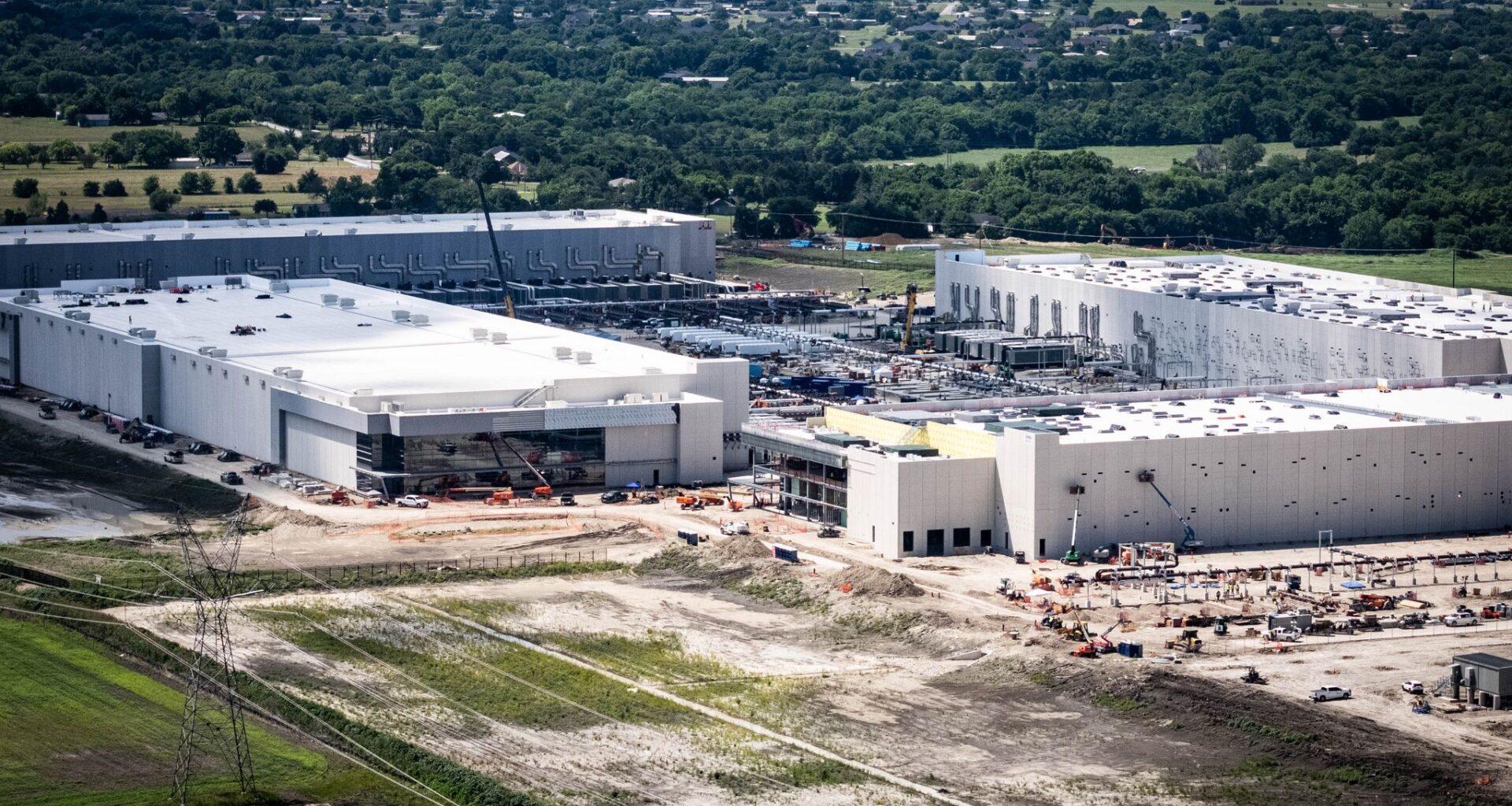
A new DataBank campus is being constructed in Red Oak, Tuesday, May 12, 2026.
Angela Piazza/The Dallas Morning News
They’re powering much of modern life — and inspiring protest movements, causing chaos at City Council meetings and upending political races.

Over the past few months, data centers have emerged as among the most incendiary issues in the country. And North Texas, where bitter fights have lately broken out over proposals in Westlake and Red Oak, already ranks among the biggest data center hubs in the world.
Debi Lee watches Brian Crawford testify at House of Representative State Affairs committee meeting against a proposed data center from a television in a lounge at the State Capitol in Austin, Wednesday, Aug. 19, 2026.
Angela Piazza/The Dallas Morning News
Analysts expect a lot more to come.
Article continues below this ad
“I got to believe that we’re the most active market in the world right now,” said Brant Bernet, an executive vice president at CBRE who leads the real estate firm’s North Texas data center team. “And if we’re not, we’re in the top three or four or five — and if we can bridge this power gap and get power to the groups that need the power, I don’t think there’s any question that Dallas becomes the number one data center market in the world.”
Here are a few other things to know about the present and future status of data centers in Texas and North Texas.
How many data centers are already operating in D-FW?
North Texas has become a major data center hub thanks largely to its central location and relative abundance of land, talent and power.
But precise figures on the number of data centers in the region (or anywhere else) don’t actually exist, in part because reporting requirements for the facilities vary across municipalities, operators are often keen on remaining under the radar and data centers vary tremendously in size and scope — some have a bigger footprint than New York’s Central Park, and others are small enough to fit inside an office building closet.
Article continues below this ad
“To be quite honest, nobody really knows the exact number,” said Chris Herrmann, another member of CBRE’s data center team.
But the commercial real estate firm, which follows the market closely, tracks about 60 different buildings in D-FW that are used as data centers, which are almost all leased. Those facilities’ capacity adds up to about 1.4 gigawatts, by CBRE’s calculation, or roughly enough to power a million homes.
Data center tracking sites also have estimates: One widely cited tracker, US Data Center Map, counts 143 operational data centers in the D-FW market, including 60 in Dallas, 28 in Fort Worth and 22 in Plano. Those facilities, according to US Data Center Map, have a total power capacity of 2.4 GW; measured by capacity, the largest local sites are Meta’s data center in Fort Worth, Compass Data Center in Red Oak and a Core Scientific data center in Denton.
An unfinished data center campus is seen behind a grazing pasture for cattle along Stainback Road in Red Oak, Wednesday, June 24, 2026.
Angela Piazza/The Dallas Morning News
How does that compare to other regions?
There’s no question D-FW is already one of the biggest data center hubs in the U.S. By most accounts, the region currently ranks second to northern Virginia, which became established as an early industry leader thanks in part to its long history with tech and proximity to Washington, D.C.’s talent and data-hungry federal contractors.
Article continues below this ad
US Data Center’s tracker, for example, lists 240 operational data centers in the region, with a combined power capacity of 9.4 GW.
Other leading American hubs include Atlanta, Silicon Valley, Chicago and Phoenix. International hubs include Frankfurt, London, Singapore and Beijing — but the U.S. has far more data centers than any other country, and northern Virginia has long been considered the largest single market in the world.
Marcia Hermann chants during a protest against data center development outside the Austin Marriott Downtown on Wednesday, Sept. 2, 2026. The demonstration took place outside the Datacloud USA conference, which brought data center, energy, fiber and AI infrastructure industry leaders to Austin. Protesters called for a moratorium on new data center development, citing concerns about the industry’s demands on water, electricity, land and infrastructure.
Jay Janner/Austin American-Statesman
What about data centers in Texas?
Texas more broadly is also a major data center hub. For years state business leaders and politicians, including Gov. Greg Abbott, sought to court data centers as part of an effort to transform Texas into an AI industry capital. Last November, while championing one $40 billion data center investment from Google, the governor even called Texas “the epicenter of AI development.”
Article continues below this ad
He’s since changed his tone, recently implementing a moratorium on new data center approvals for projects that connect to the state grid, but Texas is already home to hundreds of operational facilities, including some of the world’s biggest. Many trackers estimate the state has over 300 operating facilities, with US Data Centers listing 349 operating sites with a combined capacity of 10.6 GW, just behind Virginia’s capacity. The Texas Comptroller’s Office also tracks data centers in the state that have qualified for tax breaks, a list that includes more than 150 projects.
And while D-FW is the state’s biggest hub, Austin, Houston and San Antonio are also important markets. So is West Texas, where vast open land, including in the Permian Basin, is attracting deep-pocketed developers aiming to build massive hyperscale centers.
Where is this going?
The current backlash around data centers — and Abbott’s regulatory pause — may temporarily dampen the Texas construction boom. But analysts broadly predict that demand for new data centers over the next several years will continue surging — and that D-FW is poised to become an even bigger player.
Article continues below this ad
In 2020, according to data from the International Energy Agency, data centers globally consumed around 250 terawatt hours (TWh) of electricity. By 2024, that figure had risen to around 415 TWh, or about 1.5% of global electricity consumption. By 2030, the agency projects it will more than double, to around 945 TWh, and account for around 3% of global electricity consumption.
The already dominant U.S. market is also expected to continue growing rapidly: Another report, published in May by Goldman Sachs, predicted that the capacity of U.S. data centers would double from its late 2025 level as soon as the end of 2027. And the Texas data center market has been looking red hot — so much so that the real estate firm Cushman and Wakefield recently ranked greater Dallas as the top primary global data center market in the world. It also ranked Austin/San Antonio as the top secondary market and West Texas as the top tertiary market.
“The state’s business-friendly posture, deregulated and independent power grid, abundance of land, and willingness to extend incentives under the right conditions make Texas well-suited for the data center industry,” the report noted.
The state’s flurry of ongoing projects backs that up: In D-FW alone, according to estimates by US Data Center Map, 29 projects are under construction and 44 are planned. In Texas, the site counts 101 projects under construction and 156 that are planned. Those numbers put Texas’ incoming pipeline capacity at 85 GW — far higher than Virginia’s or any other state’s.
Article continues below this ad
The Cushman and Wakefield report also cited potential growth hurdles, including water availability and new regulation. In D-FW, continued power availability could also present a challenge, the CBRE experts said. But despite those headwinds — and maybe a potential slowdown from the recent data center backlash — analysts are still expecting ferocious longterm growth. CBRE’s tracking of D-FW’s market shows that local capacity is set to double simply based on projects that are already under construction.
Within five years, Bernet said, he expects D-FW to be the largest data center market in the world.
“There’s a lot of nuance to it,” he said. “Because you need the tech talent. You need the people that can build it. You need people that can run it once it’s up and running. You need engineers. You need security teams and all of that. And I think that because there’s such a preponderance of that in Dallas, it’s just an easy place to go.”
What are your thoughts on data centers across North Texas?
Most RecentTop Responses
Dallas City Council can’t effectively manage the city’s most basic services because we have elected activists and not servant leaders. The thought that this band of idiots is now trying to study the data center issue is laughable.
The fact is, they’re merely responding to the mob. And the mob continues to cite misinformation as justification to oppose data centers.
Charles W
Allen, TX
08/05/26
Data centers pay a lot of local taxes and, once built, put almost no strain on city budgets for police, fire, roads or social services. If the power problem is solved, it is a windfall for the city.
Garry S
Temple, TX
07/28/26
Data centers have, in most cases, been given huge tax breaks. If these are such great harbingers of future prosperity, why are they not helping allay the cost of their existence on public infrastructure? They need to bring their own water (with limited water wells which would just take water from their neighbors wells) and power to the table and/or be made to pay taxes to cover costs to local water utilities for providing the water for the data centers.
Linda H
Fort Worth, TX
07/22/26
They are going to consume too much of our scarce water and electricity raising resident’s costs for both. After construction they provide only a few jobs, 80 at most. They are noisy, vibrate and their back up generators pollute the air as do their gas fired power plants if they build those unless of using the grid. They also cause light pollution and do not generate additional economic activity while harming the value of surrounding properties.
Michael J
Lavon, TX
07/22/26
Data centers are going to be part of the future, regardless; however, they do not have to be built within a short radius of established residential communities. They bring noise and light pollution, suck up an excessive amount of water and can serve to raise residents’ electric bills. Not to mention, even the “closed loop” systems periodically need to have the contaminated water, used to cool the servers, flushed and a new water supply reintegrated within the system. So, where does that contaminated water go and how is it disposed of?
We here in Lavon are fighting a proposed data center to preserve our quality of life. We hold the city council responsible for approving, without serious input from the residents, a zoning amendment that allows for a hyper scale data center to be built right in the middle of established neighborhoods.
Data centers are NOT good neighbors, and no amount of spin by the corporate conglomerates that build and use them can convince us otherwise.
See More Responses