
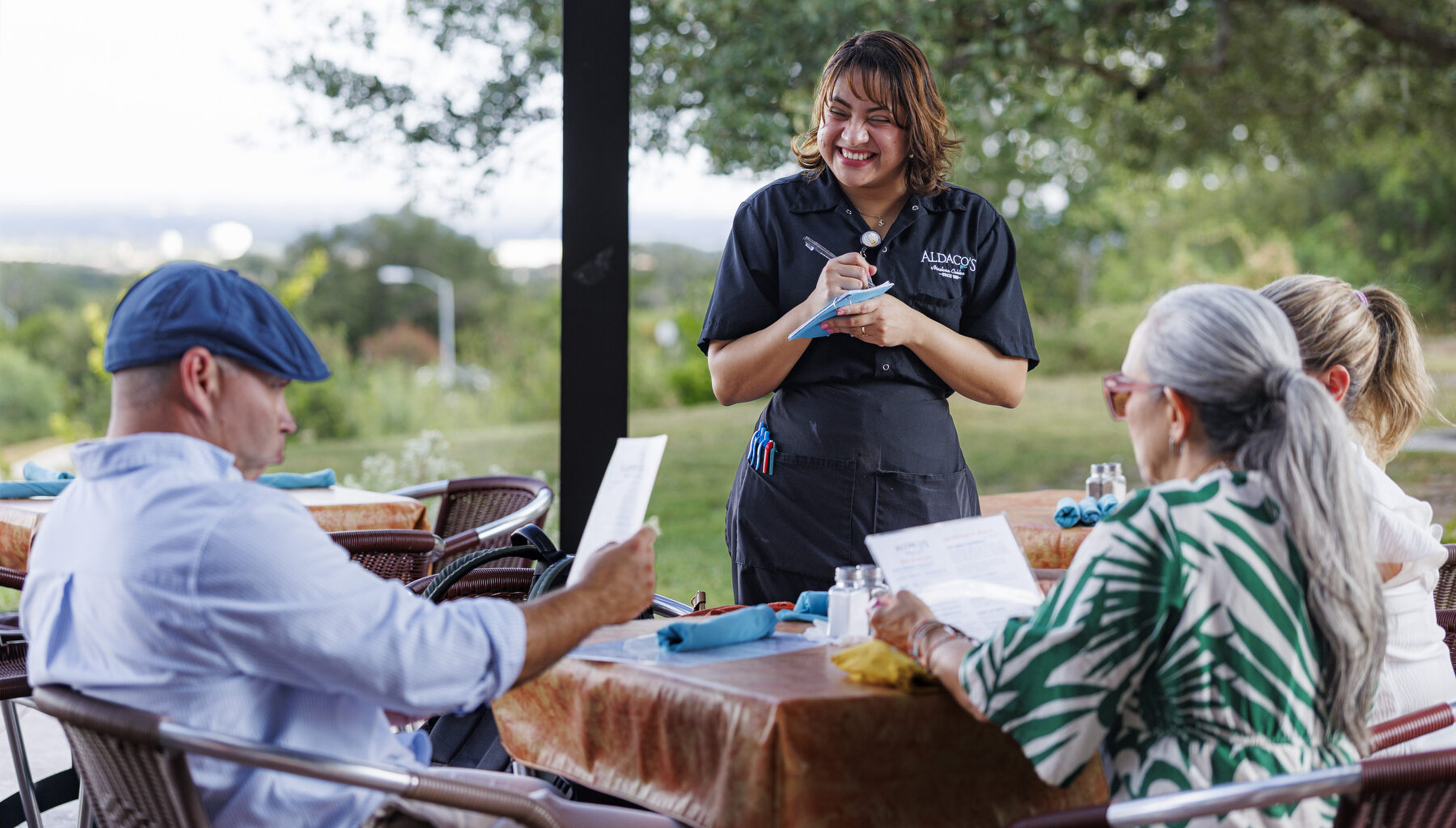
Blanca Aldaco has watched the price of beef and dairy products jump as much as 45% in the past 18 months.

For the owner of a Mexican restaurant, those ingredients are essential. But she refuses to pass the cost on to her customers at Aldaco’s Mexican Cuisine.
“Because the most expensive thing in your restaurant is an empty chair,” she said.
Article continues below this ad
READ MORE: Luna Rosa Puerto Rican Grill y Tapas owner files for bankruptcy months after Southtown move
Aldaco is not alone. Restaurants across the state are struggling to balance rising costs against an inflation-weary and increasingly price-conscious customer base.
The latest economics report from the Texas Restaurant Association found most operators are under financial pressure as they face rising costs for food, labor, insurance, utilities and payment processing while traffic and sales have improved only modestly. The picture is similar across the U.S., with 33% of operators in a recent National Restaurant Association report saying their businesses were not profitable through the first half of the year.
Those pressures have taken a toll on the local restaurant scene. From January to July, an estimated 70 San Antonio restaurants closed — the fourth-highest number among U.S. and Canadian metros, according to RestaurantData. With 1,039 closures across the state, Texas had a higher number than any other state or province.
Article continues below this ad
San Antonio has said goodbye this year to longtime favorites like Singhs Vietnamese, which closed its two locations in August. Since 2024, eight restaurants at Pearl have closed, including Cured, Carriqui, Allora and Full Goods Diner.
A handful of San Antonio restaurants have filed for Chapter 11 bankruptcy to try to reorganize their business. The list includes Luna Rosa Puerto Rican Grill y Tapas, Sushi Zushi, Lucy Cooper’s Ice House, Schooners Sports Bar and the Growler Exchange.
Blanca Aldaco, owner of Aldaco’s Mexican Cuisine, sits on the restaurant’s outdoor patio overlooking Stone Oak on Wednesday, Sept. 9, 2026.
Sam Owens/San Antonio Express-News
Longtime waiter Manolo Gamez, second from right, cleans a table as he waits for the dinner rush to start at Aldaco’s Mexican Cuisine in Stone Oak on Wednesday, Sept. 9, 2026.
Sam Owens/San Antonio Express-News
Labor shortages
Some problems are longstanding. The pandemic brought on a host of issues for restaurants across the Alamo City, and it’s had a lasting impact on operators.
Article continues below this ad
Pre-pandemic, Aldaco said her restaurant at 20079 Stone Oak Parkway had 92 employees. Now, she’s down to a team of 45 on a good day. As a result, she decided to shut down the restaurant on Mondays.
“After the pandemic, a lot of people didn’t return to the industry they were in before and everybody is shorthanded,” she said.
The COVID shutdowns caused workers to reassess restaurant jobs and move to other industries. More recently, increasing immigration enforcement has put pressure on the workforce.
MORE RESTAURANT NEWS: Beloved San Antonio Vietnamese soul food spot Singhs has closed both outposts for good
Article continues below this ad
The Texas Restaurant Association reported that 36% of surveyed operators have lost employees, and 28% saw fewer applicants or fewer offers accepted because of immigration enforcement.
“A lot of people are afraid to go out to work and afraid to go out and support the business,” Aldaco said. “The fear of ICE has affected every industry, and we are feeling it all the way from the landscaper to the kitchen crew.”
More than 1 in 5 people working in the restaurant industry are immigrants, according to the National Restaurant Association. It recently announced its support for the Dignity Act of 2025, which would provide legal protection for certain undocumented people already established in the United States.
The measure would allow eligible existing employees to receive reliable work authorization and potentially reduce ongoing labor shortages in the restaurant industry.
Article continues below this ad
This month, the Trump administration allowed roughly 170,000 immigrants from El Salvador to be covered by Temporary Protected Status, meaning they can legally work and live in the United States.
“With food costs up nearly 35% since the pandemic, the President’s decision yesterday to allow long-term, law-abiding TPS holders from El Salvador to continue to work comes at the perfect time,” Emily Williams Knight, president and CEO of the Texas Restaurant Association, said in a statement. “We are ready to work with the President and Congress to create short- and long-term solutions on this issue for local businesses and the communities they serve. A stable workforce is at the heart of America’s affordability agenda. Keeping experienced, law-abiding workers on the job is a key step to help keep American-made food within reach for every family.”
Manager Gina Torres packs a to-go order at Aldaco’s Mexican Cuisine in San Antonio on Wednesday, Sept. 9, 2026. To-go orders have been a mainstay of the Stone Oak restaurant’s business for years.
Sam Owens/San Antonio Express-News
Aldaco’s Mexican Cuisine, located in Stone Oak, has been in business since 1989.
Sam Owens/San Antonio Express-News
Rising costs
On top of labor shortages that have driven up personnel costs, restaurants have faced other cost pressures in recent years. But the pandemic isn’t solely to blame, Aldaco said.
Article continues below this ad
“The pandemic ended a long time ago and we cannot continue blaming everything on the pandemic,” she said. “You have to put your big girl panties on and figure it out.”
The cost of wholesale beef, for example, rose 7.8% in July from a year ago, according to the U.S. Department of Agriculture. That was largely due to the nation’s cattle herd shrinking. The decline stems from a severe multiyear drought, rising operating costs and limited grazing land.
Still, Aldaco has maintained the restaurant’s set price of $42.99 per pound of beef fajitas. Rather than raising menu prices, she’s working to keep the restaurant’s costs down.
RELATED: Five years after COVID-19 shutdown, San Antonio restaurants reflect on dining scene
Article continues below this ad
“My tactic has been to focus on my portion control, so that I can keep my price low and have volume,” she said. “If I start raising prices, I’m going to have a lot of empty chairs, so we pivot by controlling our costs and having good service, which is key. If you make a memorable experience, people will keep coming back.”
Rising operating costs, including utilities, insurance and credit card processing fees, have also taken a toll.
On average, Texas restaurants pay $4,102 per location for local permits, fees and inspections every year, according to the Texas Restaurant Association’s survey.
One operator told the survey that their insurance premium increased almost 40% over the past six years. Another said that insurance is among the top three expenditures for their business. One respondent said the cost of liquor liability coverage is out of control.
Article continues below this ad
Empty tables await customers on the patio at Aldaco’s Mexican Cuisine, which offers sweeping views of Stone Oak, on Wednesday, Sept. 9, 2026.
Sam Owens/San Antonio Express-News
Longtime waiter Manolo Gamez, left, packs bags of chips for to-go orders as he waits for the dinner rush to start at Aldaco’s Mexican Cuisine in Stone Oak on Wednesday, Sept. 9, 2026.
Sam Owens/San Antonio Express-News
Waiter Ivan Martinez prepares a tray to deliver to customers at Aldaco’s Mexican Cuisine in Stone Oak on Wednesday, Sept. 9, 2026.
Sam Owens/San Antonio Express-News
“We used to have coverage of $1 million at each location,” a Texas restaurant operator said. “We now carry coverage of $250,000 or less at each location.”
Article continues below this ad
Aldaco’s best advice to struggling operators is to build a good relationship with vendors, which has made it easier for her to bargain for reasonable product prices.
When she started the business in 1989, the industry was much kinder to small businesses. She now owns the building, which has made it easier to track her fixed costs and given her a sense of “tranquility,” she said.
“If I was a young, 25-year-old, and if I didn’t have big pockets, I don’t know that I could survive today,” Aldaco added.
But she’s no stranger to defeat. In 2017, she closed Aldaco’s at Dominion Ridge after three years because she couldn’t keep up with the property taxes.
Article continues below this ad
“My ego gave out, and I finally decided to move on,” she said.
Rising competition
Johnny Hernandez, owner of several restaurants in San Antonio, said labor and food costs aren’t the only challenges. The biggest difficulty for San Antonio restaurateurs is a surge in competition.
“Some people say it’s the economy or people not drinking as much, and I just feel that we’ve cut the pie into so many small pieces,” Hernandez said. “We have to weather the storm and, unfortunately, it has to do with a lot of things that are out of our control. These areas of overdevelopment and a series of large developments have created this competition. Developers are putting up all these retail centers and everyone needs a chef, a bakery or a coffee shop.”
Article continues below this ad
Chef Johnny Hernandez, who owns several concepts in San Antonio, believes the surge of competition in the area is the biggest challenge for restaurant operators.
Christopher Lee/Staff Photographer
READ MORE: 25 San Antonio restaurants that closed in 2025
Because customers have so many options, restaurant owners have a tougher time building or retaining a loyal following.
“If there were enough customers, we wouldn’t hear these conversations about product cost or labor,” Hernandez said. “Sales cure everything. If you have sales, you can pay rent. If you have sales, you can pay the labor and buy the food. But it’s the sales that are missing.”
Article continues below this ad
Hernandez has been opening restaurants for 16 years and has been offered several opportunities to open locations all over town. But he’s left several of those invitations on the table because they don’t meet his standards.
After having to close at least four of his startups, he’s found a niche opening new concepts within high-volume venues.
He now owns five restaurants inside San Antonio International Airport: La Gloria, Super Bien, Southtown Market, Chef Johnny’s Mercado and Alamo Tequila Bar.
“At least for now, the airport is one of the safest places to be in the restaurant business because of the constant flow of customers,” he said.
Article continues below this ad
He also operates Burgerteca, Super Bien and La Gloria within Frost Bank Center, co-owns the Eatery at the University of Texas at San Antonio’s School of Data Science, and opened Chef Johnny’s Mercado, a market-style concept, on the University of the Incarnate Word campus.
“Our expertise has allowed us to enter some of these campuses and that’s how I’ve shifted,” he said. “We know how to operate high-volume, high-efficiency transactions and maintain quality, and those are not easy things to do, but we’ve really refined and found how to navigate them.”
For those struggling to make it in the volatile industry, Hernandez said patience is key.
Article continues below this ad
“You have to be productive, efficient and frugal,” he said. “This is not forever. This is something we’re all going through. It’s just a competitive period, and that doesn’t mean you’re not doing the right thing; it just might mean the timing isn’t right.”