
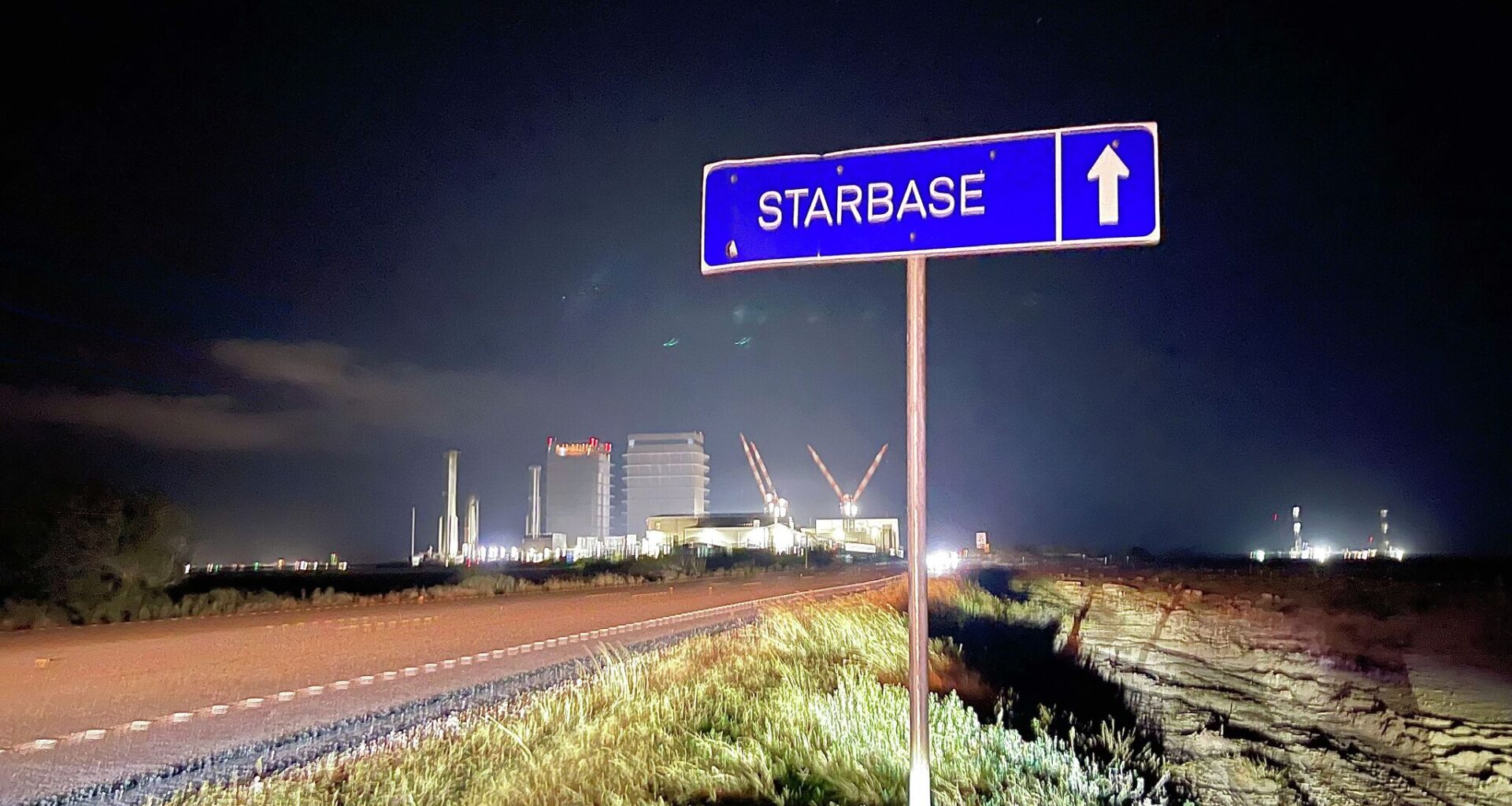
Construction cranes are seen in the distance at the edge of the Starbase city limits on Wednesday, November 19, 2025.
Dina Arévalo
It’s been 16 months since residents along the southernmost stretch of the Texas coast — most of them SpaceX employees — voted to turn their community into a city. Since then, the city of Starbase has pursued an aggressive expansion of its city limits, which currently stretch across a narrow ribbon of land along Texas 4 in rural Cameron County, in the Rio Grande Valley.

MySA looked at where and how Starbase has grown over the last year.
Article continues below this ad
How big was the city of Starbase at first?
When Starbase residents voted on May 3, 2025, to incorporate the community into a city, its limits spanned about 1.5 square miles, primarily surrounding the tiny homes and SpaceX facilities cloistered along Texas Highway 4 near Boca Chica Beach.
Not long after the election, however, Starbase’s inaugural city commission began implementing major changes to the community, including closing off public streets with electronically controlled access devices and changing zoning and land-use regulations, despite protests from longtime local property owners who showed up en masse at a June 2025 public meeting.
When did Starbase start expanding?
In late 2025, Starbase entered into a habitat conservation agreement with SpaceX for more than 1,000 acres of tidal flats, mangroves, wetlands and rare lomas. The conservation area, known as the Rockhands Mitigation Bank, is considered “critical habitat for the piping plover,” according to the Starbase city website.
Article continues below this ad
This map shows the current Starbase city limits and extraterritorial jurisdiction boundaries, as of September 2026. City leaders are expected to approve the annexation of approximately 7,133 acres of additional land by the end of September 2026.
Courtesy City of Starbase
How has Starbase continued to expand its city limits?
In late February this year, Starbase announced its intent to annex more than 7,100 additional acres of land, adding more than 11 square miles to its footprint. The city commission was slated to vote on the issue during a special meeting on September 16; however, that meeting was canceled.
Starbase interim City Clerk Keila Tuttle did not respond to MySA’s request for more information about the meeting before it was canceled. However, the city’s website shows that the 7,133-acre annexation is again on the agenda for the commission’s September 21 regular meeting.
Article continues below this ad
Starbase is also poised to expand by 700 acres through a land-swap deal with the U.S. Fish and Wildlife Service, which owns and maintains more than 100,000 acres scattered across myriad separate tracts of land in the Laguna Madre region as part of the Lower Rio Grande Valley National Wildlife Refuge.
Aside from the few private homes and undeveloped lots that existed prior to SpaceX’s development along Highway 4, much of the land surrounding today’s Starbase has long been part of federally or state-owned protected habitat.
Federal wildlife officials say the land swap would help conservation efforts by “reducing fragmented ownership.” Essentially, the refuge could create larger, consolidated sections of protected habitat by exchanging 712 acres the federal government currently owns for 692 acres privately owned by SpaceX.
In its draft environmental assessment, the USFWS said it has been negotiating with SpaceX on the proposal since 2023. However, the deal remains mired in litigation after the Center for Biological Diversity sued.
Article continues below this ad
This map shows the current Starbase city limits and extraterritorial jurisdiction boundaries, as of September 2026. City leaders are expected to approve the annexation of approximately 7,133 acres of additional land, shown in blue, by the end of September 2026.
Courtesy City of Starbase
SpaceX pressure on other South Texas cities gives Starbase more land control
During Monday’s city commission meeting, city leaders are also set to decide whether to expand Starbase’s so-called “extraterritorial jurisdiction,” or ETJ, by more than 444 acres. While the proposal won’t change the city’s footprint, it will expand Starbase’s ability to control development near its city limits and designate the area for future annexation.
The acreage, which sits near the Brownsville Ship Channel, recently drew sharp backlash from residents in the nearby city of Brownsville. That’s because, at a rare Saturday meeting of the Brownsville City Commission last month, officials unanimously voted to forfeit control of the 444 acres by disannexing it from Brownsville’s ETJ. In exchange, SpaceX — which said it was close to a purchase agreement for the land — would provide Brownsville up to $220 million in funding for critical water infrastructure projects.
Article continues below this ad
Brownsville Mayor John Cowen described it as a “take-it-or-leave-it” ultimatum because SpaceX threatened to withdraw its funding offer if Brownsville delayed the vote beyond the August 29 meeting. A day after the vote, local residents reported heavy machinery at the site.
Finally, during Monday’s meeting, Starbase city leaders will also vote on a measure to annex right-of-way along State Highway 4, the primary artery that runs through the heart of the town and terminates at the sand dunes of Boca Chica Beach.