
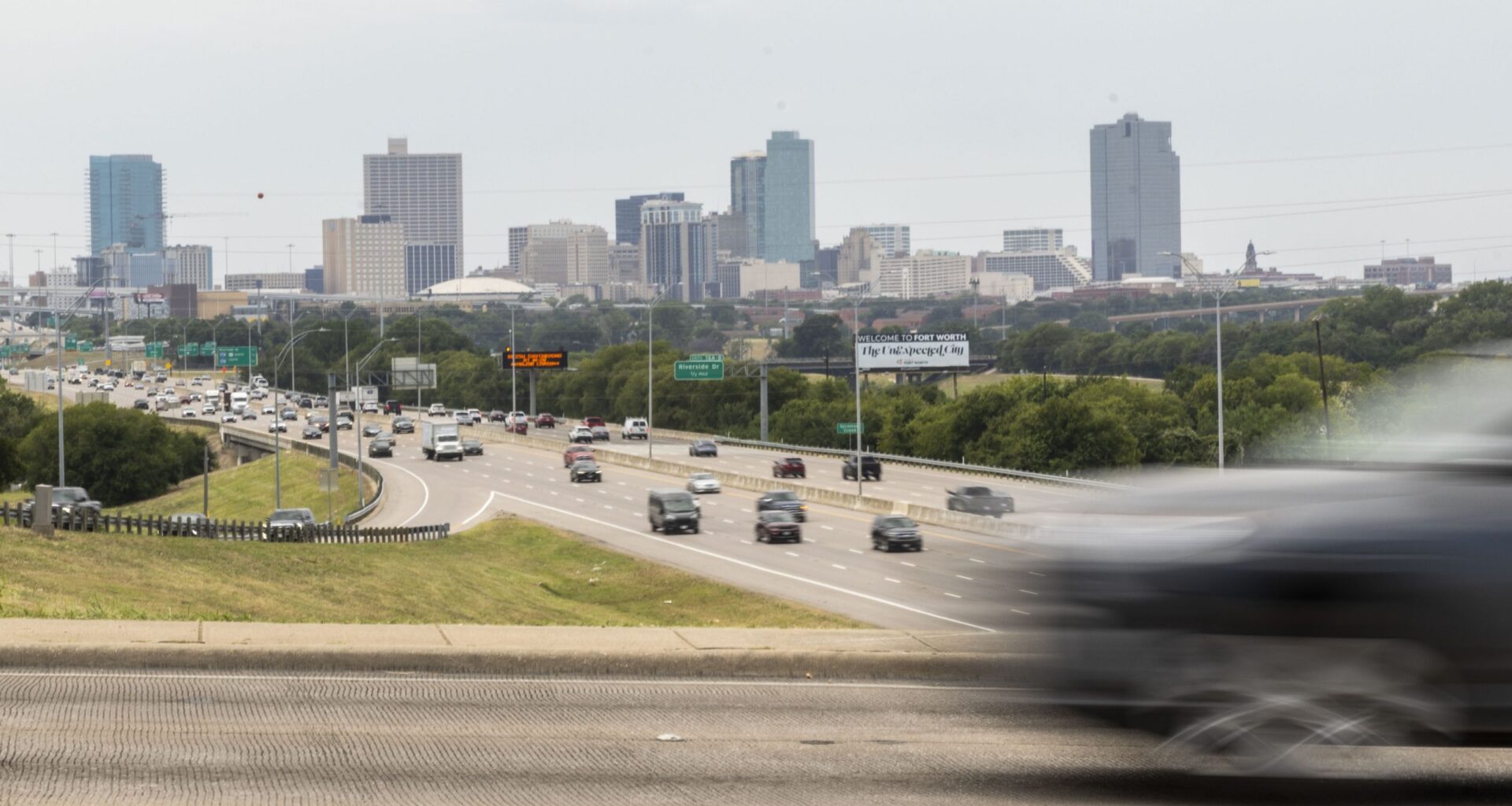
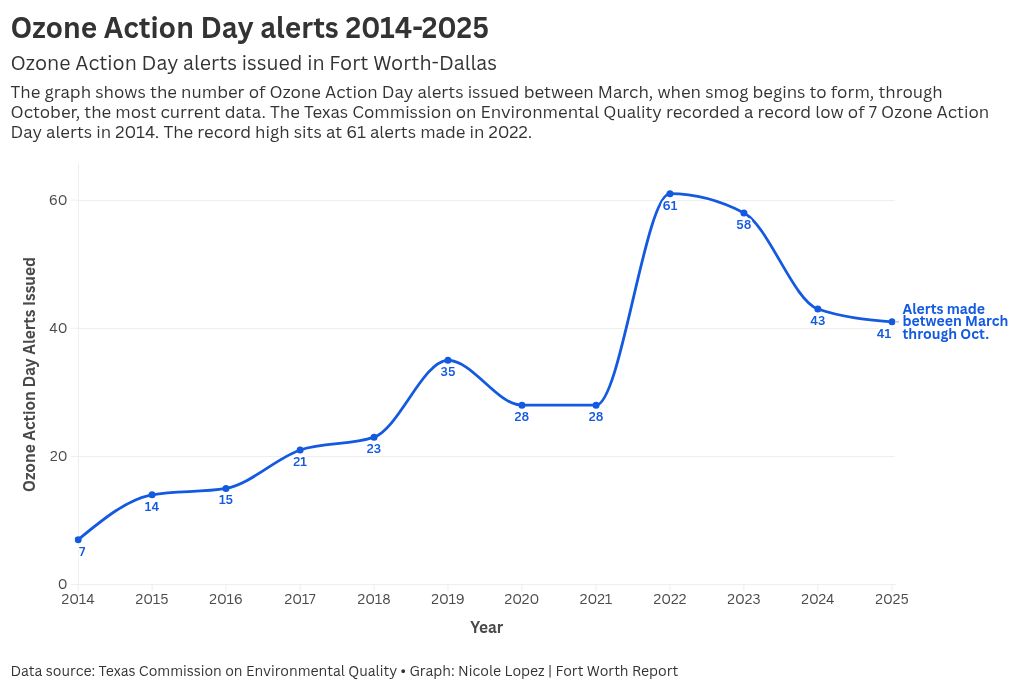
North Texas has seen 44 days so far this year when the region’s air pollution reached unhealthy levels, according to the latest data.
The Texas Commission on Environmental Quality issued Ozone Action Day alerts for 41 of those days.
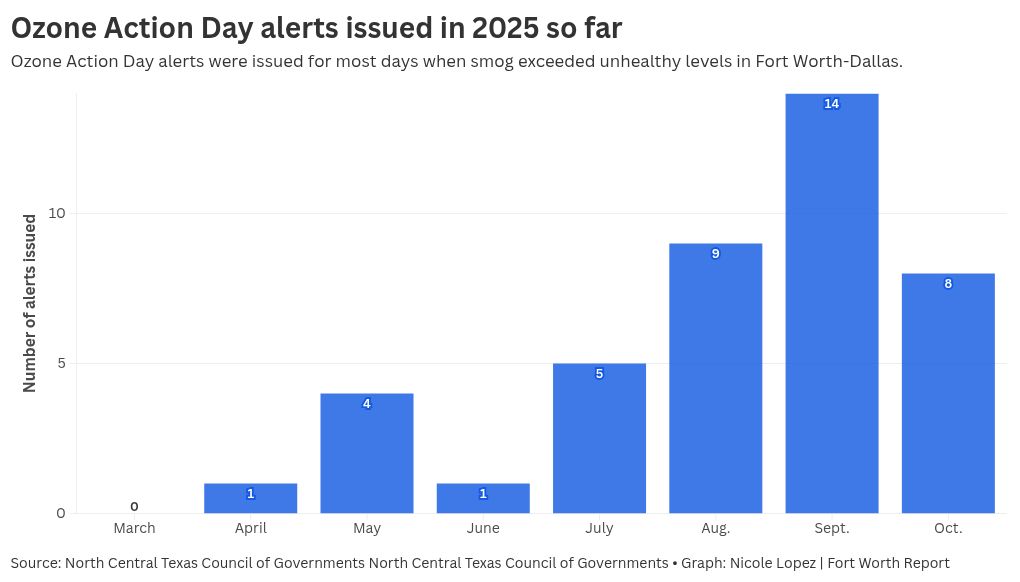
In October, the state environmental commission issued eight alerts. That was a drop from September, which saw 14 ozone alerts issued, the most of any month this year, according to data from the North Central Texas Council of Governments, the agency tasked with monitoring Fort Worth-Dallas air quality.
Such alerts are issued when smog is forecasted to exceed the federal limit of 70 parts per billion.
Ozone measured between 71 and 85 parts per billion is considered unhealthy for sensitive groups including young children, older adults, people with respiratory conditions and those active outdoors, according to the council of governments.
The alerts inform the public when weather conditions are favorable for ozone so they can adjust daily routines to minimize health risks and exposure to unhealthy air conditions. The alerts also serve businesses and industries, urging them to mitigate emissions, such as those generated by cars and power plants.
By Nov. 10 last year, 43 alerts were issued for Fort Worth-Dallas. While alerts have yet to be issued this month, the public could see additional days of high levels of air pollution as ozone season begins in March and runs through November, according to the state environmental commission.
What is ozone?
Ground level ozone, or smog, forms when nitrogen oxides and volatile organic compounds emitted by natural and human sources react in the sunlight, according to the council of governments. Predominant sources of these pollutants include vehicle emissions, motorized lawn equipment, paints, power plants and industrial sites.
Exposure to ozone can cause health issues such as chest pain, trouble breathing, coughing, irritation and congestion. The gas can also exacerbate respiratory conditions such as asthma, bronchitis, emphysema and cancer.
Major polluters in North Texas could face annual fines of $45 million if ozone is not brought down to or below 70 parts per billion by 2027 under the Environmental Protection Agency’s Clean Air Act.
Whether companies in violation will see those fines is uncertain as EPA officials propose changes to deregulate energy companies.
Within days of his presidency, Donald Trump vowed to roll back federal regulations. That includes revoking the scientific finding from 2009 that allows the EPA to enforce climate change-focused regulations on cars, power plants and other major sources of greenhouse gases.
In June, the EPA announced the closing of its Office of Research and Development, which analyzes health dangers stemming from toxic chemicals, climate change, smog, wildfires, indoor air contaminants and water pollutants, according to a report from National Public Radio.
The proposal to revoke the 2009 scientific finding requires a lengthy review process, including public comment, before it can be finalized next year, according to the Public Broadcasting Service.
Environmental advocacy groups are expected to challenge the ruling in court if implemented.
Meanwhile, the council of governments is developing the Dallas-Fort Worth Air Quality Improvement Plan, a several hundred page document consisting of strategies to improve North Texas air quality.
The council of governments has until Dec. 1 to submit the plan in order to be considered for federal grant funding.
Nicole Lopez is the environment reporter for the Fort Worth Report. Contact her at nicole.lopez@fortworthreport.org.
At the Fort Worth Report, news decisions are made independently of our board members and financial supporters. Read more about our editorial independence policy here.
Related
Fort Worth Report is certified by the Journalism Trust Initiative for adhering to standards for ethical journalism.
Republish This Story

Republishing is free for noncommercial entities. Commercial entities are prohibited without a licensing agreement. Contact us for details.