
Blaine Beckman remembers his elementary and middle school teachers telling him and other students that if they didn’t get good grades, they could end up working in construction.

Beckman, now the president of San Antonio general contractor company Nunnelly, had an internal battle when he first discovered his passion for construction.
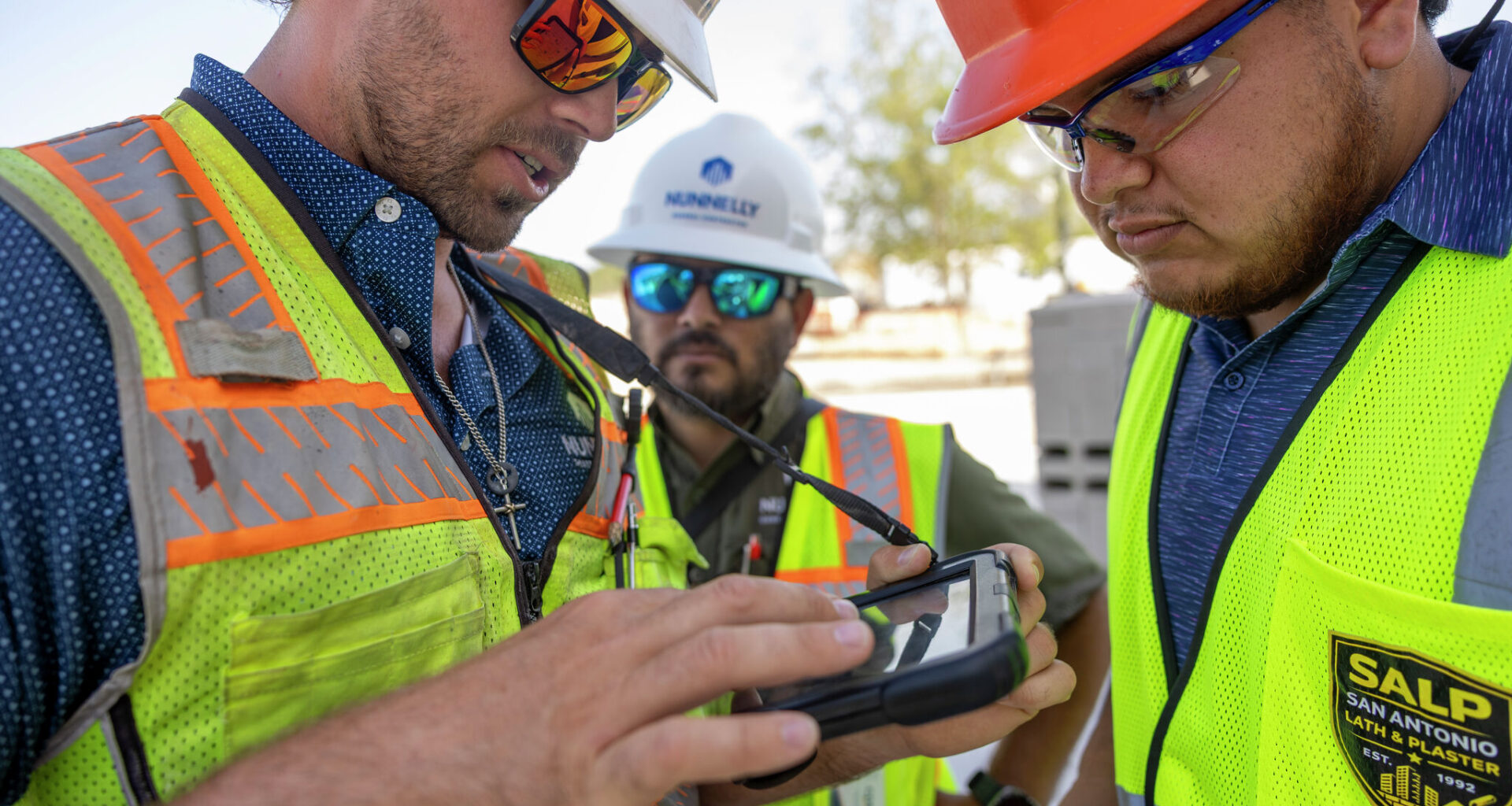
Superintendent Robert Herrera, left, talks with Nunnelly President Blaine Beckman while looking around at the construction site for a SAPD substation on the South Side.
Andrew J. Whitaker/San Antonio Express-News
Nunnelly President Blaine Beckman, left, and superintendent Robert Herrera talk Tuesday while checking out the construction site for a SAPD substation on the South Side.
Andrew J. Whitaker/San Antonio Express-News
Superintendent Robert Herrera, left, talks with Nunnelly President Blaine Beckman while checking out the construction site for a SAPD substation on the South Side.
Andrew J. Whitaker/San Antonio Express-News
Nunnelly President Blaine Beckman, left, and assistant superintendent Trevor Hawthorne, check out the construction site for a SAPD substation on the South Side.
Andrew J. Whitaker/San Antonio Express-News
“Even though I loved the feeling it gave me, I thought I didn’t want to be in construction or be viewed as a construction worker,” he said. “I wanted to get my four-year degree and be a doctor because that’s what I thought success was, not construction.”
Article continues below this ad
CONSTRUCTION NEWS: Meta launching construction training program with $115M investment
This stereotype is a major factor why the industry is struggling to find skilled trade workers. The Associated General Contractors of America recently released its annual Construction Workforce Survey results, which revealed that labor availability is the construction industry’s central challenge in Texas. The association represents more than 28,000 companies, general and specialty contractors, and subcontractors.
The United States historically has invested more in college prep than vocational training, particularly following the 1983 A Nation at Risk report, which spurred school districts to replace hands-on vocational classes, like shop, with computer labs and academic requirements.
“It’s getting harder and harder to find individuals who have grown up in the trades and with the knowledge of how the buildings actually go together.” — Nunnelly President Blaine Beckman
Decades later, the construction industry is feeling the workforce squeeze as employees age out. AGC surveyed 70 respondents in Texas, 87% of whom reported having hourly craft openings, while 80% have salaried openings.
Most say hiring has become harder, with electricians and pipefitters/welders being especially difficult to recruit. Half of the respondents said available candidates are not qualified to work in the industry, and the labor shortage is leading to project delays.
Article continues below this ad
They’re also competing against data center projects, which are offering higher wages and pulling workers from housing, infrastructure and conventional commercial projects.
Firms are responding with higher pay, expanded training, digital recruiting and school partnerships.
“We need to get more people exposed to the trades earlier,” said Lauren Mandel, president of the San Antonio AGC. “We need to get to students in middle school and let them know that construction careers aren’t just jobs to move on from. There are incredible ways to build a career in the construction industry, whether you start off as a laborer and move your way up to a superintendent or a leadership role.”
Workers are seen at a construction site for a SAPD substation on the South Side.
Andrew J. Whitaker/San Antonio Express-News
Building a future
Beckman was first exposed to the construction industry, not through school, but through his father teaching him a lesson.
Article continues below this ad
When he was in high school, Beckman was offered an old Pontiac Fiero for free. But his father wanted him to learn that nothing in life is free, so he told the family offering up the auto that in exchange for the car, his son would work for them.
“He was the worst negotiator,” Beckman joked.
“Even though I loved the feeling it gave me, I thought I didn’t want to be in construction.” — Beckman
The family was building a home, so Beckman learned to frame houses.
His father also had a background in construction — he had owned a general contracting firm and built their family home. Even after becoming a chiropractor, he would fix things around the house.
Article continues below this ad
Beckman planned to eventually take over his father’s chiropractic practice.
“I was going to get my four-year degree, and I had no part in construction,” he said. “That’s a dirty industry.”
MORE CONSTRUCTION NEWS: Track 20 of San Antonio’s biggest developments
But after spending that summer getting his own hands dirty, he was hooked. He ended up learning the trade of carpentry and worked his way through various positions at a commercial construction company.
Article continues below this ad
“I couldn’t imagine doing anything else,” he said. “I love construction. I love seeing it develop young talent. The industry is filled with men and women who problem-solve day in and day out and produce successful results. I couldn’t imagine going to an office every day, taking doctoral notes, signing forms and fighting with insurance companies.”
Nunnelly had been family-owned and -operated from its start in 1922 until 2016, when Beckman and his partner and CEO, Greg Vaughn, acquired it. The San Antonio commercial general contracting company focuses on school, healthcare, nonprofit and municipal projects.
As of late, the company has struggled to hire superintendents, trade workers and technical builders.
“It’s getting harder and harder to find individuals who have grown up in the trades and with the knowledge of how the buildings actually go together,” Beckman said. “We’ve had to drastically increase the amount of spending that we do on training.”
Article continues below this ad
Since COVID, Nunnelly has nearly doubled its expenditure to train its team members.
“I think you can sit on the sidelines and gripe about not having workers, or you can just stop talking about it and start moving with action,” Beckman said. “Our leadership decided to stop complaining about it and start changing our future here. That’s when we started doubling our efforts, and we’ve seen the fruits of that.”
Workers Manuel Galvan and Jesus Rivera draw numbers on the concrete Tuesday at a construction site for a SAPD substation on the South Side.
Andrew J. Whitaker/San Antonio Express-News
Assistant superintendent Trevor Hawthorne, from left, superintendent Robert Herrera and Osaias Sanchez, with the lath and plaster team, talk Tuesday at a construction site for a San Antonio Police Department substation on the South Side.
Andrew J. Whitaker/San Antonio Express-News
Immigration
Immigration enforcement has only exacerbated the ongoing labor shortage within the industry.
Article continues below this ad
As fewer young workers enter the industry, immigrant workers have played an increasingly important role in addressing workforce shortages. But rumors of raids by Immigration and Customs Enforcement agents can scare entire crews away.
READ MORE: Is ICE going door to door in San Antonio? Here’s what we know.
“Immigration enforcement has caused some people to be detained or deported and kept others away from job sites where that might happen,” said Ken Simonson, chief economist at AGC.
The Texas AGC survey reported that 45% of respondents experienced at least one direct or indirect effect of immigration enforcement, higher than the national AGC finding of just under one-third.
Article continues below this ad
As a result, construction projects, particularly residential, have stalled, putting pressure on housing supply and prices, as builders see fewer workers showing up.
Data centers
While other sectors of the industry struggle to find workers, data center projects are creating new construction career opportunities. Oracle, for example, reported this year that it needs anywhere from 2,500 to 8,000 construction workers to develop its campuses.
Data center projects need technicians, electricians, plumbers and HVAC specialists, among other trades, and most companies are willing to pay a premium to attract more workers, putting pressure on other segments of the industry.
Article continues below this ad
While they often have a quick development timeline, there are hundreds of planned data centers in the area, so workers have other projects they can move onto next.
RELATED: Will San Antonio pause new data centers? City Council weighs its options.
“Data centers are really one of the only sectors of construction that’s growing right now,” Mandel said.
Locally, several San Antonio City Council members wanted to adopt a moratorium on data centers — freezing plans and permits for the sprawling, power-hungry facilities popping up in the area. The council eventually opted against it in August, instead choosing to focus on tightening and fine-tuning local zoning, land-use rules and Unified Development Code amendments to manage the facilities.
Article continues below this ad
“The industry is filled with men and women who problem-solve day in and day out and produce successful results. I couldn’t imagine going to an office every day.” — Beckman
While these projects can strain the already limited workforce, they are encouraging more people to join the construction industry.
“Plenty of our members’ companies are working on data centers, and it’s why some of the conversations with the city have been so frustrating because a moratorium would be so detrimental to the construction industry. There are thousands of folks employed on these jobs,” Mandel said.
“In the long run, they really are helping,” she added. “They are creating thousands of jobs for people, and job creation is always a good thing.”
But in the current market, some Texas construction companies are having trouble filling positions with skilled workers because of the competition from data center projects, according to the AGC Texas survey.
Article continues below this ad
Funding the future
AGC officials believe that funding for trade programs in schools is necessary to make a difference in the industry’s labor shortage.
“At the federal level, AGC of America is trying to get Congress and the administration to recognize the huge imbalance in federal support for higher ed versus career education,” Simonson said. “For every dollar that is being spent on career education, $4 is going toward higher ed.”
“We need to get to students in middle school and let them know that construction careers aren’t just jobs to move on from.” — San Antonio AGC President Lauren Mandel
Federal funding for construction trade schools and vocational programs expanded significantly with the launch of the Workforce Pell Grant program in July. The program helps students gain skills for high-demand jobs without accruing large debts.
Earlier this month, Gov. Greg Abbott introduced four Jobs and Education for Texans grants totaling $1.3 million to schools in West Central Texas to support career and technical education training programs.
Article continues below this ad
READ MORE: New Alamo Technical Institute aims to help adults move quickly into better jobs
Beckman was asked to serve on one of four specialized advisory panels under the Texas Jobs Council, launched by Abbott to address high-demand labor shortages.
“The governor is really pushing to find any and all ways that we can cut red tape to help expedite getting young talent to not only be trained and brought into the workforce, but to understand the paths,” Beckman said. “That goes all the way to elementary schools in helping them understand the opportunities out there. A lot of people don’t realize that you can have a six-figure-plus job in the construction industry very easily, especially because of the need.”
There also have been efforts at the local level by community colleges such as Alamo Colleges District.
Article continues below this ad
Alamo Colleges’ five campuses have more than 17,500 students enrolled in career and technical education programs, but only a fraction of them are in construction trade programs. However, the numbers are growing. From fall 2024 to spring 2026, enrollment in electrical trades grew from 887 to 1,190 students, while plumbing enrollment nearly doubled from 281 to 523 students and welding grew from 1,171 to 1,449 students.
In July, the district launched the Alamo Technical Institute, a new initiative to provide students access to short-term credentials and workforce training. It also partners with area school districts, including Northside, San Antonio, South San, Southwest, Boerne, Comfort and Ingram independent school districts, to introduce students to construction careers earlier and create pathways to continue their education and training after high school.
Beckman believes that if he had been exposed to these kinds of programs earlier in his schooling, he never would have had to question whether construction was the right path for him.
Article continues below this ad
“And it’s all because my father wouldn’t let me get that car for free,” he said.