
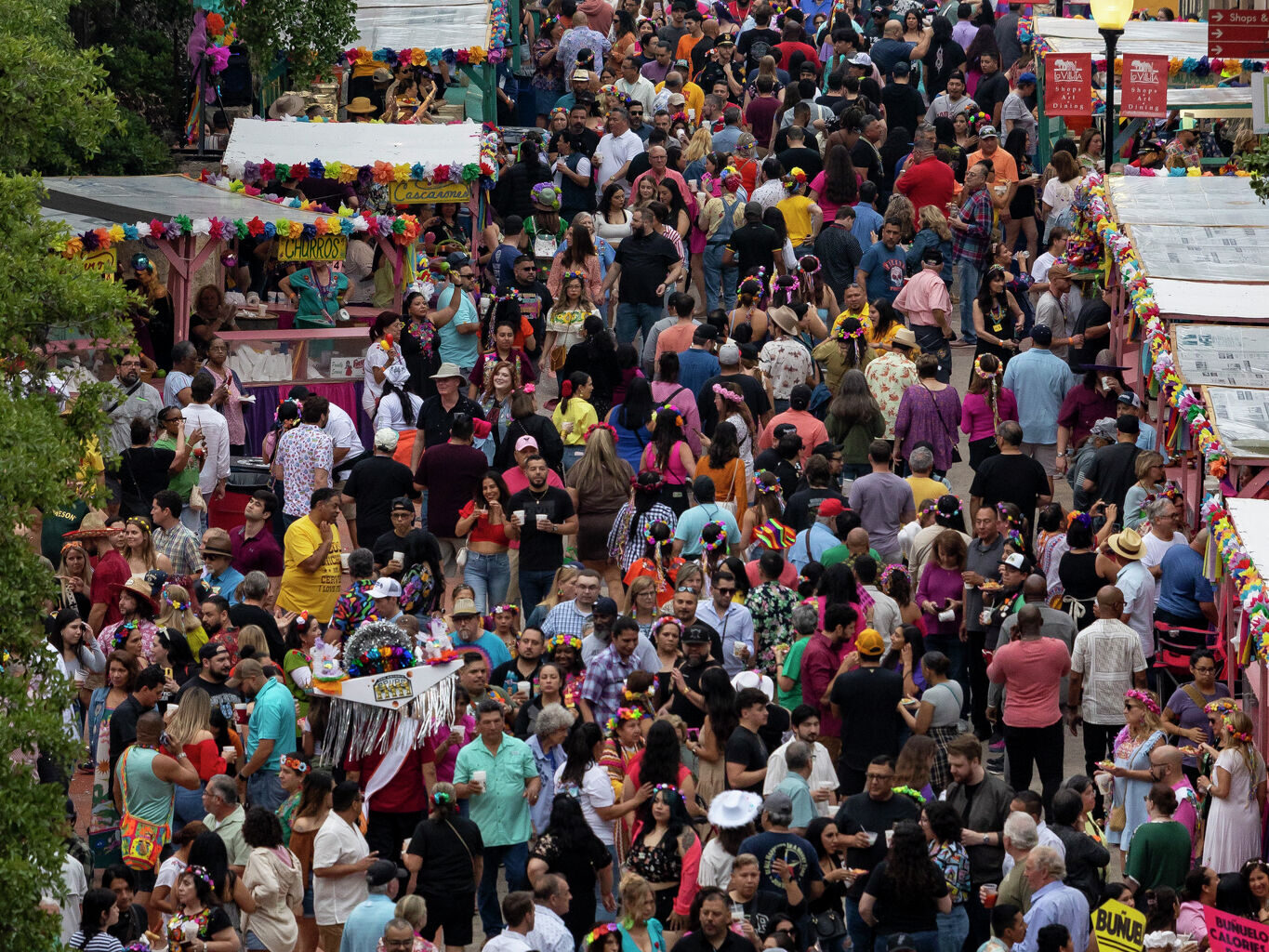
People attend the opening night of A Night In Old San Antonio (NIOSA) at La Villita in 2024.
Salgu Wissmath/San Antonio Express-News
Western-style food was sold at NIOSA from a chuckwagon, shown at left behind the Mexican Market in this undated photo.
Conservation Society of San Antonio
A Night in Old San Antonio as seen in 1964.
File photo
Revelers gather for the Conservation Society’s River Festival in 1941, a forerunner of A Night in Old San Antonio.
Courtesy / Conservation Society
News that A Night in Old San Antonio will not happen next year spread quickly after organizers announced they were hitting “pause” on the event.

Many longtime revelers who grew up attending NIOSA shared their memories on social media. Others lamented not attending in April, especially if 2026 could end up being the event’s last year.
Article continues below this ad
The Conservation Society of San Antonio, the nonprofit that produces NIOSA, announced Wednesday that the four-day celebration, an official Fiesta event for over 75 years, will take a hiatus in 2027 so organizers can “review, retool, and reinvigorate the beloved tradition.”
Conservation society officials cited declining attendance, rising costs to produce the event and a lack of adequate space, as reasons for canceling the 2027 installment. Attendance at NIOSA has dropped sharply in recent years — down 48% since 2000, Conservation Society President Betty Bueché said. The event has not been profitable the “past couple of years,” she said.
Bueché attributes the declining numbers to waning interest in large events, safety concerns and high ticket and food prices. Reaction on social media supports this, with several saying they stayed away in recent years because it was becoming too expensive to attend and no longer as enjoyable.
ALSO READ: NIOSA canceled for 2027 as organizers ‘pause’ to regroup
Article continues below this ad
Despite reports of declining attendance, plenty of San Antonians see NIOSA as an essential part of Fiesta and can’t imagine the annual celebration without it.
“This one hurts,” WOAI radio host Chris Duel wrote on X. “For those of us who grew up in San Antonio, this isn’t simply the loss of another Fiesta event. It feels like losing a piece of home.”
“NIOSA is a true treasure of FIESTA! Happy to help save this event in any way I can!,” San Antonio Zoo President & CEO Tim Morrow wrote on X.
San Antonio Explained looks at the origins and evolution of NIOSA, an event with roots dating to the 1930s that’s become a cherished Alamo City tradition.
Article continues below this ad
Its origins
A one-night harvest festival was held in 1937 at Mission San José as a way to celebrate the city’s cultures. The event, hosted by the conservation society, was created to raise money for the group’s preservation efforts. It later became known as the Indian Festival, a one-night street fair held in the fall that was inspired by the traditions of San Antonio’s early days.
By most accounts, the event originated with a format that would become its signature: an outdoor festival showcasing food, dance and music in sectioned areas dedicated to specific themes that celebrate the historical influences on San Antonio.
The fall event continued into the 1940s in various formats and names, including the River Festival and River Jubilee. In 1946, city officials, recognizing the event’s growing popularity, asked the conservation society to move the one-night festival to the spring so it could coincide with Fiesta.
Article continues below this ad
The event underwent another name change in 1948, when it was officially renamed A Night In Old San Antonio — or NIOSA, as it soon became known. The acronym, which the conservation society later trademarked, was even used in the event’s first year, according to historical accounts.
ALSO READ: San Antonio Explained: How Historic Market Square evolved as city’s signature site
Its evolution
NIOSA became an official Fiesta event in April 1948, when the event moved to La Villita, news accounts show. It started as a one-night event that was held on the Tuesday of Fiesta.
Article continues below this ad
The growing popularity of NIOSA prompted organizers to expand to two nights in 1954, and to three nights two years later. In 1958, the four-night format that Fiesta revelers would enjoy for decades was adopted.
In its early years, much of the food sold at NIOSA was prepared by volunteers in their homes. Among the foods sold were tamales, chili, homemade candies, kabobs, tortillas and various baked goods.
Volunteers have been essential to the event, manning its various booths and serving on committees that work year round. There are countless stories of volunteers who have served for decades, and generations of families who have spent Fiesta on NIOSA grounds.
In recent years, roughly 10,000 volunteers have worked at NIOSA in a single year.
Article continues below this ad
READ MORE: NIOSA’s commemorative beer cups saved on cleanup and became collectibles
Its popularity
Some of the vendors that were popular during NIOSA’s early years remained favorites decades later.
Maria’s Tortillas, where you could buy grilled corn tortillas filled with butter, cheese and salsa that were made to order, had its NIOSA debut in the early 1950s. Anticuchos – marinated steak kebabs – were introduced in 1955 inside the Mexican Market area, newspaper archives show. And, chicken-on-a-stick, a popular handheld Fiesta food that’s been paid homage on T-shirts and medals, made its NIOSA debut in 1990 in the event’s Froggy Bottom section.
Article continues below this ad
Images of revelers enjoying these NIOSA staples circulate on social media every April.
It’s been said that if you want to see someone you haven’t seen in years, head to NIOSA and you’ll run into them.
Some of those meet-ups are deliberate, with NIOSA serving as a reunion spot for old friends and former classmates. The iconic rustic windmill in Frontier Town has served as a popular meeting spot where revelers would regroup after getting separated.
And, those friends likely were carrying stacks of commemorative plastic cups bearing that year’s theme and image.
Article continues below this ad
NIOSA was an early adopter of the reusable, logo-printed cups, becoming the first official Fiesta event to start using them. In 1982, NIOSA started selling 16-ounce beer commemorative cups instead of paper or Styrofoam containers. The cost of a beer that year was $1, records show.
Its future
NIOSA isn’t the only long-running Fiesta event facing financial challenges.
In March, just weeks before Fiesta started, organizers of Alamo Heights Night announced they were canceling the event because of declining attendance and revenue. They have not said whether the event will be back next year.
Article continues below this ad
It’s not clear when, or if, NIOSA will return. And, it could be in a different format than the NIOSA that Fiesta-goers have enjoyed for decades.
Before the “pause” was announced, there was talk of going back to NIOSA’s origins of a one-day festival or having it at a venue other than its longtime home at La Villita.
Organizers insist that last week’s announcement doesn’t signal the end of NIOSA, and that all options of keeping the event going will be considered.
Article continues below this ad