
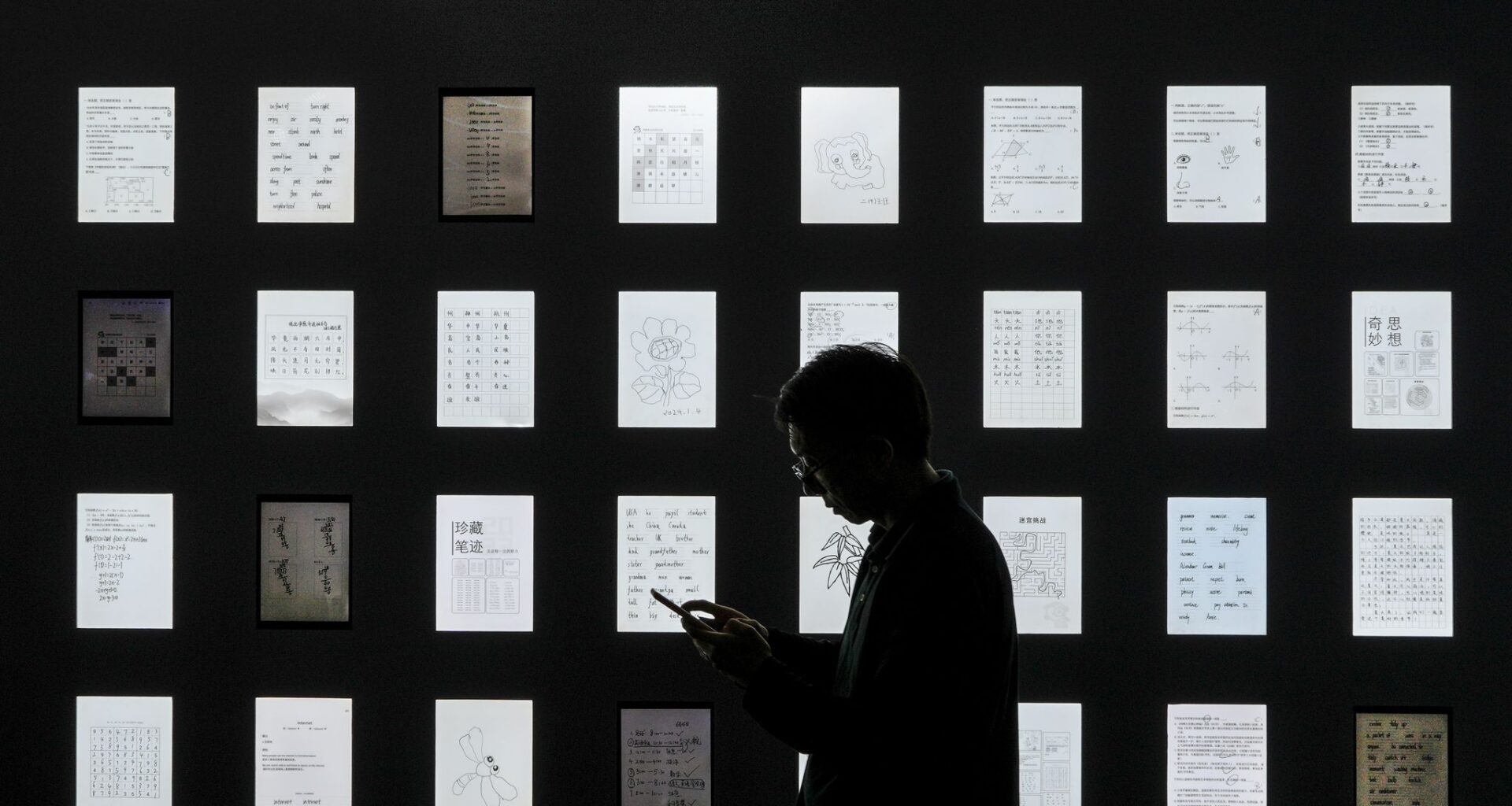
A visitor walks by an exhibition about AI in education during the the 2024 World Artificial Intelligence Conference in Shanghai China, July 4, 2024. Contributing columnist Abby McCloskey writes that AI seems to be working against educational objectives, and urges Dallas ISD to restrict it.
Andy Wong/AP
Dallas-Fort Worth is projected to become the third-largest U.S. metro area sometime in the next decade, surpassing Chicago. It’s time we started acting like it, starting with our schools.
School districts in the largest cities in the nation — Los Angeles and New York City — have taken dramatic steps to curb AI use in the classroom this school year. The former has banned it for all grades; the latter until middle school. The Big Apple has gone so far as to ban screens entirely until third grade.
Here at home, my son took home a school-sponsored iPad starting in kindergarten. At least mandatory masking was only during school hours. When it comes to screens, we’re playing it loosey-goosey down here. A bit too much, in this mom of three’s opinion.
Article continues below this ad
Official AI guidance for pre-K to fifth grades students from Dallas ISD reads: “sit with your child while they use AI. Treat it like reading a book together.” You read that right, Winnie the Pooh and Richard Scarry. ChatGPT is the new family-friendly bedtime story.
DISD guidance continues, laddering up to equity and the promise to use AI to enhance learning, not replace it. The problem is that learning loss with AI seems to be unavoidable.
There are the cheating and plagiarism issues. A new survey by Common Sense Media’s Youth AI Safety Institute found that 63% of teens are using AI to get homework answers. But many schools seem to be getting rid of homework anyway, and testing could return to pens and blue books.
The real problem is what the researchers call “cognitive offloading,” and children with developing brains asking AI for information on the regular that they used to have to critically think about. In a journal article titled “Your Brain on ChatGPT,” MIT researchers found that subjects using ChatGPT to write had 55% less brain activity and weaker neural connectivity than those who wrote without it. The vast majority (83%) were also unable to remember parts of the essays they had just written.
Another recent study, this time out of the University of Hong Kong and Stockholm University, looked at 27,000 students ages 12 to 18. After six months of using AI, students scored 20% lower on exams than their classmates who had not utilized AI.
Article continues below this ad
This couldn’t be coming at a worse time for American students. Forget the coastal elites as our primary competition. The latest Program for International Student Assessment scores show American kids are the equivalent of seven years behind Chinese students in math and our reading scores are near 25-year lows.
The PISA assessment also found that nearly half of kids use AI for educational purposes, and it’s not helping. Students who didn’t use AI for drafting text scored 28 points higher, on average, than those who said they use it almost every day. That gap is equivalent to about 1.5 school years.
This should trigger some soul searching and, more importantly, action. To be sure, the drop in student scores is influenced by many factors. But we can start rebuilding by ensuring kids read, write and do math with their own brains.
No one else will do it for us. We cannot rely on Big Tech to exercise caution for students on our (or educator’s) behalf. ChatGPT Teen is their latest offering in this regard, promising to prompt students to keep thinking through answers to homework questions instead of answering for them.
Super! But so long as there are alternatives, students will find them. For example, Common Sense Media testers asked Google Search to do their homework (math sets and essays) and it completed every assignment. And there is currently no way to turn Google AI’s assistant off.
Article continues below this ad
The whack-a-mole nature of the thing, weighing this app versus this chatbot versus that search engine, is why I’m partial to a district-wide AI pause or ban. Let’s not introduce something else risky to the mix while the student achievement indicators already are blinking red.
Last year, the hubbub in Texas schools was about the divide between public and private education with the issuing of public vouchers for private schools. What if the education divide should actually be about tech-restricted versus tech-soaked schools?
If we’re not ready to go all the way to a ban, might I suggest an experiment fit for Dallas. Could one school in the district pilot the type of AI and screen restrictions we are seeing in our nation’s leading cities? Surely, with equity as a lead value, that experience shouldn’t be reserved only for the most expensive private Christian schools in town, as is currently the case.
This won’t make our kids fall behind. I’m living proof they don’t need exposure to AI starting in pre-K. I learned ChatGPT at 40!
Nor is it a shot in the dark. The areas in our nation experiencing the largest leaps in education — I’m thinking about Mississippi’s literacy improvements, for example — did so by going back to the basics at early ages and learning the old-fashioned way, not by using fancy new apps and methods, which if anything, have tipped in the opposite direction.
Article continues below this ad
What if, in addition to the gift of growing up in one of America’s largest cities, this generation of Dallas kids receives another gift: the ability to learn and critically think apart from a machine?
It’s within DISD’s reach.