
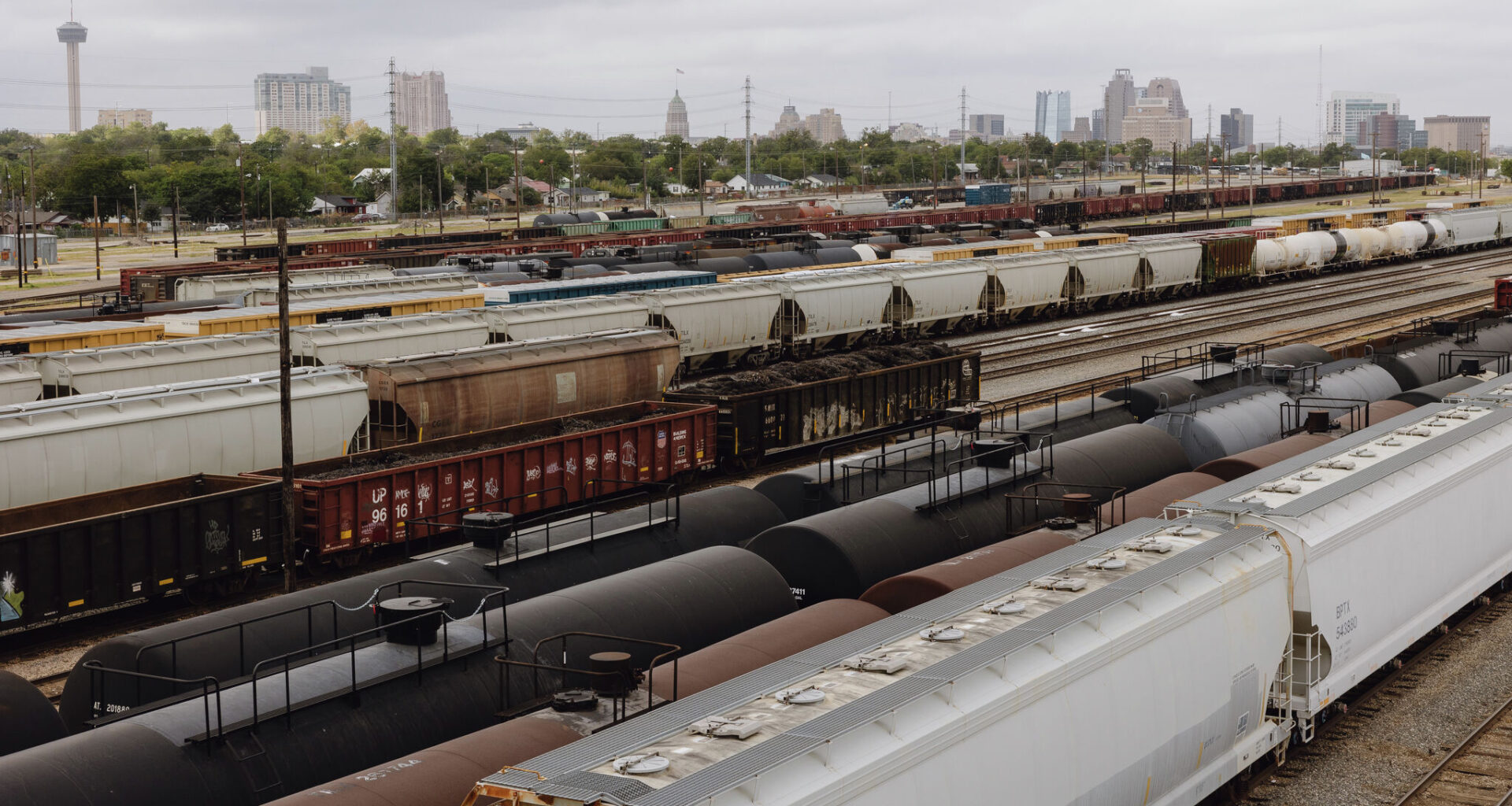
Trains sit at the Union Pacific East train yard located just outside of Downtown San Antonio. We need to examine our processes see whether they make it needlessly difficult to build the things the public wants, Joseph El Habr writes.
Christopher Lee Staff Photographer
Recently, two studies were released on passenger rail between Austin and San Antonio.

The Texas Department of Transportation studied additional service on the existing Union Pacific freight corridor, while Travis County examined an alignment largely within the right-of-way of Texas 130 and Interstate 10.
Article continues below this ad
Central Texas has studied Austin-San Antonio passenger rail for decades, with little to show for it.
The problem is that we have never built a governmental process designed to actually deliver one.
Have you ever asked yourself, “Why can’t we just do big things anymore?” Passenger rail in Central Texas is a case study in the answer: A layer cake of bureaucracy where responsibility is spread across governments, agencies and funding programs, leaving the average citizen unsure where to direct their ire.
Article continues below this ad
At the top of the bureaucratic cake is the federal government. Highways and airports have established funding systems that routinely move money where it needs to go.
The Federal Highway Administration sends states billions of dollars through formula-based programs, meaning states can count on a predetermined share each year rather than competing for every dollar. The Federal Aviation Administration similarly provides airports with predictable formula-based funding, supplemented by competitive grants. There are rules, processes and, imperatively, certainty.
Passenger rail has a federal agency too, the Federal Railroad Administration, but not an equivalent funding machine.
RELATED: Hey, Greg Abbott, make passenger rail between Austin and San Antonio a reality
Article continues below this ad
There is no dependable formula-based federal funding Texas can expect each year for intercity passenger rail. Instead, states and local governments largely compete for competitive grants whose availability and funding levels can change with Congress and each presidential administration.
Then comes the state. The State Highway Fund and major revenue streams such as Propositions 1 and 7 are TxDOT’s major funding sources, and all are statutorily restricted to roadways. Billions can predictably flow toward highways, while passenger rail scavenges for pennies.
Further, our current system requires active state cooperation to get passenger rail chugging.
That’s a problem when passenger rail has become politicized, and Texas leaders have shown little appetite for making it a priority. A viable project therefore requires immense regional will, local technical knowledge, a willing state partner and a stable funding source all at once.
Article continues below this ad
Compare that with Interstate 35 through San Antonio, where TxDOT’s gargantuan Northeast Expansion program is widening roughly 20 miles of the corridor. TxDOT is able to advance a multibillion-dollar expansion through an established process using dedicated state and federal highway dollars. It has an agency, a funding pipeline, decades of institutional knowledge and a prescribed path from planning to construction.
TxDOT can move forward with a thinly veiled, preordained project because the money and process are already there. The path, or rather, highway of least resistance is already paved.
SIGN UP FOR THE AUSTIN ANGLE and get Statesman commentaries in your inbox
On the contrary, passenger rail works almost entirely in reverse.
Article continues below this ad
A local champion first has to say, “We want to do this,” then is left to their own devices to assemble the political support, institutions and money necessary to make it real.
Cutting red tape shouldn’t be a partisan issue.
At its core, it should mean taking a hard look at the processes we have inherited and asking whether they still serve us, not simply whether projects can be built faster. It should also mean asking whether our rules and processes make it needlessly difficult to build the things the public wants.
For Austin-San Antonio rail to become realistic, Texas would need a predictable funding source, a durable project-development pipeline and an institution empowered to carry projects from idea to operation.
Article continues below this ad
Until then, we will keep taking the highway of least resistance because that’s just the way we’ve always done it and keep wondering why big things don’t get done.
Joseph El Habr is a an urban/transportation planner based in Austin. He works for the consulting firm contracted by TxDOT for its Austin-San Antonio passenger rail study and did the market analysis section of it.