
Float On Boat owner David Callejas with one his kids preparing for a boat ride at Lake Austin.
David Callejas/Courtesy of David Callejas
A major shake up in seasonal maintenance of a popular Austin lake is causing Lake Austin boat operators to push back against its governing body. Operators say a planned 10-foot drawdown could force cancellations, cut into tourism revenue and leave businesses scrambling during one of Austin’s busiest visitor months.

One operator could be out as much as $100,000 if the proposed cleanup takes place this October.
Article continues below this ad
David Callejas, 40, is one of several Central Texas boat business owners that relies on a body of water to feed his and more than two dozen of his employees’ families. Born and raised in Austin, he started Float On Boat Rentals in 2013 as a way to showcase tourists and residents his favorite part of the city — Lake Austin.
Thirteen years later, Lake Austin which has now become his livelihood, is set to change next month. At the request of the City of Austin, the Lower Colorado River Authority (LCRA) is planning to lower the lake by 10 feet from October 12 through November 30.
The drawdown means that public boat ramps along Lake Austin will be closed, swimming will be restricted in some parts and businesses won’t be able to store or operate as many boats while the weather remains warm throughout the fall. Callejas told MySA he learned about the drawdown 53 days ago, which he believes is not enough time to prepare for the impacts.
Article continues below this ad
MySA reached out to the City of Austin for comment on when officials made the decision to draw down the lake.
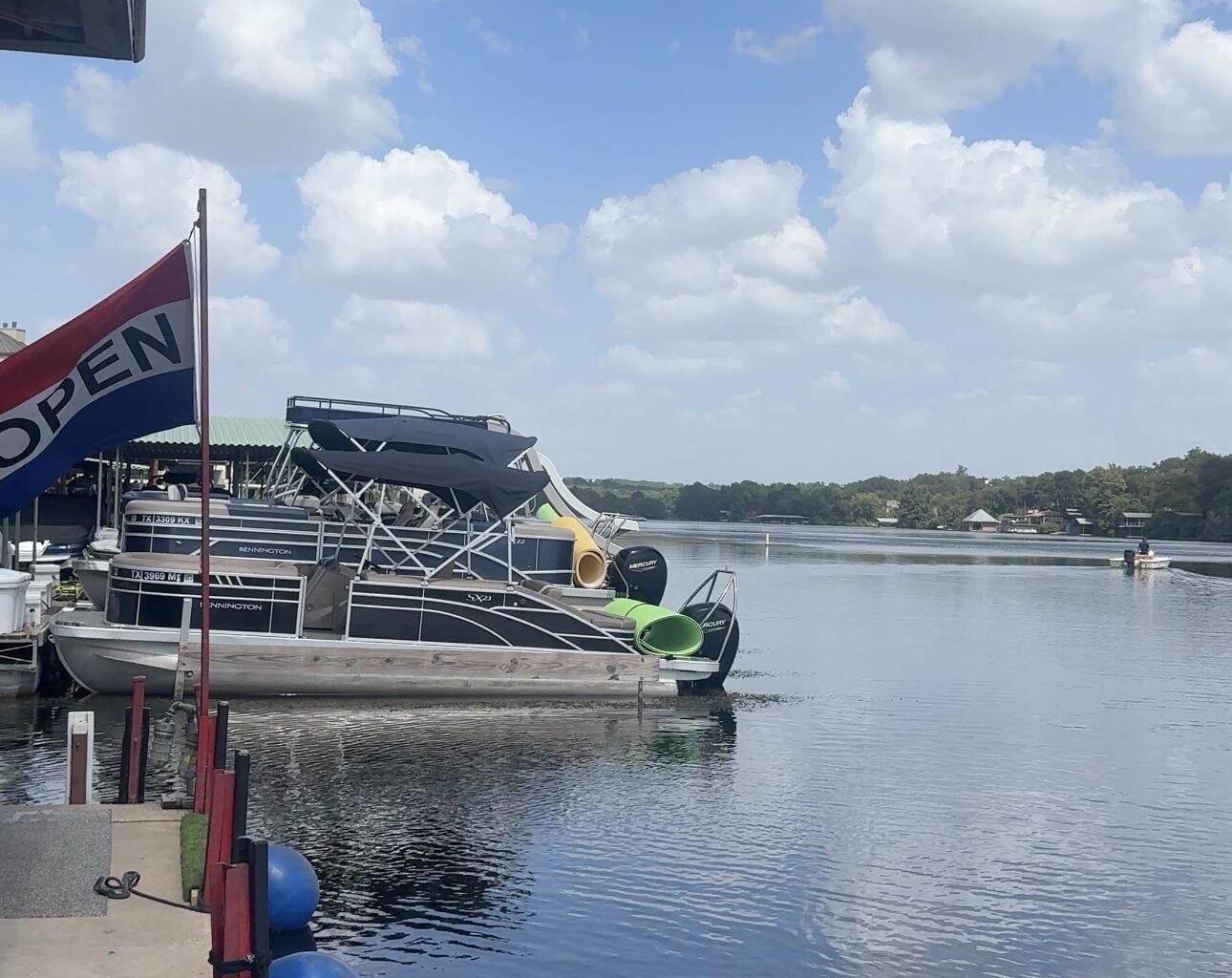
Boats parked on a dock at Lake Austin Marina on Wednesday, September 16 in Austin, Texas.
Cristela Jones/Cristela Jones/MySA
“It was a real shocker when they kind of published you know the the decision to do it because nobody voted on it,” Callejas said. “There was no you know, economic impact report done on it, and so it was kind of done abruptly and on short notice.”
He, alongside other local businesses, are preparing for Austin’s busiest month of tourism in October with Formula 1 races, Texas football games and Austin City Limits slated to bring hundreds of thousands of visitors into the city. Callejas says that if the drawdown were to begin, he could lose up to $100,000 in revenue from pre-booked boat trips to servicing private clients and residents who enjoy water activities in the fall.
Article continues below this ad
“October, November [are] huge months for all of us, and for it to kind of deter people from hanging out at our establishments and spending money is really unfortunate,” Callejas said. “It’s not just the direct impact on our business, but also the overall economic impact of the city and people that also love the lake and love Austin because of the lake, and they’re probably going to change their plans.”
Callejas operates 18 boats and has 25 employees at Float On. He says that if the drawdown were to happen next month, he will have to begin canceling bookings and laying off some staff earlier than expected.
And the impact, Callejas says, won’t just be financial.
“The part that not a lot of people are talking about is like, well, the lake is going to be inaccessible and closed, and it’s also going to smell really bad,” Callejas said. “So even like hanging out at Mozart’s and drinking a coffee, you think, oh, that won’t be affected, but it actually will. Like the views will be ugly, the smells will be bad, you know. So it’s just a lot of things that’ll kind of trickle down effect of it.”
Article continues below this ad
Why is Austin lowering Lake Austin?
The city says the drawdown will help control the growth of hydrilla, an invasive aquatic plant that has taken over most of the lake, and allow shoreline property owners and city departments to perform needed maintenance. Lake Austin Marina general manager Tara Carr and other stakeholders argue that the city’s new timeline could make operations worse.
Invasive hydrilla plants have overtaken the waters where boats are docked at Lake Austin Marina on Wednesday, Sept. 16 in Austin, Texas.
Cristela Jones/Cristela Jones/MySA
“The City of Austin has said at this point in their own memos that they believe hydrilla can actually spike after drawdowns, and that’s even with them happening in the traditional January to February timeframes,” Carr told MySA. “So, with the understanding that they’re going to do it in October and November when it’s so bright and sunny like this was very surprising.”
Article continues below this ad
Historically all 18 drawdowns on the lake have happened from January through February since 1976. After Winter Storm Uri in 2021, LCRA adopted a policy banning drawdowns from December 1 to March 1 in order to conserve hydropower generation in case of another massive ERCOT blackout.
However, Carr says that both Mansfield and Tom Miller Dam, which both supply water to Lake Austin, do not generate enough hydropower to be affected by a drawdown. She also worries that the forecast Super El Niño weather season, a wetter and colder fall and winter in Texas, may cause major flooding like it did in July making a lowering problematic as Lake Travis remains nearly full and its runoff flows into Lake Austin.
“The last time we had that [El Niño] was, I believe, October 2018, and there was massive flooding for the Highland Lakes,” Carr said. “That would be a really dangerous situation to have people who have equipment in this lake bed because of the drawdown and expecting to do incomplete work that, on a moment’s notice, could find out that they have to, pull back safely, and the lake is flooding, and it could be in an astronomical way if it’s anything like it was in the past.”
Boats parked near Lake Austin Marina’s store, which is the only fueling station on the lake that also sells drinks, snacks and other merchandise inside.
Cristela Jones/Cristela Jones/MySA
One of the three solutions she hopes the city will consider includes partnering with Austin-based Base Power, which has offered emergency backup power from its installed batteries at market rates. The other two are that the city pre-purchases standby emergency capacity from an ERCOT-approved provider and apply the same weather-monitoring abort plan already set for the fall drawdown.
Article continues below this ad
“Right now, nobody is showing their work or giving the reasons behind these decisions,” Carr wrote in an email shared with MySA to Austin City Council member Marc Duchen, whose District 10 covers Lake Austin. “So right now, hydropower availability and the December to March policy are being discussed as though they categorically eliminate traditional January-February timeframe. But before accepting that conclusion, we need to know how many megawatts are we actually talking about and what it would cost to replace that capacity.”
In a statement, the LCRA said, “the City of Austin’s drawdown request is consistent with LCRA’s intent to no longer conduct lake lowerings in the winter, when power demands often peak.” The LCRA added that while it has shared its preference not to schedule lowerings from December through February, if the City requested a change in the timing of the drawdown, they would consider the request.
While Callejas and Carr agree that a drawdown is necessary, they both question the timing of the exercise and are hopeful that the city will reconsider delaying the process next month. The next LCRA Board of Directors committee meeting is scheduled for Sept. 23 and the next Austin City Council meeting is set for Sept. 24.