
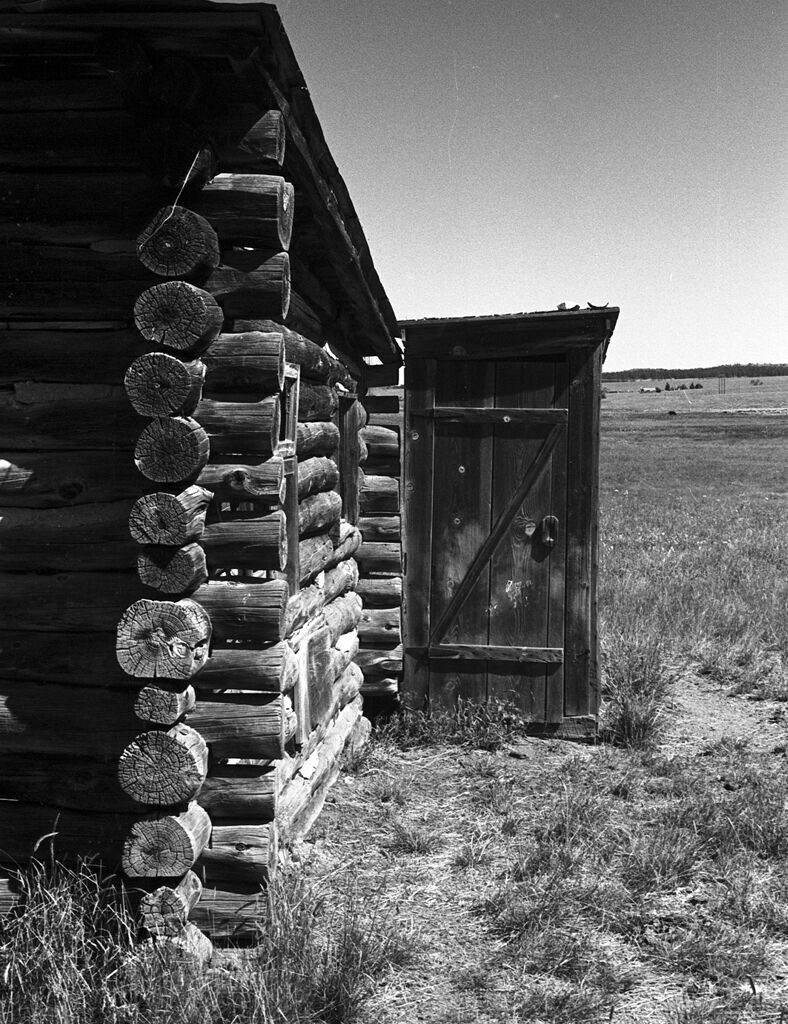
There are hundreds of little ghost towns throughout Colorado, hidden away in or near the former gold rush mining camps or settlements or near the railroads. They’re easy to spot and pass by on the way to popular ski areas.
But there are others that are extinct with names that have never been on highway signs and aren’t even on maps. There’s no “there” there any longer. Several that had been thriving communities or ranches in 1800s northern El Paso County, though, have histories compiled by Palmer Lake Historical Society, Lucretia Vaile Museum and the Air Force Academy Special Collections.
Recommended Stories
▶
Husted
One busy spot was Husted, named for Calvin Husted from New Jersey in 1859, 6 miles south of Monument. He had a lumber mill until 1878,and much of the wood went from Black Forest to Colorado Springs where there was busy homebuilding starting.
The Palmer Lake history researchers reported the Husted area was familiar with friendly Ute Indians but had to fend off attacks by the Arapahoe and Cheyenne, with families gathering together in homes for safety.
Archivists researched two Husteds, East and West. East Husted was along the Santa Fe Railroad and had two hotels built in 1883. There was a general store, post office, saloon and church as well as the Branding Iron Café, the Frontier Service Station and Jones General Store.
West Husted was along Monument Creek and the bluffs overlooking the creek. Population 75. There were stations for both the Santa Fe and D&RG railroads. In the late 1800s, between Husted and Monument, high winds blew trains off the tracks several times over the years. There were also two serious crashes recorded: a derailment was in 1888 and in 1909 a northbound train and southbound train collided head-on.
The historians said Husted had a fox farm south of the community thatin the 1930s had bred as many as 3,500 foxes. A clay pit on the West Husted bluffs provided rail cars of clay sent to Standard Fire Brick Co. in Pueblo.
The two Husteds vanished when the federal government took the land for the Air Force Academy in the 1950s. Some of the homes were moved to Monument and Palmer Lake, but the town was gone.
Gwillimville
The Gwillim family from South Wales came to America in 1869, starting out in Illinois. Reported to have been seeking a more desirable climate, they came to Colorado Territory and in 1870 built a home in a pastoral setting east of Monument (originally called Henry’s Station for Henry “Dutch” Limbach). Their home was near West Cherry Creek close to what today is Walker Road andColorado 83.
First to arrive were Gwillim Rees Gwillim and his family, followed in 1871 by his brother Richard J. Gwillim, who apparently traveled back to Wales for a bride before building a ranch next to his brother. An estimated 25 more Gwillims and their families arrived in the settlement over the years.
The community was never incorporated but included a one-room schoolhouse, the post office, saloons, a store, a blacksmith and their church. The brothers had a cheese factory and creamery and supplied butter to customers in Colorado Springs and Denver.
The Gwillims raised potatoes and other crops, but stories say the potato crop was wiped out by a blight in 1895. Monument historian Lucille Lavelett wrote that two of Richard’s daughters died during a diphtheria epidemic. In 1895, Richard’s home burned down. It was rebuilt but Richard and his family never lived there, moving instead to Colorado Springs in 1900. Other Gwillim families also drifted away from Gwillimville and over time its buildings were abandoned, leaving only some foundations on the land.
The Gwillimville School building had been moved to Monument where it became Sunday School for the Presbyterian Church and then, in the 1980s, the former Tri-Lakes Chamber of Commerce building on Colorado 105.
For over 20 years the original Gwillimville land has been Cherry Springs Ranch, home to the well-known Searle Ranch family’s Longhorn cattle grass- fed beef business, which also has grazing ground in Ellicott.
Edgerton
The town site of Edgerton was south of Monument along Monument Creek and settled by David Edgerton in 1868.
According to railroading history, it became a stagecoach stop in an area with a most unusual crop: ice. The man-made Ice Lake from the 1880s produced ice for Cascade Ice Co. It was cut from the lake in large blocks, put into rail cars and stored in special ice storage buildings insulated by sawdust in the walls. There was enough ice to keep food cool on the railroads all summer.
Palmer Lake Historical Society says that Monument and Palmer Lake also had ice production on their lakes during this time preceding refrigerators.
Around 1869 the Pueblo-to-Denver stagecoach made weekly stops at Edgerton House, a boarding house and dining room in what had become a health resort. During summers, tents were on the grounds of the home built by Harlow “Leafy” Teachout. There was nearby access to the D&RG railroad.
In 1891 Edgerton had 50 residents. This grew to 250 by 1902.
Edgerton had a post office from 1870 until 1902. All that remains of the town today are the foundation ruins of “Leafy” Teachout’s hotel and barn near Santa Fe Regional Trail.
Table Rock
There are two Table Rocks in Colorado, one in Golden and the other in northern El Paso County.
Golden’s has hiking trails and residential areas. In El Paso County it was all about history and a 19th-century settlement east of Palmer Lake and Monument in Black Forest.
According to Arcadia Publishing’s “Communities of the Palmer Divide,” this Table Rock community was a rural post office from 1873 to 1893 and was on the route used by Native American tribes including the Utes, Cheyenne, Arapaho and Kiowa. The trail through the Palmer Divide has included arrowheads, a medicine wheel and a grave.
The community of Table Rock, established in 1872, included a store, creamery, church and school and was near Table Rock Mesa on East Cherry Creek. Later it moved south on what is now Walker Road between Bar X Road and North Black Forest Road.
The Table Rock Cemetery is on a homestead with an earliest grave of 1872.
Pring Station
Going north along the rail lines, along the Santa Fe trestles south of Baptist Road, was what had been the town of Pring Station. The Air Force Academy’s “Communities of Yesteryear along the New Santa Fe Trail” recounts John William Pring arriving in the area in 1876 and purchasing 240 acres of land, sight unseen. It became the town in 1888 and the history account has a special pat on the back.
John Pring’s effort in improving the land, raising cattle, dairying and farming would soon earn him accolades for having one of the best farms in the area. Sheep and cattle would be loaded onto trains at the Pring Station, which accessed the Santa Fe (to the west was the Borst Station, which accessed the D&RG). Also, once a week, the Pring dairy business would provide milk and 35 pounds of butter to The Antlers hotel in Colorado Springs.
By World War II Pring Station was no longer a town, a victim of urban growth and the moving of its train depot to Palmer Lake and the abandonment of the Santa Fe rails through it. The name Pring continues in major residential developments in the Pikes Peak area.
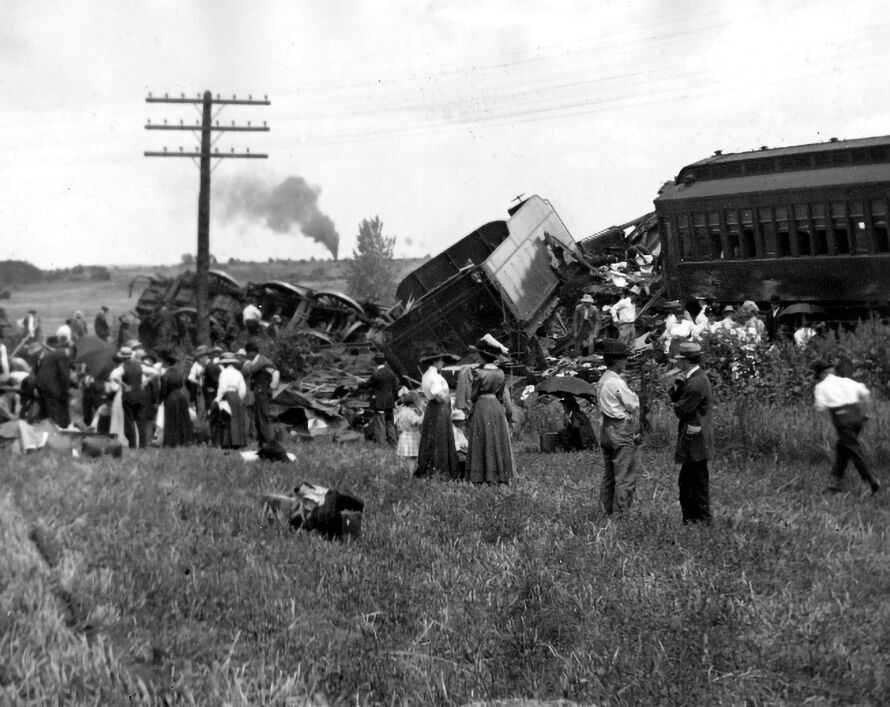 Husted train wreck in El Paso County. Town is now extinct. (Palmer Lake HIstorical Society)
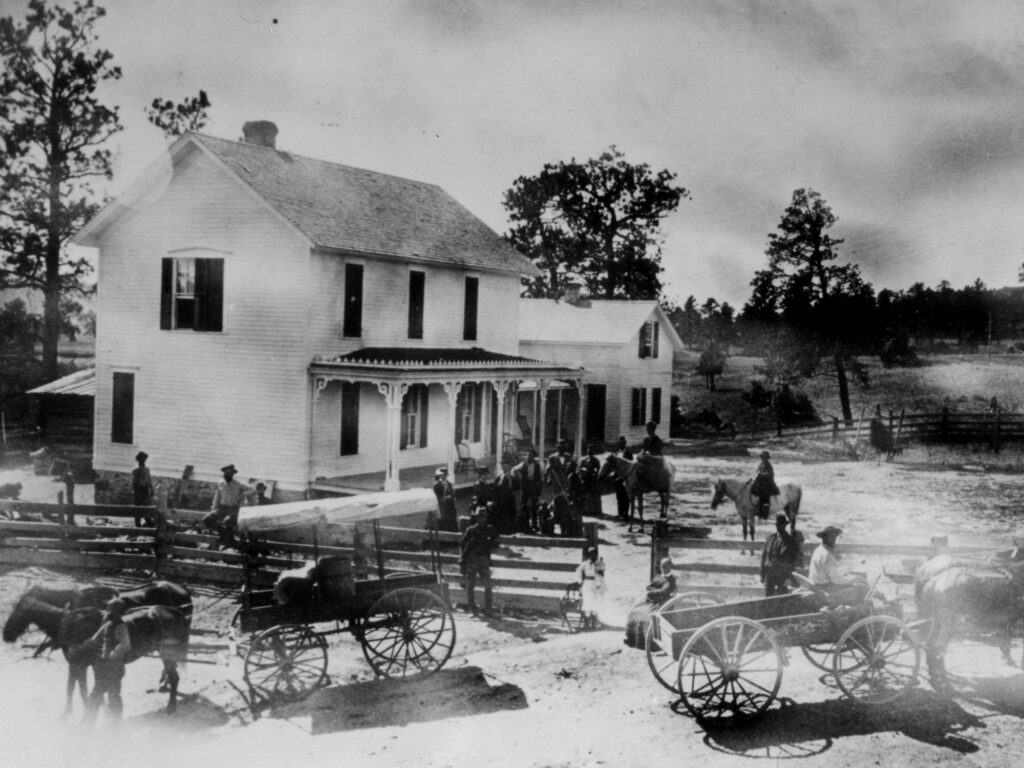 Edgerton Hotel in Northern El Paso County. Town is now extinct. (USAFA Special Collections)
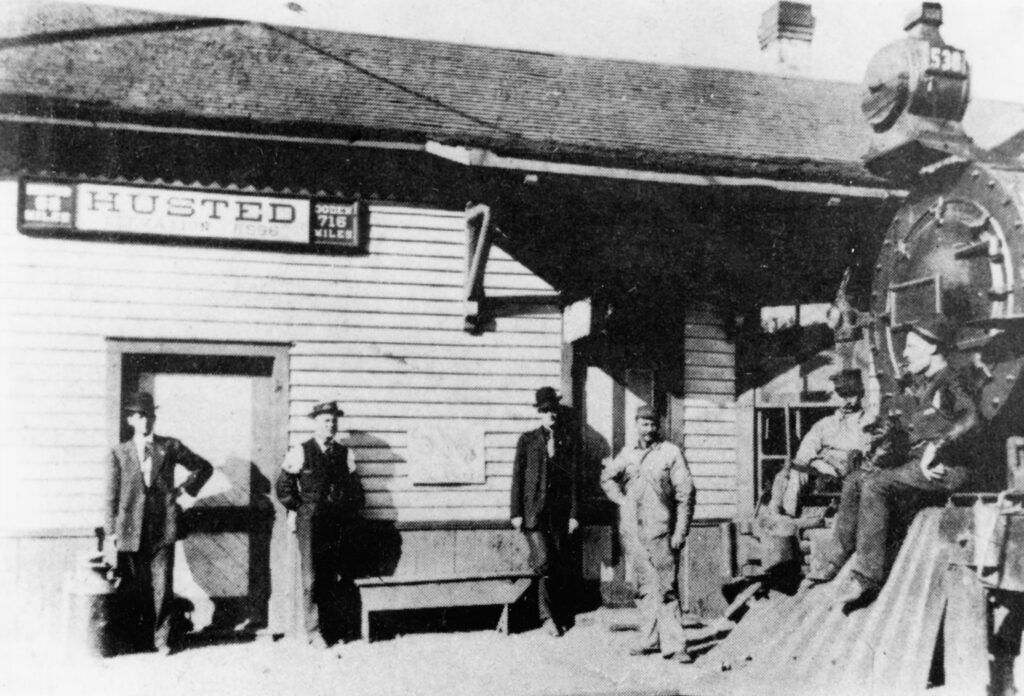 Husted train depot. Town is now extinct. (USAFA Special Collections)