
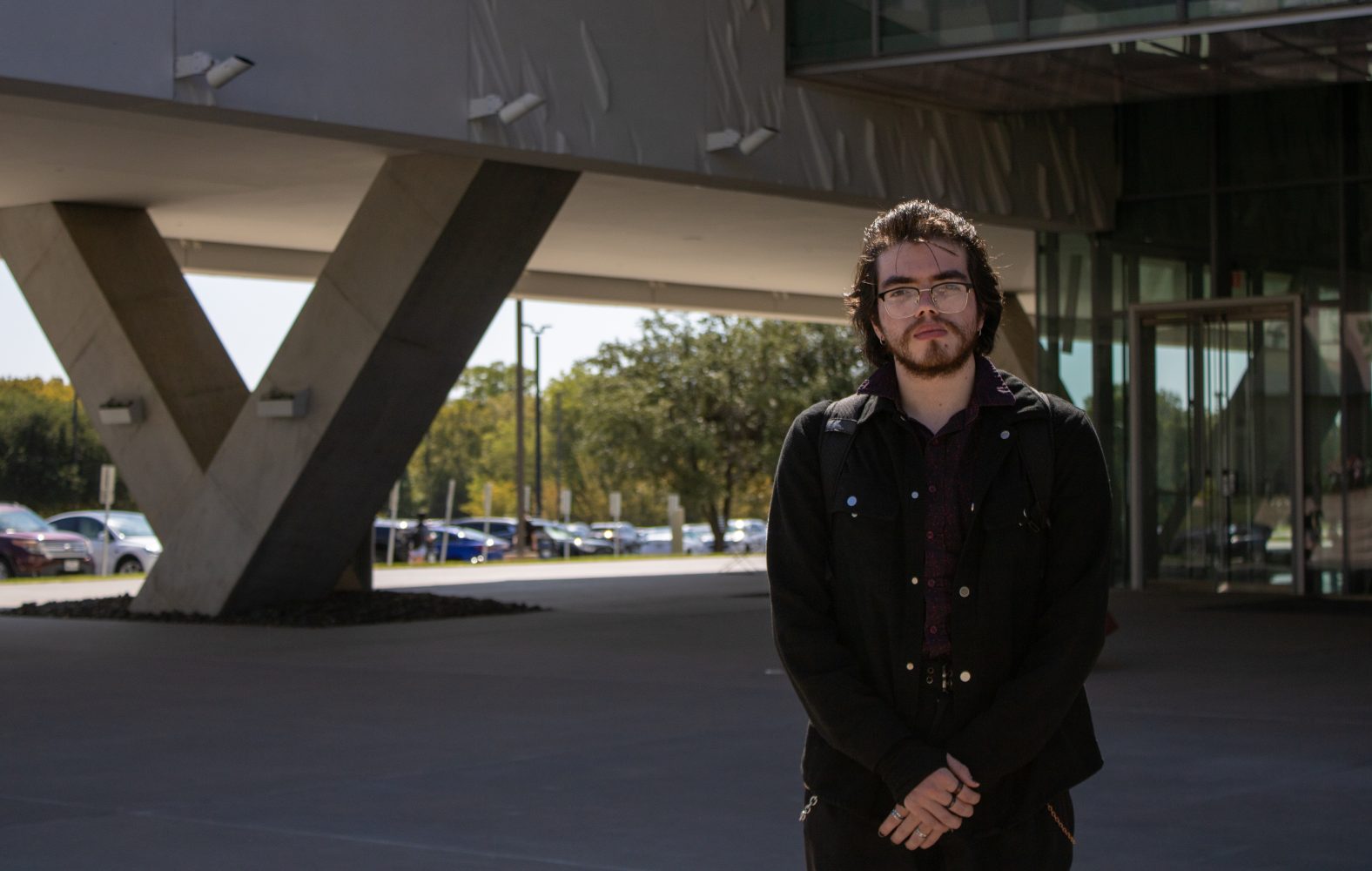
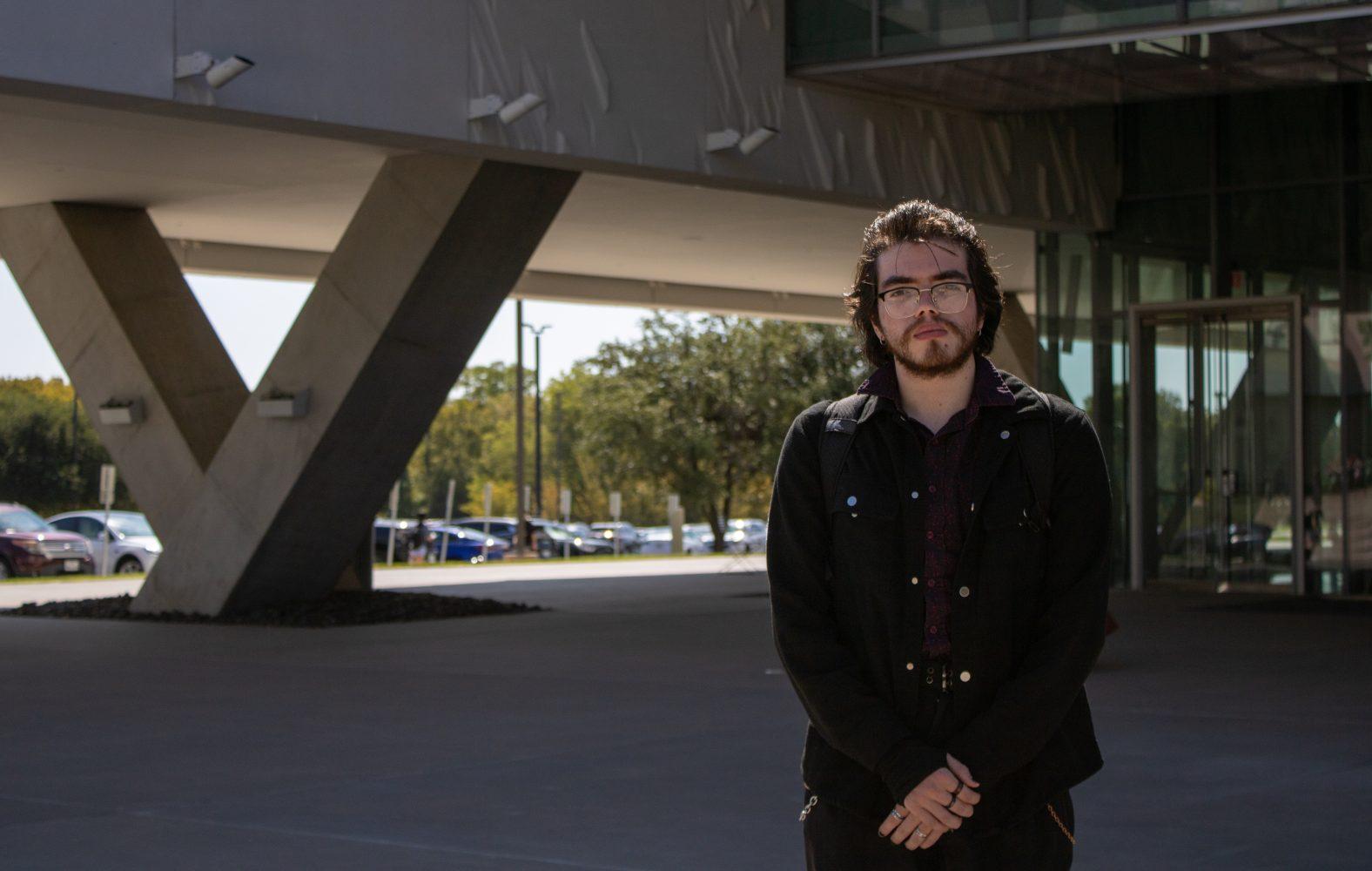
Gregorio Olivares Gutierrez stands outside The Crow Museum of Asian Art on the University of Texas at Dallas campus. He is suing the university for free speech violations. Photo by Hannah Everett
Hannah Everett
On Oct. 15, 2024, former editor-in-chief of The Mercury, Gregorio Olivares Gutierrez, received an email from the University of Texas at Dallas administration saying he was under investigation for discrimination. This was the day he knew he would have to pursue legal action against the college.
Olivares Gutierrez, a current UTD student, filed a lawsuit against the school’s administration last week for free speech and press freedom violations.
The investigation, which the school informed him of a month after firing him, was for “discriminatory harassment,” filed by a student who had submitted a letter to the editor for publication.
The lawsuit claims the university administration jumped at the opportunity to silence Olivares Gutierrez, as they had long clashed with the editor-in-chief over the publication’s critical reporting on the administration.
Sign up for the This Week’s Top Stories newsletter to get the latest stories delivered to your inbox
THANK YOU!
You’re all set.
CLOSE
“When it comes to doing student journalism, there’s a lot of really important things that we cover, and unfortunately it doesn’t always paint our school in the best light when we have to cover scandals with professors or different sorts of things that are going on at that high end level of the university.
“But it is important that we cover it truthfully nonetheless. In my time doing so, I angered a few university administrators who now see fit to weaponize parts of university policy to strip students of their free speech,” Olivares Gutierrez said.
The suit, filed last week in the U.S. District Court for the Western District of Texas, claims UTD violated Olivares Gutierrez’s First and Fourteenth Amendment rights. Dallas attorney Griffin S. Rubin, a partner at Sbaiti & Company PLLC and a member of the FIRE Legal Network, represents the student and took the case pro bono, Olivares Gutierrez said.
“My problem has always been with the university acting as if it knows better than the law, as if students aren’t real people who have real rights,” Olivares Gutierrez said.
What happened
In July 2024, Olivares Gutierrez accepted the letter to the editor from the president of UTD’s Hillel chapter to be published in The Mercury. The letter went through the publication’s editing process and Olivares Gutierrez requested the writer substantiate claims with appropriate sourcing. The writer declined to do so through multiple rounds of back-and-forth feedback, and the story was published with a disclaimer stating the piece did not meet The Mercury’s journalistic standards and should be read as the author’s opinion.
Olivares Gutierrez said it was still important to him to publish the letter, titled “Campus antisemitism,” even with unsubstantiated claims. He said the disclaimer was the publication doing its due diligence to provide readers with factual information.
“If I didn’t want to see that student’s voice being heard, I would not have published the piece,” He said. “In my opinion, it’s always been better to show more student voices than fewer.”
After publication on Aug. 19, 2024, the author filed a complaint with the Office of Institutional Compliance saying they felt discriminated against because of their Jewish faith. The university administration fired Olivares Gutierrez on Sept. 13, which triggered a staff strike and then the removal of student employees on strike.
In the month between Olivares Gutierrez’s removal and the university informing him of the investigation, he and the former staff of The Mercury formed a nonprofit newspaper called The Retrograde.
Olivares Gutierrez met with UTD administration about the investigation in October. In June 2025, UTD concluded he discriminated against the student who wrote the letter to the editor. An administrator told him he would face a two-year deferred suspension and an educational sanction grounded in media ethics.
After a letter from the Foundation for Individual Rights and Expression (FIRE) and public backlash, the university granted Olivares Gutierrez a hearing rather than a suspension. After the hearing in February 2026, UTD’s findings remained the same, and Olivares Gutierrez appealed.
“To see the university use this as a cudgel against the freedom of expression and the freedom of the press is really disappointing and something I am committed to pushing back against,” Olivares Gutierrez said.
UTD did not respond to requests for comment.
What’s next
Rubin said the next step is to apply for a temporary restraining order and a preliminary injunction while the lawsuit is resolved. Olivares Gutierrez is completing his final semester at UTD and said he is working on applying to law school.
“Law school has always been the goal. I think there are a lot of injustices in this world and law is an effective way to combat it,” he said.
Gutierrez said the legal battle is worth it, even as he nears graduation, because of the implications it may have for current and future journalism students at the university. He said the impact of university policy on free speech could cause students to rethink their degree plans and steer clear of college journalism.
“The university is very clearly doing something that has a terrible precedent for future student journalists,” He said. “Imagine you’re a student journalist at UT Tyler or even here at UTD in future generations and you see UT System uses its own policy to stop students from asking for facts and from making sure the basic journalistic standard any article should go through is being met because the university disagrees with the speech. That’s terrifying.”