
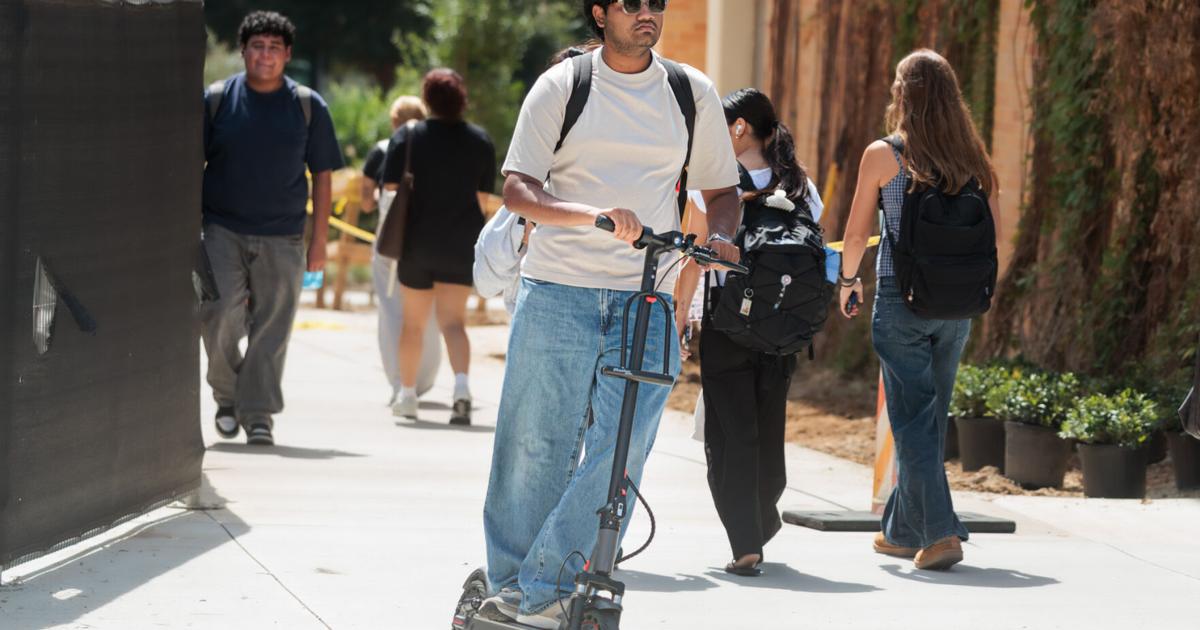

Computer science junior Mushthir Kabir rides a scooter Sept. 21 near the Central Library. Kabir said having a scooter is useful to get around campus, especially during the summer.
With the semester in full swing, students are out and about on campus and the surrounding areas.
Electric scooters and bikes can reach fast speeds, and riders or pedestrians could be wearing headphones and not be aware of their surroundings.
Several universities across the country started the year with new mobility rules, designed to keep students who are walking and those riding personal electric vehicles safe.
Larry Cummings, UTA parking communications manager, said in a Teams message that UTA has existing procedures governing motorized vehicles in pedestrian areas. He said the university is aware of other colleges developing new policies for e-bikes and e-scooters but currently has no specific plans to announce changes to its own policies.
According to a UTA Police Department report, there have been no accidents involving scooters on campus from Aug. 17 to Sept. 10. Of the seven vehicle-related accidents reported, only one involved a pedestrian.
“When you have a pedestrian and a vehicle, or scooter or bike and a vehicle, that can be a little bit more hairy,” said Gregory Finney, UTA Police crime prevention and community engagement officer.
The pedestrian only had minor elbow abrasions, according to the report.
Electric vehicles and bikes should be treated as regular motor vehicles, Finney said. This means e-bikes and scooters can get citations from police or campus police.
“If you’re on a scooter, it’s still considered to be a vehicle according to the law, just like a bicycle,” he said.
General rules for personal electric vehicles on campus
Motorized vehicles are required to operate at a walking speed, equivalent to 5 mph, in pedestrian zones and yield to pedestrians on campus, Cummings said.
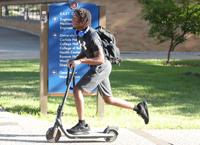
A student rides around campus on their scooter Sept. 23 near Woolf Hall. Motorized vehicles on campus have regulations, including a 5 mph limit in pedestrian zones.
“Campus is a shared environment, and pedestrians have the right-of-way,” he said. “Slow down in crowded areas, stay alert and give others plenty of space. A little courtesy and awareness can go a long way toward keeping everyone safe.”
Finney said scooters should not be in buildings. He said bike and scooter riders are discouraged from riding on sidewalks, and that it is dangerous to ride any vehicle down the accessibility ramps on campus.
Finney recommends students who are on bikes, e-bikes or e-scooters use the designated lanes on the streets for slow-moving vehicles rather than the sidewalks where people are walking.
Safety protocols personal electric vehicles
Pedestrians should use marked crosswalks and pedestrian signals when out and about. Before crossing the street, they should look left, right and then left again, even when walking with the right of way.
Cyclists should wear helmets every time they ride. They should follow traffic signals and signs, and ride in the same direction of traffic on the road. Cyclists should also use front and rear lights or reflectors when traveling in the dark.
Scooter riders should also wear helmets when on the go. When in an area with pedestrians, intersections, blind corners and crowded areas, riders should slow down. Scooter riders should not carry passengers and not ride while using a phone or being impaired.
“Being safe, watching your surroundings — that’s key to everything,” Finney said.
@j.e.journalism