
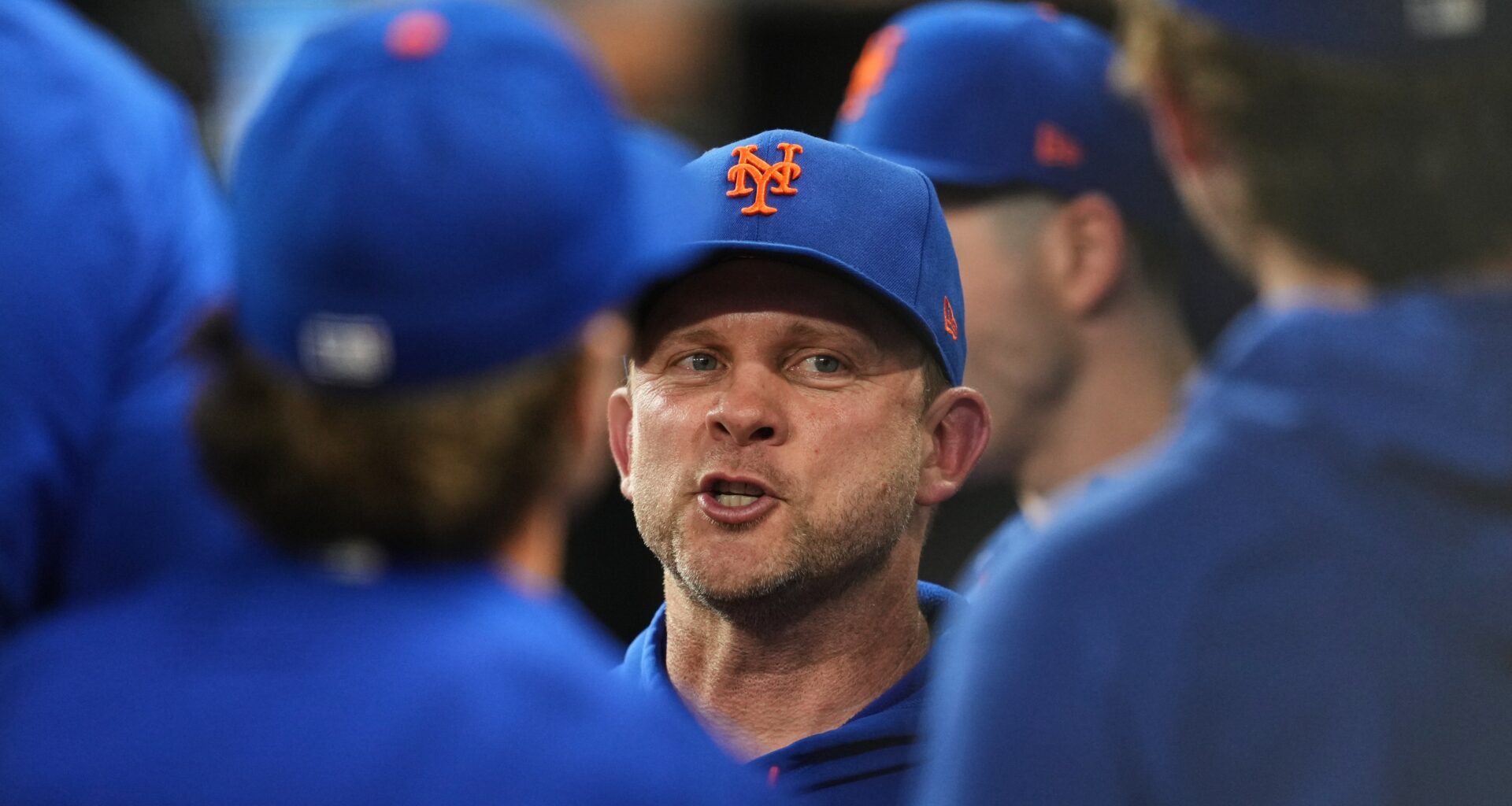
ARLINGTON — At the end of Andy Green’s Tuesday afternoon press conference, he highlighted a member of the Mets’ clubhouse staff: Theodore Mosley, a Citi Field kitchen worker. Green wanted to publicly credit him for his work ethic and impressive eye for detail.
“If you walk into our clubhouse kitchen, every label is perfectly spun out,” Green said. “It’s as meticulous as you could imagine how amazing he puts every water bottle in, every drink in, every cup on the stand correctly, picks up every last bit of trash that exists, does it with a smile and excellence.”
Green wrote him a letter before the final home game of the season.
“I said if all of us could be as excellent as our job as you are, we’ll be World Series champions next year,” he said. “The ability to dominate details that the rest of the world overlooks is an absolute separator.”
If you were listening closely, this spoke volumes about Green’s management style.
It’s not about micromanaging, and it’s certainly not about attaining perfection. So much of the manager’s job is building culture, which requires identifying the small details others often overlook to establish its foundation.
Building a culture gives the team an identity, something the team has lacked since the OMG season.
Former Mets right-hander Luke Weaver accidentally summed up the current culture earlier this season: “It’s not very often you have such a talented team where everything just doesn’t really click in the right way. It’s quite an impossible feat, but we made it possible.”
Since last season, the culture has essentially been a collection of stars trying not to cave under the immense pressure of championship expectations. What made the 2024 Mets so good was their underdog mentality. Underdogs typically don’t have exceptionally high payrolls like the Mets, but the term is subjective. The Mets often overachieve when the rest of baseball counts them out, and underachieve when the expectations are the highest.
The answer to the question of what kind of team the Mets want to be can’t be a “championship team” because championship teams have identities. They have to know their strengths and how to rely on them in tough moments of games and in tough stretches of winning seasons. It’s what provides direction and keeps teams going when losses pile up.
The Mets never stopped to think about what kind of team they wanted to be. Are they going to pitch their way out of trouble? Are they going to outslug their mistakes? Will they be more than just advantageous on the basepaths, running enough to make it a key component in how they win games? Is the defense so stifling that it can take away hits from some of the heaviest-hitting lineups with their starting pitcher in the middle of a slump?
The details matter because they set a standard. Accountability is what comes when the standard isn’t met.
Buck Showalter made a living off course-correcting teams that had no culture or identity. He was able to look around, find seemingly insignificant details that had been missed, and help teams understand their significance. What Showalter did effectively was instill belief that standards could be met.
This seems to be where Green shines as well. A manager is only as good as the players he has on the field, and the best managers and coaches will get the absolute most out of their players.
“You have to see something more in people than goes beyond just the truth of what they currently are,” Green said. “I think that’s actually the joy of the job I found that I didn’t have the last time, and part of that is the experience I got running [player development]… I had hundreds of interactions with players, and I needed them to see themselves as a better version of what they were.”
With Green, the Mets appear to be a fun, young team that plays without abandon. Talented rookies like Carson Benge and A.J. Ewing still play as though they’re playing with their buddies in the neighborhood, competing to see who can get to the most balls without letting one drop. It’s helped relax the veterans, who, in turn, are showing them how to work and prepare as pros in order to maximize their performance and extend their careers.
Green tells players what they need to hear, not what they want to hear. The overwhelming sentiment out of the clubhouse is that Green is honest, but not so honest that it destroys their confidence. They know he has confidence, in large part because of his ability to notice the small details that will help them get better.
“He’s somebody that said from day one that he’s going to hold players accountable, so when he says something for better or for worse, you’ve got to listen,” said shortstop Francisco Lindor. “I think he can be a guy that can blend in and a guy that can stand out as well, and with that being said, that gives him the ability to call people out, and the ability to pat people on the back and say, ‘Hey, good job.’”
Now that Green is in place, the team can finally start to form an identity and work towards solidifying it next season.