
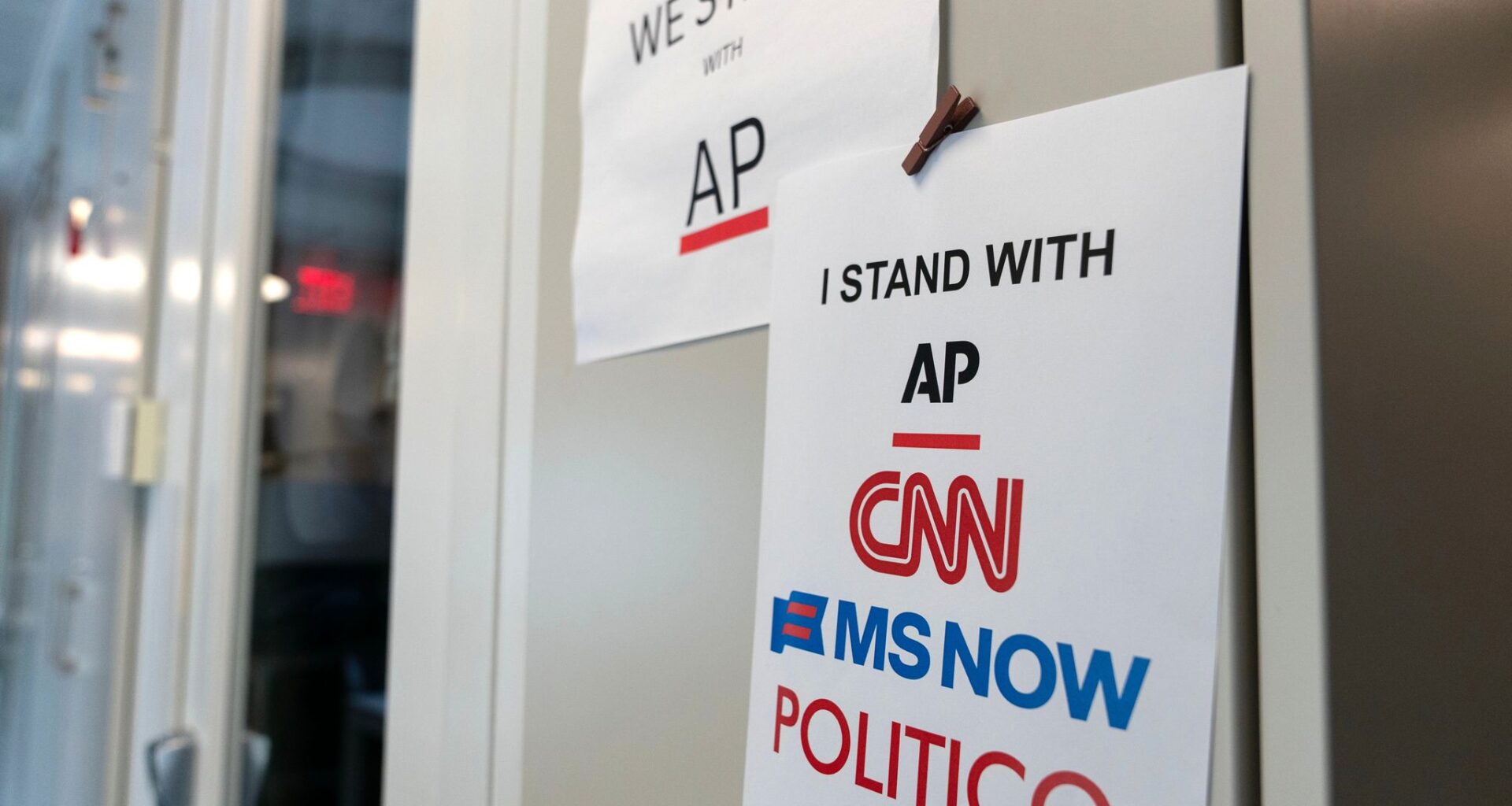
A sign in support of news outlets is seen at the White House press room on Sept. 19 in Washington.
Jose Luis Magana/AP Photo/Jose Luis Magana
Teaching the First Amendment
Re: “Journalists denied access to the White House,” Sunday news story.
As a high school government teacher, I always look forward to teaching the First Amendment. I begin with a principle that captures its essence: This sacred right protects our liberty to speak without fear of government punishment. It also requires us to tolerate offensive speech.
Article continues below this ad
At that point, I hope my students begin to understand the high bar that our First Amendment sets and why vigorous, even uncomfortable, civil debate is essential to democracy.
This week has provided a striking real-world example. President Donald Trump barred reporters from CNN, MS NOW and Politico from the White House after criticizing their coverage as “fake news.” Trump feels that journalists should report only what he deems credible.
The three news organizations rightly maintain that the selective denial violates their First Amendment rights.
That dispute raises the kind of constitutional question I want my students to wrestle with: Where does the government’s authority end, and where does the First Amendment’s protection of a free press begin?
For my students, the lesson is valuable. First Amendment protection matters most when speech is challenging or critical.
Article continues below this ad
Andrew L. Norton, Mesquite
A plan for ERCOT
The energy-only scarcity pricing model that ERCOT has been using since 2006 is not getting enough power plants built for reliability. The electric grid is relying mainly on solar, wind and batteries, but they will not be enough to supply the load growth that ERCOT predicts by 2032.
There is no reliability obligation in the existing ERCOT model that requires those entities that sell power to the public to buy power from power plants. The regulated utilities in the past had an obligation to serve the public with enough power plants. But Retail Electric Providers have no such obligation. Instead, they must purchase high-priced energy during shortage periods.
Scarcity pricing is increasing customer electric bills, increasing profits for those who sell or trade, but it’s not getting enough plants built.
Article continues below this ad
My proposed solution is simple. Require all retail providers to purchase enough power from power plants based on the ERCOT Reliability Standard using Power Purchase Agreements to replace scarcity pricing.
Generation companies will compete which will lower the cost of the PPAs that the retail providers must pay for. Lower cost means lower electricity rates for the public that they serve. Competition will be increased, and reliability will be protected. ERCOT needs reliability, not scarcity of supply.
Thomas L Darte, Greenville
Retired utility executive and former ERCOT board member, 1999-2000
Diesel fuel prices
There’s a maxim in the petroleum industry I learned decades ago: The price of diesel fuel changes inversely with the demand for gasoline.
Article continues below this ad
Here’s why. The reason a barrel of crude is refined is to supply the demand for gasoline. All the rest — diesel, jet fuel, home heating oil, lubricants, even the higher distillates — all just come along for the ride.
In case you have not noticed, the rise in sales of electric vehicles is having a significant effect on the demand for gasoline. You might notice significant rises in the cost of other items. One you might notice is the cost of new tires. The rubber is a petroleum product, and the raw material cost has been rising 16% to 18% per year for quite a while. Check out nylon clothing. Same deal.
In the news on Sept. 22, President Donald Trump is considering enforcing a moratorium on the export of diesel fuel. This could help bring down the price a bit. But overall, we will still be looking at that demand for gas situation.
Thinking ahead, if electric vehicles become ever more popular (I have a Tesla, by the way), the day may come where a barrel of crude is refined to get the diesel and jet fuel, and the price of gas just may drop like a stone. Then again, a new set of tires might triple in cost. We’ll just have to see.
Kenneth K. Ebmeier, Round Rock
Article continues below this ad
Regarding dialysis patients
When I was first diagnosed with chronic kidney disease in my 20s, I had never heard of it. I thought I was healthy. But by 2021, I was on dialysis. My first months in-center were awful. Between painful needle sticks and blood pressure crashes, I was ready to quit.
Thankfully, a good doctor helped me transition to home hemodialysis. I had bariatric surgery, lost weight and got on the transplant list. But the financial challenges remained. I was working and had private insurance, with Medicare as my secondary. That coverage helped me survive. When I left my job, I was terrified I’d lose it all. I went a month and a half without private insurance. While Medicare covered my care, not every patient is as lucky.
Now there’s a looming crisis: New dialysis patients are at risk of losing their private insurance almost immediately because a recent Supreme Court decision lets insurers push them off. That puts patients at risk of financial ruin — and even worse, it can reduce their chances of receiving a transplant.
That’s why I support the Restore Protections for Dialysis Patients Act. It would restore the 30-month grace period patients need to stay covered and stable during a life-altering diagnosis.
Article continues below this ad
U.S. Rep. Marc Veasey should cosponsor it.
Guadalupe Ayala, Grand Prairie
The job of a U.S. rep
The job of a U.S. representative is to speak and vote in Congress on behalf of the people in her district. Yet Veronica Escobar of El Paso championed the elimination of commercial traffic at the Bridge of the Americas without an economic-impact study to measure the consequences.
When the Hunt Institute at the University of Texas at El Paso subsequently documented a $36.6 billion fallout in foregone trade, Escobar continues to insist that the decision is final.
Isn’t it time for El Paso to consider electing someone who understands — and respects — the job description of a U.S. representative?