

DEL VALLE, Texas — Theranos founder Elizabeth Holmes is scheduled to move to a residential reentry center (RRC), or halfway house, in Del Valle next August, ABC News reports.
Per ABC News, an update via the Department of Justice’s Victim Notification System says Holmes will be relocated to Austin Transitional Center next August
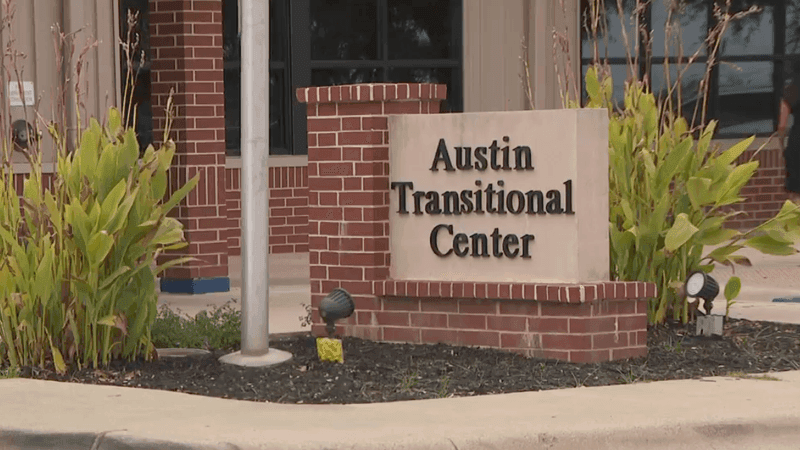
ABC News reports that Elizabeth Holmes has been approved to transfer to Austin Transitional Center in Del Valle in August 2027 (Photo: CBS Austin)
Holmes is currently in federal prison in Bryan, Texas, convicted on federal charges after defrauding investors of hundreds of millions of dollars.
She claimed her blood-testing startup, Theranos, would revolutionize blood testing using a method that could yield results with small volumes of blood.
Holmes was originally sentenced to serve 11 year sand 3 months in federal prison before a judge reduced her sentence to 10 years and 3 months. Her final release is scheduled for February 2030.
PREVIOUS COVERAGE | Holmes gets more than 11 years in prison for Theranos scam
Geoffrey Loveless, who we met at a business near the Austin Transitional Center, said he is frustrated to learn Holmes could be transferred from prison.
“She’s gonna get, you know, a slap in the hand or slap on the wrist, while there’s people here at Texas going away for years at a time,” he said.
However, legal experts say halfway homes are a run-of-course part of the justice system for many inmates.
Dustin Rynders, Legal Director at the Texas Civil Rights Project, explains that residents of RRCs are still in federal custody.
“It’s not the same as being released by in any stretch of the imagination,” said Rynders.
“A lot of times people who have spent long periods of time in prison are more likely to recidivate,” he explained. “And so it’s actually, halfway houses are considered a best practice to allow people to get closer to community settings and earn privileges gradually while still under robust supervision.”
Mark Osler, Chair in Law at the University of St. Thomas School of Law, explains that halfway houses are a common transition inmates make toward the end of their sentence.
With Holmes’ final release date scheduled for February 22, 2030, he explains that Holmes may have been able to expedite the process through the First Step Act, federal criminal justice reform passed in 2018.
“We see this coming a lot earlier for people than we used to in many instances, because as of 2018, they’re able to accumulate credits that they couldn’t before under the First Step Act for taking programming and things like that. And that’s likely what has advanced the timetable in this particular case.”
Osler also said it is possible that Holmes could have permission to temporarily leave the grounds of the RRC if she is transferred.
“It varies, but generally, they are allowed to leave the property for designated tasks. Sometimes it’s for work. Sometimes they’ve begun a job. Sometimes, it is going to be for therapy, medical treatment, things like that,” he said.
CBS Austin reached out the Federal Bureau of Prisons (BOP) to confirm reports of Holmes’ relocation next year.
The BOP responded that it “does not discuss the conditions of confinement for any individual, including release plans” and that “specific designation information cannot be released until after an individual arrives at their designated institution.”
The BOP did share that it “assigns individuals to facilities based on several factors.”
“These include the level of security and supervision required, medical or programmatic needs, separation or security considerations necessary for the individual’s safety, and other relevant factors, such as proximity to the individual’s release residence,” the BOP wrote.
CoreCivic, the company that operates Austin Transitional Center, wrote to CBS Austin that it “does not determine when an individual is transferred or placed into our care.”
“Those decisions rest entirely with our government partners,” CoreCivic continued.
More on Residential Reentry Centers (RRCs)
Kevin Collins, a criminal defense attorney and former federal prosecutor, provided CBS Austin with answers to a series of questions.
How does a federal inmate become eligible for transfer to a residential reentry center (RRC)? What factors affect eligibility? Sentence length, conduct, charges, something else?
“BOP makes that decision on an individual basis as an inmate approaches the end of the sentence. The BOP looks at the nature of the offense, the inmate’s history, conduct while in prison, public-safety concerns, the sentencing judge’s recommendations, and available community resources. Under the Second Chance Act, BOP can place an inmate in an RRC for up to the final 12 months of the sentence. First Step Act credits can affect when an eligible inmate becomes eligible for community placement—effectively speeding that moment up.”
Who decides the length and location of placement?
“The Bureau of Prisons does. The inmate’s prison unit team makes a recommendation, the Warden reviews it, and BOP’s Residential Reentry Management office works the location and the date. The RRC facility is often near the community where the inmate will be released. I think “bed availability” affects these decisions.”
What does a federal RRC do, and how is it different from being released from prison?
“The RRC is a transition between prison and full release. The inmate is still serving her federal sentence and remains in federal custody. The RRC provides structure and supervision while eventually helping the person find employment, arrange housing, upon full release, receive counseling, and prepare to return to the community.”
What freedoms does a resident have in an RRC, and what remains restricted?
R”RC is definitely better than prison. But residents are still subject to monitoring and control. A resident can generally leave for approved purposes such as work, looking for employment, counseling, visits, or other authorized activities. But the resident must sign out, her whereabouts are monitored, and she can be tested for drugs and alcohol. She is still accountable to BOP.”
Is this an ‘easy way out’ for federal prison inmates?
“I would not characterize it that way,” Collins wrote. “Congress deliberately created RRCs as part of the federal sentence and reentry process. The person is still in federal custody and still serving the sentence. It is less restrictive than a prison, which is intentional—the purpose is to move someone gradually from incarceration back into employment, housing, family responsibilities, and ordinary life, rather than simply opening the prison door one day and sending them home.”