
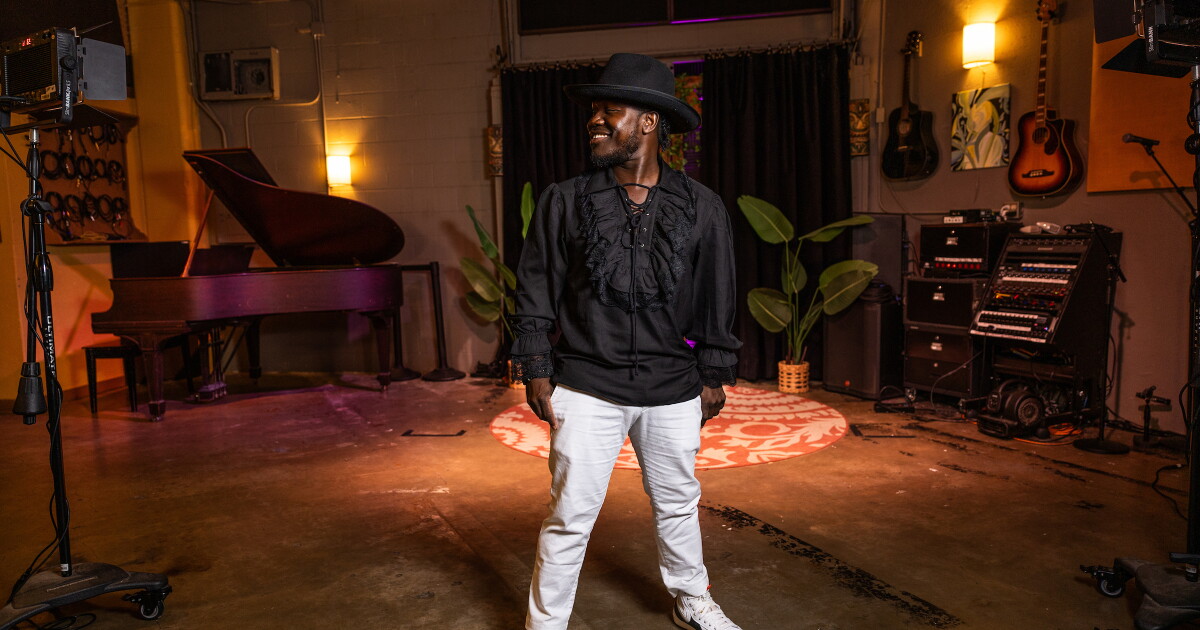
At his first-ever headline concert in Austin, soul-rock singer Pascal Kerong’A showed little trace of jitters as he led his four-piece band through a pulsing, sweaty set at How Much?! Studios in Central Austin.
But it wasn’t just his standout stage presence that made the night distinctive. Kerong’A had sold tickets before he had the venue booked.
Like many emerging musicians in Austin, Kerong’A had little local ticket-sales history. He had toured with Austin songwriter Bill Callahan and later appeared on his live album, Resuscitate! But he didn’t have the track record venues wanted to see before putting him on their calendars.
“I told [my fans] that venues want proof, and I don’t have any proof. And I want you guys to be my proof.”
Pascal Kerong’A
The 42-year-old had to convince club owners and promoters that people would pay to see him.
He decided to bet on his fans’ support. He picked a date in early September and created a ticket page on the event platform Luma. He told his followers what he was trying to accomplish and asked them to buy tickets anyway.
“I told them that venues want proof, and I don’t have any proof,” Kerong’A said. “And I want you guys to be my proof.”
Bandmates and collaborators were skeptical. Someone interested in managing Kerong’A told him bluntly: “You are not Beyoncé.”
Kerong’A said he had moments of doubt.
“I was kind of fighting with myself as well,” he said. “But in the end, I was like, I’m gonna do this. It doesn’t really matter.”
Initiative and resourcefulness
His fans were receptive, buying 17 tickets in the first week and 30 by the end of the second. At that point, Kerong’A could show venues he had what it takes to draw a crowd.
“Music is something that I quit my economics degree and a guaranteed life for,” said Kerong’A, who came from the Democratic Republic of Congo in 2014 to study at UT Austin. “And so this is it, I’m gonna go for it, just do it my way since nobody is basically giving me that opportunity, I’m going to create my own opportunity.”
Kerong’A brought his unorthodox show pitch to HowMuch?! Studios, a recording and video production studio that also hosts concerts and private events.
What stood out to co-owner Paul Chapin was that Kerong’A was not simply asking for a room and hoping an audience would materialize.
“A lot of people throw shows around town, and they just expect everybody to show up,” he said. “But this guy, even before he had a venue picked out, he had already had the show in mind. He was already selling tickets and had the vision for how he was going to expand his reach for the show.”
On top of the initiative and resourcefulness Kerong’A showed, Chapin said, he came across as unusually direct about what he wanted to accomplish. Chapin and co-owner Phil Kegley quickly decided they wanted to be involved, even though the studio might normally hesitate to take on a show like that on short notice.
“We didn’t want to be the guys that skipped on this opportunity,” Chapin said. “We feel like it’s just as much of an opportunity for us to work with him as it is for him to have a venue here.”
‘Real data’
For Zach Ernst, who handles bookings for legendary blues club Antone’s as well as the Paramount and State theaters, Kerong’A’s approach immediately made sense, even though he hadn’t heard of him or his ticket-selling strategy before being told about it during an interview.
Ernst said Kerong’A’s strategy offered an unusual way to answer one of the central questions facing a booker: Can this artist actually bring paying customers through the door?
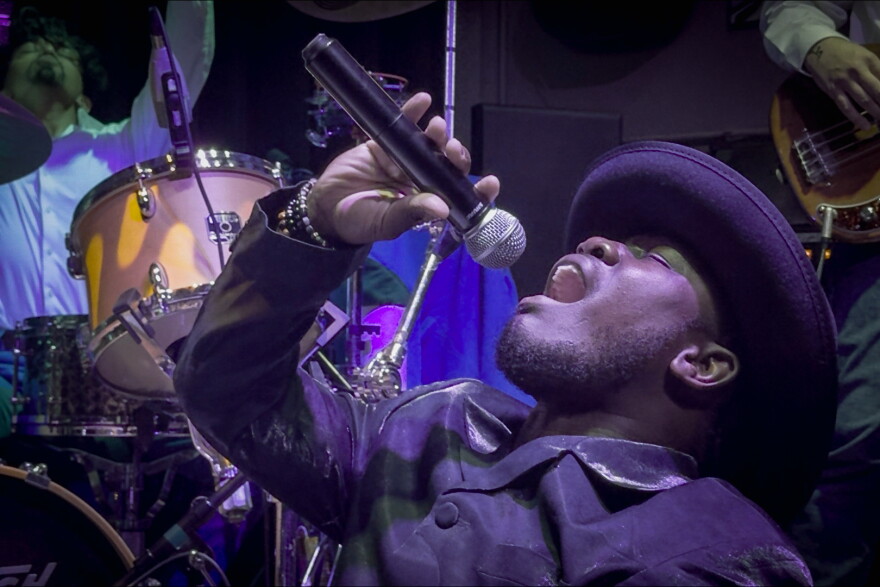
Courtesy of Pascal Kerong’A
Kerong’A performs at How Much?! Studios in Central Austin.
At Antone’s, Ernst said, he often encourages developing musicians to take a traditionally slow night — typically a Tuesday, Wednesday or Sunday — and prove they can turn it into something. The expectation is not necessarily a sellout, but evidence the artist can promote the show and build an audience that will show up.
“If I can give you kind of an off night and you can make a thing, I’m not asking you to sell it out,” Ernst said. “I’m asking you to prove that you can kind of hustle and you can get people to come.”
Ernst said social-media follower counts or monthly streaming numbers carry less weight for him than tangible evidence of an artist’s ability to attract an audience. He looks at “real data” like where musicians have played, how professionally they communicate and, whenever possible, turnout from previous shows verified by other bookers and club owners.
Ernst called Kerong’A’s idea clever and said he had not heard of another local artist approaching the problem quite that way.
“For him to be building that list organically, selling the tickets himself and all that, is really cool,” Ernst said. “I would have taken that deal.”
A victory
Kerong’A said How Much?! Studios charged him $800 to use the concert space, but took no cut of ticket or merchandise sales.
The singer was still responsible for making the economics of the show work, and the math was tight. At $15 per ticket, 57 advance sales totaled $855 — barely more than the venue fee before accounting for paying his band or other costs.
But the experiment did give Kerong’A a documented record of people willing to pay to see him perform originals “My Goodbyes” and “Never Gonna Give Up” mixed in with covers like an up-tempo, muscular take on Seal’s “Crazy.”
For Kerong’A, the audience represented much more than a number to put in future booking emails. When he first began selling tickets, he said he would have considered getting more than a handful of fans to turn out as a victory.
“If I could get between 15 and 20 people to walk through the door to come to this show, that to me would be almost like winning a Grammy,” he said.