
TEXAS — Friday night lights is kicking off across Texas. But there’s something different about high school football games this year.
The start time for many matchups has been later. It made many curious as to why. It turns out the later game times are connected to a new record set this month, but not on the scoreboard. This record has to do with the heat.
This month, North Texas hit a new record for the number of days with triple-digit temperatures.
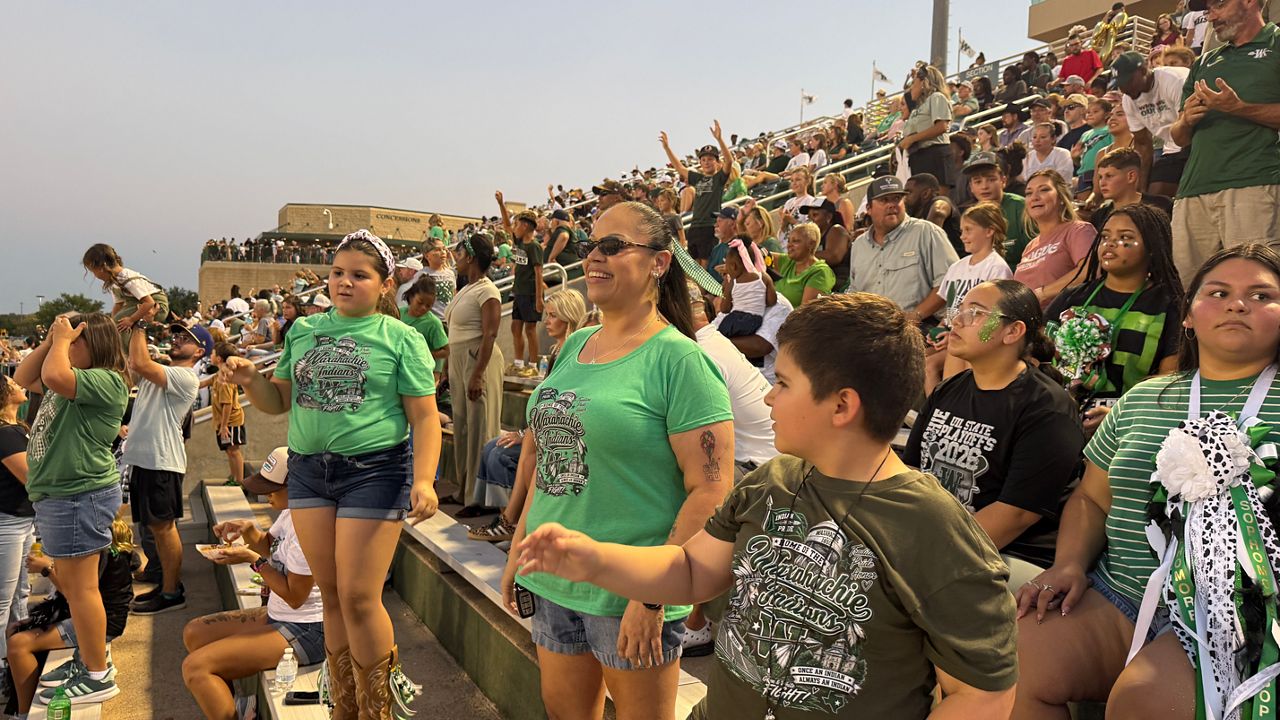
Fans attend a homecoming football game at Lumpkins Stadium in Waxahachie, Texas. (Spectrum News 1/Blessing Iwuchukwu)
With cheers that can shake a stadium, Fridays in fall mean football in Texas.
Tabitha Hall and the kids she babysits are there with bells on — literally. They jingled while connected to her decorated cowboy boots.
But that’s not all she brought to Lumpkins Stadium in Waxahachie.
“We have an umbrella to try to keep us a little bit cooler because it is crazy hot here in Texas this year,” said Hall, a Waxahachie mom.
She and her fellow fans are covered by shade, unlike their opponents on the other side.
“Luckily, we’re really blessed with this particular stadium and the way the sun lays and the way the stadium is built,” said Randy Fouse, Waxahachie ISD color guard parent.
Some of you may be thinking, look – it’s Texas. Of course it’s hot! But this year has been really, really hot.
As football games began in August, North and Central Texas scored their fifth-hottest August on record.

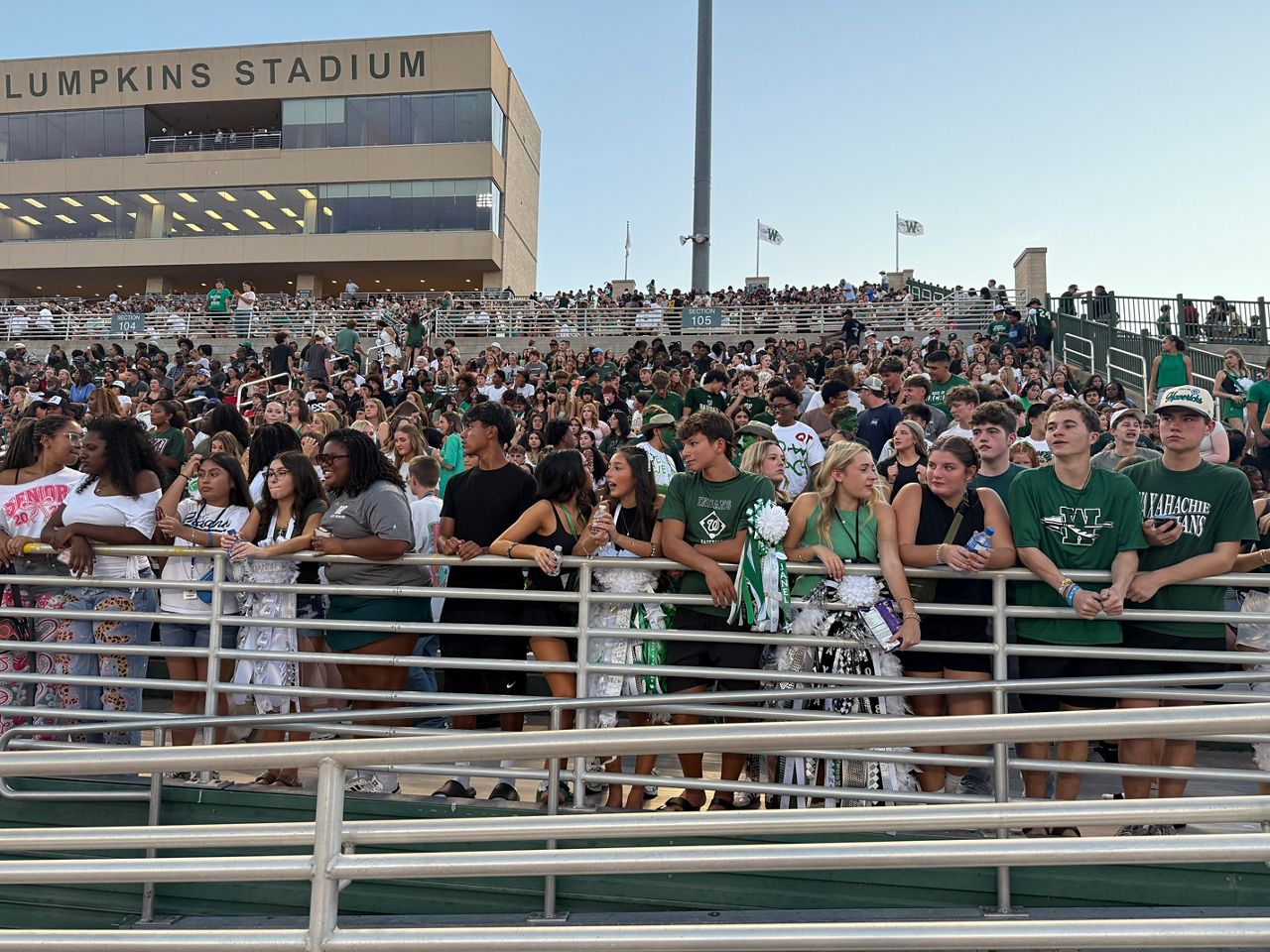
A fan attending a football game. (Spectrum News 1/Blessing Iwuchukwu)
We learned that heat pushed school districts to break game start time traditions — like Richardson ISD in North Texas.
“They had posted that the start time was delayed until 7:30 for heat reasons,” said Chris Terry, Richardson ISD band parent.
Thirty minutes can make a difference.
“Super challenging when start times are changing or the end times are different, and you don’t know if you’re coming or you’re going, and the players are exhausted. A little bit easier for the upperclassmen since they do drive and they get to be in charge of their schedules a little bit. But I mean, the kids are, I mean, they’re tired. The boys are tired at the end of the day,” said Erica Love, a Richardson ISD football parent.
If schools don’t push back the start time to when it’s cooler, the whole game could be at risk.
To beat the heat, the University Interscholastic League — the group that regulates public school extracurricular activities — requires schools to monitor temperature, relative humidity, wind speed and solar radiation from three different thermometers.
If it’s too hot, expect more frequent hydration breaks, adjusted practice times and more.
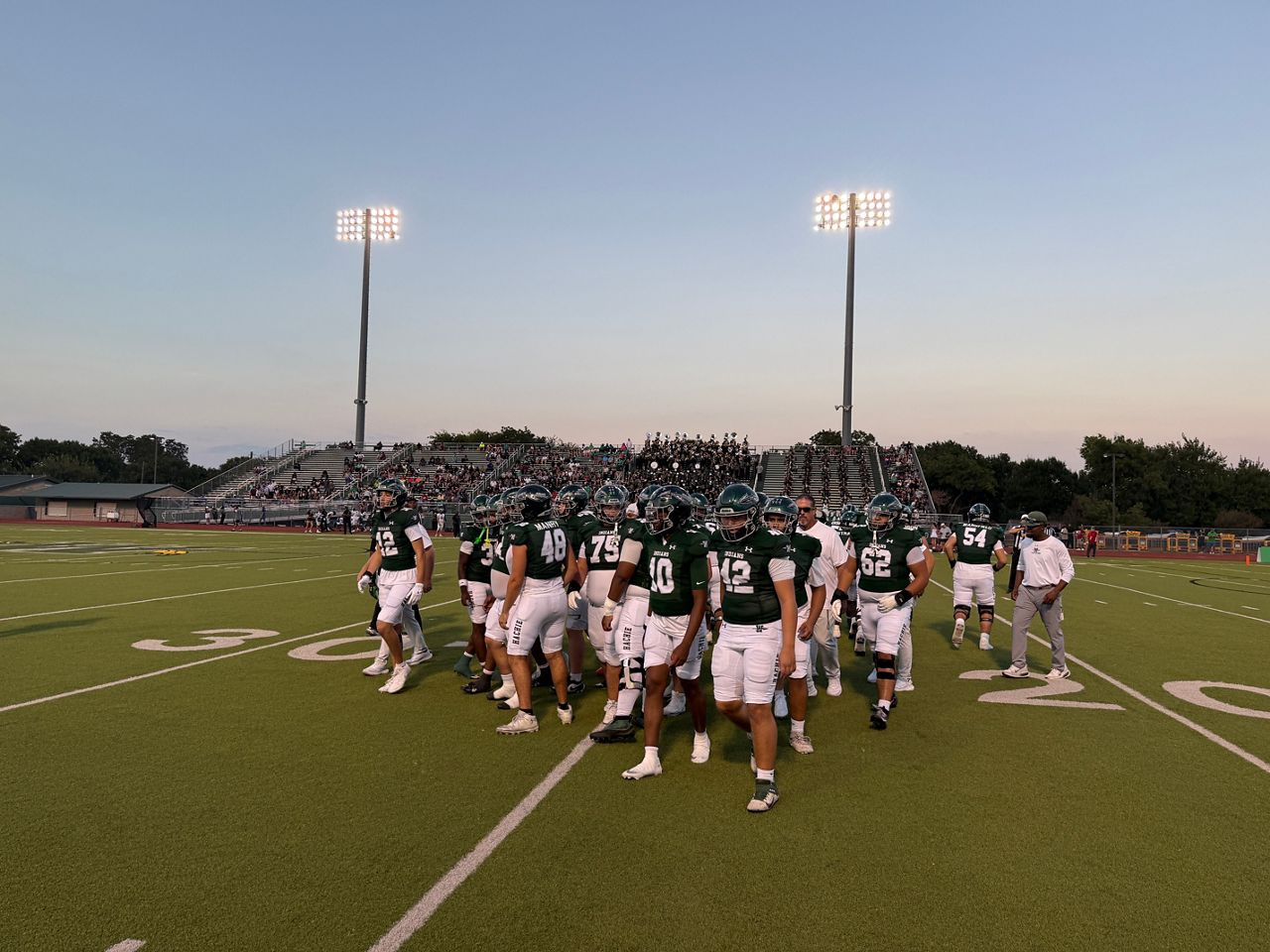
Football players compete on artificial turf. (Spectrum News 1/Blessing Iwuchukwu)
Those were just suggestions before a new mandatory enforcement went into effect on Aug. 1.
But all those required readings measure the air. We wondered about the impact of the Texas sun on the field, as in the actual ground. Spectrum News learned there’s no safety protocol in place for artificial turf.
Researchers at Pennsylvania State University discovered surface temperatures on astroturf can be up to 50 degrees higher than natural grass. Injuries go up too.
NFL data from 2021 showed lower extremity injuries are 16% higher in games played on turf compared to grass.
Spectrum News monitored past UIL committee meetings and found an exchange acknowledging the danger.
“The temperature at Memorial Stadium on the field was 163 degrees. What was the wet-bulb reading? Are they related? And so, I think as we go down the road with our protocol, we need to keep that in mind,” said Jesse DeLee, UIL Medical Advisory Committee chair.
“So, in other words, the measurement could be done on the track, but on, for instance, a synthetic surface it might be quite a bit different. Is that what you’re saying?” said Dr. Al Hergenroeder, a primary care sports medicine specialist at Houston-Baylor College of Medicine, Texas Children’s Hospital.
“Yeah,” said DeLee.
“Yeah, I’m not aware of that,” said Hergenroeder.
For context, Spectrum News polled nearly a dozen of the largest school districts across the state and found most do use artificial turf fields for high school football games with some exceptions.
All of Dallas ISD’s nine main stadiums have turf, except one. But most Texas schools do practice on fields with natural grass. Turf is for game day.
While there may be no statewide standard to monitor turf temperatures, some of these schools are tackling the issue themselves.
Cypress-Fairbanks ISD in the Houston area tells Spectrum News that eight of its football fields use a special turf that keeps the surface up to 30 degrees cooler than traditional turf fields.
Back in Waxahachie, where the homecoming game was heating up, the new safety protocols did not go unnoticed by eagle-eyed fans.
“The district is doing right now. They’re helping them stay hydrated by pickle juice. Lots of water. They’re supposed to bring ten bottles of water a day. Even in the morning, when he gets up at 5 in the morning, he’s chugging down 64oz of water, so he won’t cramp up,” said Mark Piper, Waxahachie ISD football parent.

Hydration station at a high school football game. (Spectrum News 1/Blessing Iwuchukwu)
“I noticed that they have a lot more people with the Gatorade water and stuff, the jugs that have Gatorade. And then there’s a lot of parents will keep the wet towels for their, their athletes,” said Hall.
As health remains top of mind this season, Texas schools’ reaction to record heat could be driving the nation in proactive solutions.
“Texas moves the needle when it comes nationally related to this topic especially,” said Ray Zepeda, UIL athletic director.
So that when a student athlete takes the field, they’re only sweating over the plays they make and touchdowns they score.
The UIL Medical Advisory Committee said they plan to meet again in April. They said they will share data from the first season since the new requirement went into effect.