
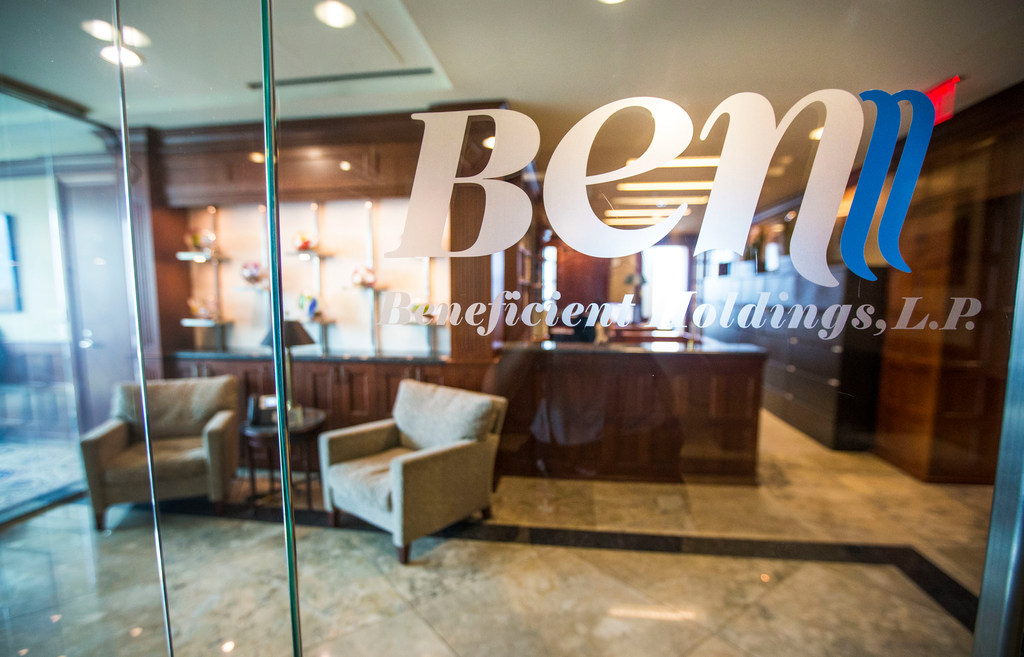
The company logo at Beneficient, a new financial services company in Dallas that turns assets into cash for high-net-worth individuals, institutions and private equity funds.
Carly Geraci/Staff Photographer
Months after its founder was convicted for charges related to a $150 million fraud scheme and in dire financial straits, Dallas-based Beneficient has announced its plan for a path forward.

As detailed in a Wednesday news release, the alternative asset company will pursue the liquidation of founder Brad Heppner’s equity and elimination of the $130 million in debt remaining on Beneficient’s balance sheet that was a cornerstone of Heppner’s fraud scheme. Beneficient says it is seeking a consensual resolution with Heppner before he is set to be sentenced on Oct. 21 for charges carrying a maximum combined sentence of more than 60 years, but it is prepared to pursue all possible remedies and claims if an acceptable resolution cannot be reached.
“Since the conviction, we have focused on pursuing a resolution that fully addresses Mr. Heppner’s misconduct and the harm it caused Beneficient,” CEO James G. Silk said. “Our objective is a complete separation through the elimination of the purported HCLP debt and all of Mr. Heppner’s remaining equity, contractual and governance interests in the Company. We believe that outcome is both just and necessary to protect Beneficient from further harm. Achieving it would transform our balance sheet, unlock substantial value for our stockholders, and position the Company and its operations to realize its full potential.”
Article continues below this ad
Heppner, 60, was arrested in November and convicted in May on multiple fraud charges, a conspiracy charge and for making false statements to auditors. The indictment alleged Heppner used Beneficient as a middleman to funnel money from GWG Holdings, which operated in the life insurance sector, to a shell company he controlled.
Related story: Beneficient founder Brad Heppner convicted in $150 million fraud scheme
GWG Holdings took a stake in Beneficient in 2018, and the following year, Heppner, in his capacity as CEO, allegedly directed Beneficient to acquire the equity interests of GWG Holdings’ founding shareholders, according to the indictment. Heppner then installed himself as chairman of GWG Holdings’ board and appointed his associates as CEO and directors.
At the time GWG Holdings took a stake in Beneficient, Beneficient had a $141 million debt on its books to Highland Consolidated Limited Partnerships, or HCLP, purportedly a third-party lender that had helped get Beneficient up and running. However, it was actually a shell company controlled by Heppner, who fabricated the debt.
Then, Heppner allegedly convinced the board of GWG Holdings to transfer $300 million to Beneficient, ostensibly to pay down its debt, and Beneficient ultimately transferred about $150 million to HCLP. That money flowed through entities Heppner controlled, covered up by fabricated documents and board meeting minutes, while he spent millions on renovating his Highland Park mansion, private air travel and jewelry.
Article continues below this ad
GWG Holdings filed for Chapter 11 bankruptcy in 2022 following a U.S. Securities and Exchange Commission investigation into its accounting practices, leaving thousands of investors holding the bag for more than $1 billion GWG Holdings owed them.
Brad Heppner, CEO of The Beneficient Company Group, poses for a portrait at Beneficient in Dallas on Aug. 24, 2018. Beneficient is a new financial services company in Dallas that makes turning assets into cash easier for high-net-worth individuals, institutions and private equity funds.
Carly Geraci/The Dallas Morning News
Heppner founded Beneficient in 2003 to help the ultrawealthy turn nonliquid assets into cash and became a prominent local businessman. In 2020, Heppner and his wife, Aurelia, donated $11.5 million to Southern Methodist University, where Heppner is an alumnus.
Following GWG Holdings’ bankruptcy, Beneficient went public via a SPAC merger in 2023 and has been in financial tumult ever since. Its stock price opened at around $16 a share, but the company has routinely run afoul of Nasdaq’s rules, risking being delisted as a penny stock. It has initiated two reverse stock splits, 1-for-80 in 2024 and 1-for-8 in 2025, and is still trading at barely above $1 a share as of Friday. It has reported a net income loss every year but one since going public, including a loss of $2 billion in 2024. Its stock price briefly jumped to about $3 on Wednesday’s announcement it would seek to cut out Heppner, but has since fallen again.
Article continues below this ad
According to Wednesday’s release, Heppner’s stock in Beneficient has an aggregate liquidation preference of $850 million, which the company is seeking to convert into 162,132 shares of the company’s Class A common stock. It is also seeking to void any remaining contractual arrangements with Heppner, who resigned as CEO in summer of 2025, and associates without paying the $88 million purportedly owed under those arrangements.
“The criminal trial revealed overwhelming evidence that Heppner fraudulently concealed his control of HCLP and fabricated the purported HCLP debt. The Company believes the conviction provides substantial support for its position that the purported HCLP debt is invalid and unenforceable,” the release said. “The Company further believes that Heppner’s fraud and other misconduct support substantial claims for damages and other relief, including the elimination of the Heppner Equity Interests and the termination of the Heppner Agreements.”