
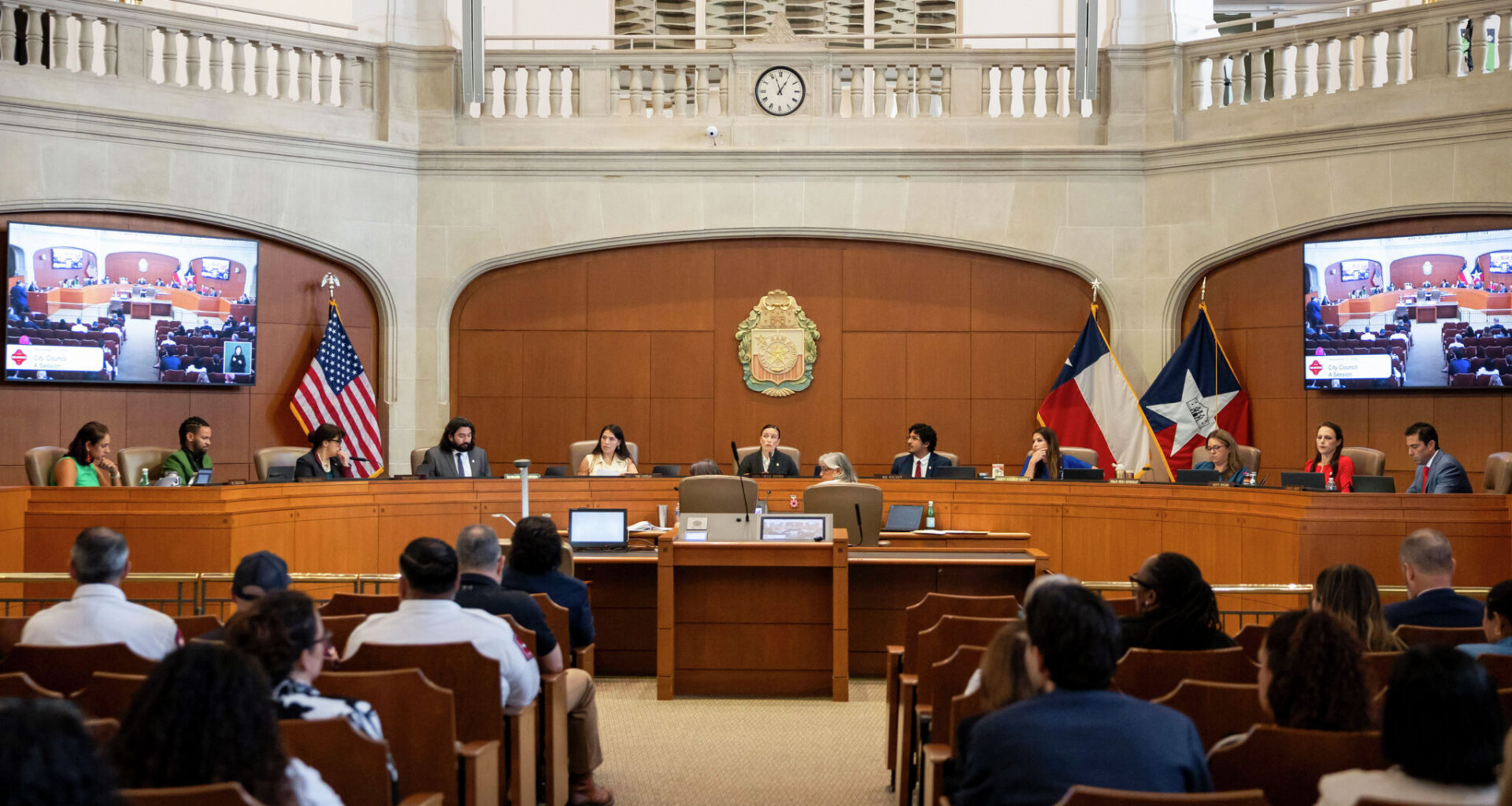
The San Antonio City Council at the Sept. 18, 2026, meeting, when members adopted the new budget in a split vote.
Katina Zentz/San Antonio Express-News
Mayor Gina Ortiz Jones immediately went on the offensive after voting against next year’s city budget.

She blamed her City Council colleagues for adopting a $4.4 billion budget that in her view was beyond city government’s means — and for approving a 3.9% property tax rate hike to help pay for it. She also criticized City Manager Erik Walsh and his staff for not offering up a more fiscally responsible spending plan.
Article continues below this ad
“Ultimately, there wasn’t a big enough appetite to do things differently,” Jones said at the Metro SA Chamber’s City Vision event Monday, which five of City Council’s 10 members attended.
City budget writers, with direction from council, had to close a $158 million gap between revenue and expenses over the next two years.
As Jones puts it, few council members were willing to consider her spate of proposals to tap sales and hotel tax dollars to pay for a handful of programs and grants for San Antonio nonprofits. The idea was to stop paying for them out of the city’s $1.76 billion general fund, which funds street repairs, fire and police protection, and other basic services.
But she didn’t try to rally a majority of council members to support her vision for city spending — which is a basic move for a mayor. Instead, she largely laid out her ideas in memos, brief conversations with a few members and news conferences.
Article continues below this ad
Her approach to City Council boiled down to “take it or leave it.”
Jones told the San Antonio Express-News that if council had been focused on not raising taxes, rethinking general-fund expenses and helping as many residents as possible, “then we can have some substantive conversations about paths forward.”
“That’s my going-in position,” she added. “At the end of the day, I can only control myself.”
Councilwoman Teri Castillo said Jones’ conversations with her largely amounted to the mayor telling her about a budget proposal instead of asking for her feedback.
Article continues below this ad
“At most, it’s to check a box to say she called someone,” the West Side councilwoman said.
City Council appeared to be fractured and directionless as the budget vote approached, and Jones caught nearly everyone by surprise when she pitched 1.6% across-the-board cuts to save $28 million and avoid a take hike — which the council’s progressive members criticized as irresponsible.
But nothing came of her proposal because Walsh said his staff didn’t have enough time to identify what would be on the chopping block.
The next day, Jones joined North Side council members Marina Alderete Gavito, Misty Spears and Marc Whyte in voting against both the budget and the tax increase. City Council’s other seven representatives voted for both.
Article continues below this ad
The mayor and council are responsible for devising a budget “that is good for the city,” said political consultant Brielle Insler, who ran then-Councilwoman Melissa Cabello Havrda’s 2025 mayoral campaign against Jones and more than 20 other candidates. “A mayor voting against it means that you didn’t accomplish that task.”
Economic divide
Jones said at the chamber event that City Council “punted on important allocations and reasonable cuts that could have saved our neighbors from a property tax increase during this affordability crisis.”
The city had not raised its property tax rate since 1992. The new budget raises it by two cents, to just over 56 cents per $100 of assessed value. That will cost the average homeowner with a homestead exemption about $35 more on their annual tax bill.
Article continues below this ad
The new budget and tax rate kick in Oct. 1, the start of fiscal year 2027.
Councilman Edward Mungia said Jones’ characterization was unfair to City Council members who weighed the costs of cutting services many of their residents rely on versus asking them to pay a few dollars more in property taxes a month.
“The perception that we didn’t do enough doesn’t sit well with me — it’s not a team message,” said Mungia, who represents District 4 on the Southwest Side. “To criticize our vote as we didn’t care or we were lazy is not a productive conversation.”
Ultimately, it was the council members from San Antonio’s poorest districts — including Mungia’s — who supported the tax hike.
Article continues below this ad
Human Services Director Melody Woosley told council in late August that the 48 nonprofits that will receive a total of $5.1 million in general-fund dollars next year will serve 9,300 residents, 70% of whom live in council Districts 1 through 5. Those districts include the East, West and South sides and downtown.
The organizations include the Boys & Girls Club, the YWCA of San Antonio, Goodwill Industries, Meals on Wheels of San Antonio and the Alamo Area Rape Crisis Center. Not raising the property tax could have resulted in cutting city support for them in half.
“Slashing funding doesn’t do half of this city justice for the services that they need,” Mungia said ahead of the council’s Sept. 18 vote to adopt the budget. “When we talk about something to lift all boats — when half of this city is continuing to deal with poverty, drainage issues, infrastructure concerns, lack of programs for their own families and kids, the bottom will fall out of this city.”
Jones has cast herself as a fighter for San Antonio’s most vulnerable residents, whom she says city leaders have overlooked as they’ve prioritized flashy development projects aimed at San Antonians and visitors with money to spare — such as the planned $1.3 billion Spurs arena downtown.
Article continues below this ad
But her decision to vote against the budget and tax increase set her against the council members who represent San Antonio’s struggling neighborhoods.
The no vote
Bert Santibañez, a Democratic political strategist who worked on Jones’ mayoral campaign last year, views her vote against the budget as political “positioning,” not governing.
“Voting no consistently gives her a record she can point to come reelection time, that she was with residents when the rest of council wasn’t,” he said.
Article continues below this ad
The next city election isn’t until November 2029, but the race is expected to draw current or former City Council members, whether or not Jones decides to seek reelection. Some political insiders speculate that Jones could launch another congressional bid, having twice sought the Congressional District 23 seat seat prior to running for local office.
The budget vote is one of many that Jones has lost since taking office in June 2025 — and she doesn’t appear to be bothered by that record, even though a mayor who routinely loses major votes effectively isn’t leading City Council.
A month before the budget vote, Jones’ push to have San Antonio voters decide whether the city helps finance the new Spurs arena failed in a 5-6 vote.
Insler, the political consultant, said mayors and council members usually collaborate because they want to advance the policy changes and projects they campaigned on.
Article continues below this ad
“They really do want to work together because they know they were elected to serve constituents, and they all have goals of moving the city forward,” she said.
But Jones doesn’t prioritize sitting down with council members to learn about their goals and sell them on hers. Instead, she regularly appears on Q&A segments on TV and radio news programs, holds news conferences on the steps of City Hall and films social media videos in which she asks residents to contact their council members to urge them to back her proposals. That was largely her approach to her budget proposals.
“I think the win for (Jones) is being able to tell constituents, ‘I pushed back on this thing I think is bad, and I was on the right side of history,’” said political consultant Andrew Solano, who ran tech entrepreneur Beto Altamirano’s mayoral campaign last year.
Solano also worked as a council aide when Ron Nirenberg was mayor and served as Mayor Ivy Taylor’s council liaison, which meant working closely with members’ offices on policy ideas.
Article continues below this ad
Whyte said it was not until the eve of the budget vote that Jones approached him about how they could avoid a tax hike. Whyte, Spears and Alderete Gavito had been adamantly opposed to raising the tax rate since budget talks began in May.
Jones frustrated the three when she proposed cutting every city department budget by 1.6%.
“If she would have said, ‘Let’s do the cuts’ six weeks ago, I think we would have actually avoided the tax hike,” said Whyte, who had proposed cutting department budgets by 2%. “Rather than focus on the one path that we had to avoid the tax hike — to make strategic and reasonable cuts — she was doing all these other things.”
Alderete Gavito said Jones never spoke to her one-on-one about the budget. Councilwoman Sukh Kaur, who represents downtown and parts of the North Side, said she didn’t hear from the mayor either.
Article continues below this ad
This isn’t Congress
Jones’ contrarian approach has gotten results. She’s focused public attention on longstanding city practices or policies that previous mayors and councils hadn’t questioned, particularly those that have benefited developers and other business interests.
One example: how the city uses special taxing districts, known as tax increment reinvestment zones.
TIRZs are intended to encourage private investment in blighted areas. The city essentially freezes property values when it creates a zone, and as developers build housing, stores and offices within the boundaries, those values rise. The city then uses the resulting increase in tax revenue to reimburse developers and nonprofits for public improvements, such as building sidewalks and drainage.
Article continues below this ad
Some of the city’s nine zones have raised hundreds of millions of dollars — which would go into the city’s general fund to help pay for services if it weren’t for the TIRZ capturing that money. (For their part, developers say that bounty of tax revenue exists solely because of the tax zones, and that the blighted areas would have remained so without them.)
Jones has been adept at focusing public attention on TIRZs. She has referred to the city’s wealthiest zone, the Midtown TIRZ — which includes, and has benefited, the luxury mixed-use development Pearl — as an example of “modern-day redlining,” the historical practice of restricting loans and financial services because minority residents lived there.
But delivering a policy win is another story.
She failed to convince City Council to pull the plug on the Midtown zone. The council voted 7-2 to extend the zone’s end date from 2041 to 2060. And over the mayor’s objections, a majority of council OK’d using $115 million from the zone to cover the costs of issuing debt to acquire land for the new Spurs arena.
Article continues below this ad
Jones has been upfront about having little interest in counting votes to ensure she has at least five members on her side to notch a win.
Asked by a reporter after the budget vote whether she regretted not trying harder to find a potential compromise, Jones scoffed at the question.
“Leaders lead. That’s what I do,” she said. “I ask the questions to make sure we’ve got the data to make sure we have informed decisions.”
Solano said Jones operates like she works on Capitol Hill, not in City Hall.
Article continues below this ad
San Antonio Congressman Joaquin Castro can repeatedly call for U.S. Immigration and Customs Enforcement to be dismantled and make regular visits to the agency’s detention centers without constituents expecting him to deliver. His actions might move public opinion about the federal immigration agency and excite supporters, but they won’t lead to change because he’s in the Democratic minority in a politically polarized U.S. House of Representatives.
Even if Democrats flip control of the House in November, President Donald Trump will still wield veto power.
City Council is a different animal. It’s nominally nonpartisan and — because of San Antonio’s strong city manager-weak mayor system — it has traditionally relied on collaboration and compromise to function.
Article continues below this ad
“I believe the mayor when she says that she’s principled,” said Solano. “Every elected official thinks they’re principled, but they also know they have to be willing to compromise to get stuff done for the betterment of the community.”
Staff writer Megan Rodriguez contributed to this report.