
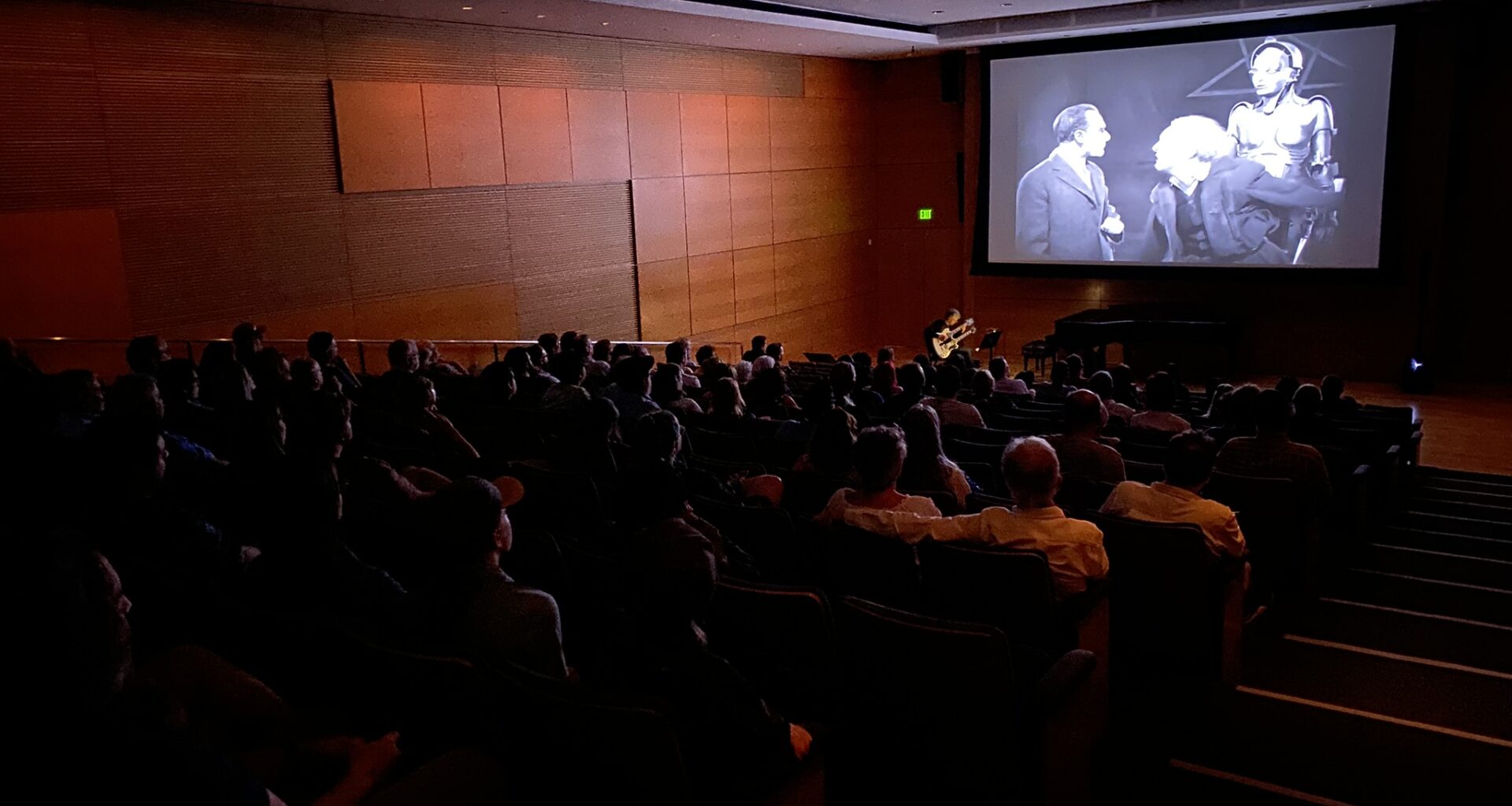
There’s a scene in the 1927 silent film Metropolis where a gong sounds as a city floods. The camera zooms in as a character bangs the gong. As the mallet raps, it fills the entire screen. It’s a striking shot. But as Austin musician David DiDonato watched the film with a friend, he didn’t think the orchestral score that syncs with the movie matches the scene’s urgency.

“It’s ‘ding ding ding,’ and I was just like, ‘This is not right,'” DiDonato recalled.
For silent-era films like Metropolis, which feature no dialog and convey the story through gestures and intercards interspersed throughout, a traditional orchestral score playing alongside the movie was the norm. But Metropolis is hardly a standard film. A pioneering work of cinema and a foundational science fiction movie, DiDonato thought it would be an interesting creative exercise to create a score that conveyed its themes of class struggle and the conflict between man and machine.
Article continues below this ad
“I just had a different vision for it,” DiDonato said. “I was thinking, ‘Shouldn’t it be some kind of heavy industrial music with big booming kick drums and heavy sounding synths and basses and guitars?'”
So around 2014, DiDonato, a veteran of countless Austin bands, sat down at his laptop to try his hand at scoring a scene from the movie showing the workers maintaining a machine that runs the city. It’s a frantic, fast-paced scene, and all the workers move in rhythm before an industrial accident befalls them. DiDonato set up a metronome and began scoring. When he was finished, he felt compelled to try another.
“I thought that it sounded pretty good and then I was like, well, ‘What about this scene here?'” DiDonato said. “I didn’t necessarily set out to do the whole movie.”
Article continues below this ad
‘It deserved that type of treatment’
The exterior of a well-lit cinema showing Fritz Lang’s ‘Metropolis’, in Vahamorf Platz, Berlin.
Hulton Archive/Getty Images
DiDonato had experience scoring movies before; In 2006, he created a “primitive” soundtrack for the 1922 silent movie Nosferatu. But Metropolis is a different beast. The work of German expressionist director Fritz Lang, Metropolis took up 4,189 meters of film; that’s about two and a half hours of movie. Upon its 1927 release, the film’s distributor enlisted an American playwright to create a simpler, shorter version of the movie that removed several of the film’s plotlines. Restorations released in the 1970s, 1980s and mid 2010s restored much of the removed material. Today, modern viewers can watch the film mostly as Lang intended, though some footage is still missing.
DiDonato went scene by scene, scoring different parts of the film. He never intended to create a whole new soundtrack; it took him hours to perfect a piece of music for 30 seconds of the movie. The project was mostly intended to keep his musical production skills sharp. But as he continued working, he realized he was making a full-fledged soundtrack.
Article continues below this ad
“If on the onset if you had said, ‘Hey, you’re gonna make this score to this entire thing,’ I would have said no,” DiDonato said. “But I just kept working at it just because, I believed in it, I liked where it was going, and I thought that it deserved that type of treatment.”
Around 2018, four years after he started making a new soundtrack to the nearly 100-year-old movie, DiDonato realized he had finished. But he wasn’t quite sure what to do with his new work. What if he muted the guitars on the soundtrack and played his guitar live alongside the music while the film played to an audience? His first-ever show was at an Austin club called North Door.
“It was just so well received and there were so many people there that I decided that this is what I should do,” DiDonato said of that first show.
David DiDonato performs his soundtrack to “Metropolis” live outside at the Texas Theatre Drive-In.
Courtesy of David DiDonato
Since that very first performance, DiDonato has taken his show on the road. He can be found at local movie theaters around Texas, on stage performing his soundtrack for Metropolis, as well as soundtracks for The Cabinet of Dr. Caligari and Häxan. He also hopes that through his performances, he can help new, modern audiences find something to love in old silent films.
Article continues below this ad

Smart, funny and sometimes unhinged look at the week that was.
By signing up, you agree to our Terms Of Use and acknowledge that your information will be used as described in our Privacy Policy.
“I think that [silent films] have a bad rep, and I think people will dismiss them,” DiDonato said. “They were being viewed as being outdated, but this is a time when they were at the vanguard of making just moving pictures in general, so there was a real excitement and enthusiasm for the craft of filmmaking.”
And for a film like Metropolis, he sees value in showing audiences a movie about tension between workers and the rich in a new light.
“All these movies have messages that are still relevant to this day, in addition to being, I would say, wildly entertaining,” DiDonato said with a laugh. “Especially if the music is right to them.”
Article continues below this ad