

Peering over the wheel of a golf cart, Alan Graham makes slow progress up and down the streets of Community First! Village, an enclave of tiny homes on the eastern edge of Austin. Graham can only make it about 15 feet down the street before he stops for a conversation with one of the residents who calls this unusual neighborhood home.
Even in the high heat of Texas summer, zinnias and cosmos are blooming wildly in yards and median strips as Graham completes his circuit. A tall man with tanned skin and an easy smile yells “Hello” from one of the communal outdoor kitchens and shares an update on his recent visit to the dentist. Another man tucks his silver hair behind his ears, offers a fist bump, and starts talking about band practice the previous night. “Did you sing?” Graham wants to know.
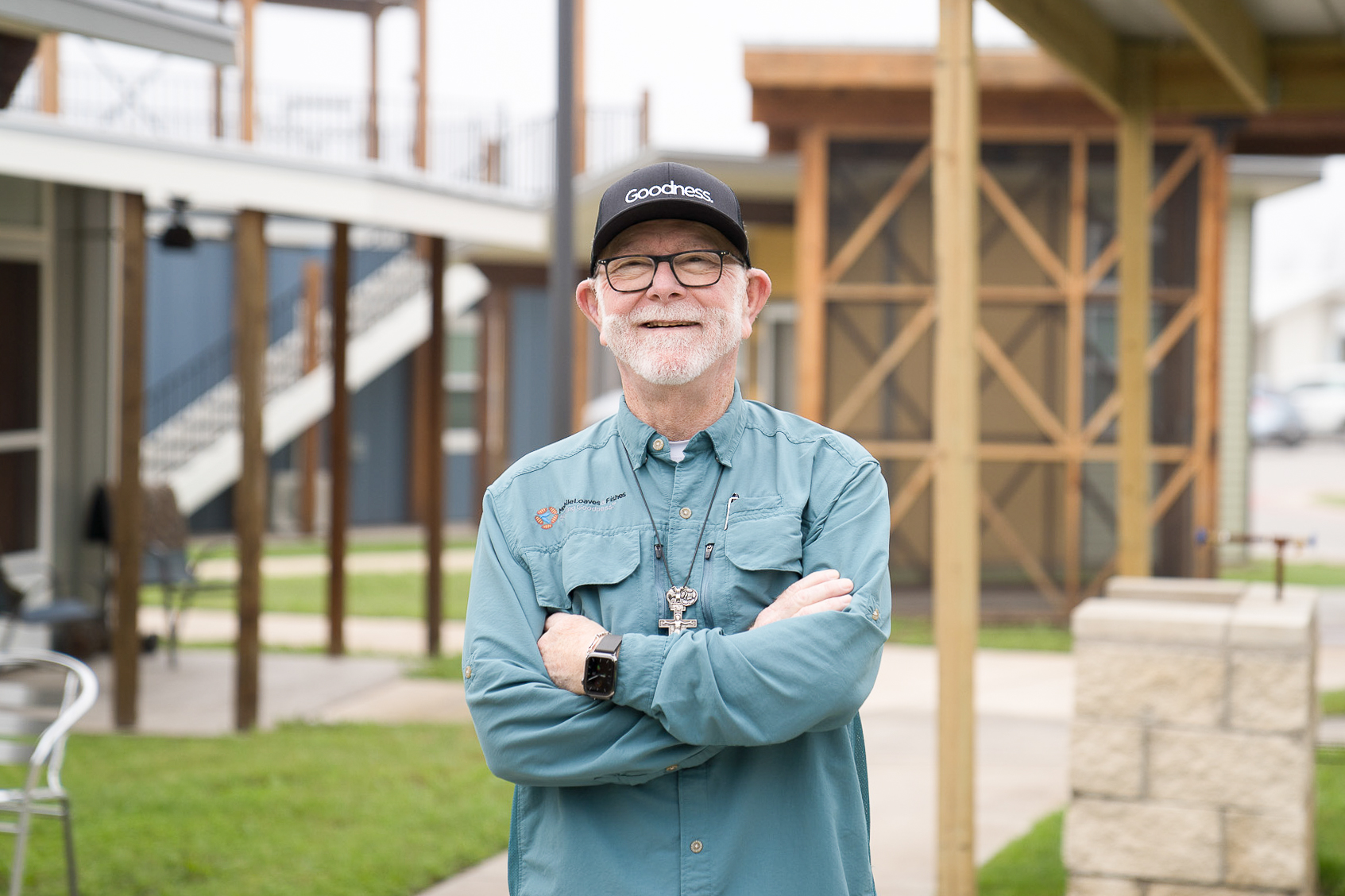 Community First! Village founder Alan Graham strolls the grounds of the neighborhood.
Graham is the CEO and founder of Mobile Loaves & Fishes, the nonprofit behind Community First! Village, which has taken a radical approach to solving the problem of chronic homelessness in Austin. At 70 years old, Graham is brimming with the kind of energy necessary for tackling such a monumental task. He recently returned from hiking the Camino de Santiago, a 485-mile historical pilgrimage that ends in northwestern Spain. He’s full of pop culture references and quotes, bouncing fluidly from Malcolm Gladwell to Alexander de Tocqueville, then Beyond Homelessness: Christian Faith in a Culture of Displacement. He lives here, too, in a house with a wide screen porch, near the center of the village.
“When I walk out my front door, I have to look down the street to see who’s there to decide whether I’m gonna wait another minute,” says Graham, who “commutes” each morning to the on-site Mobile Loaves & Fishes headquarters across the road. “Otherwise, I’m gonna get stopped. The short trek into the office can turn into a long, long walk pretty quickly.”
While he rarely misses the chance for a little playful irony, Graham’s pride in the buzz of social activity peeks through. Human connection, he believes, offers the most lasting pathway out of chronic homelessness-a federal designation for people with a serious disability who have gone unhoused for extended or repeated periods-and it’s the core principle behind Community First! Village, which marked its 10th anniversary last October.
“We believe that the greatest cause of homelessness is a profound, catastrophic loss of family,” explains Graham. “It’s not drug addiction, alcoholism. Those are exacerbating things.”
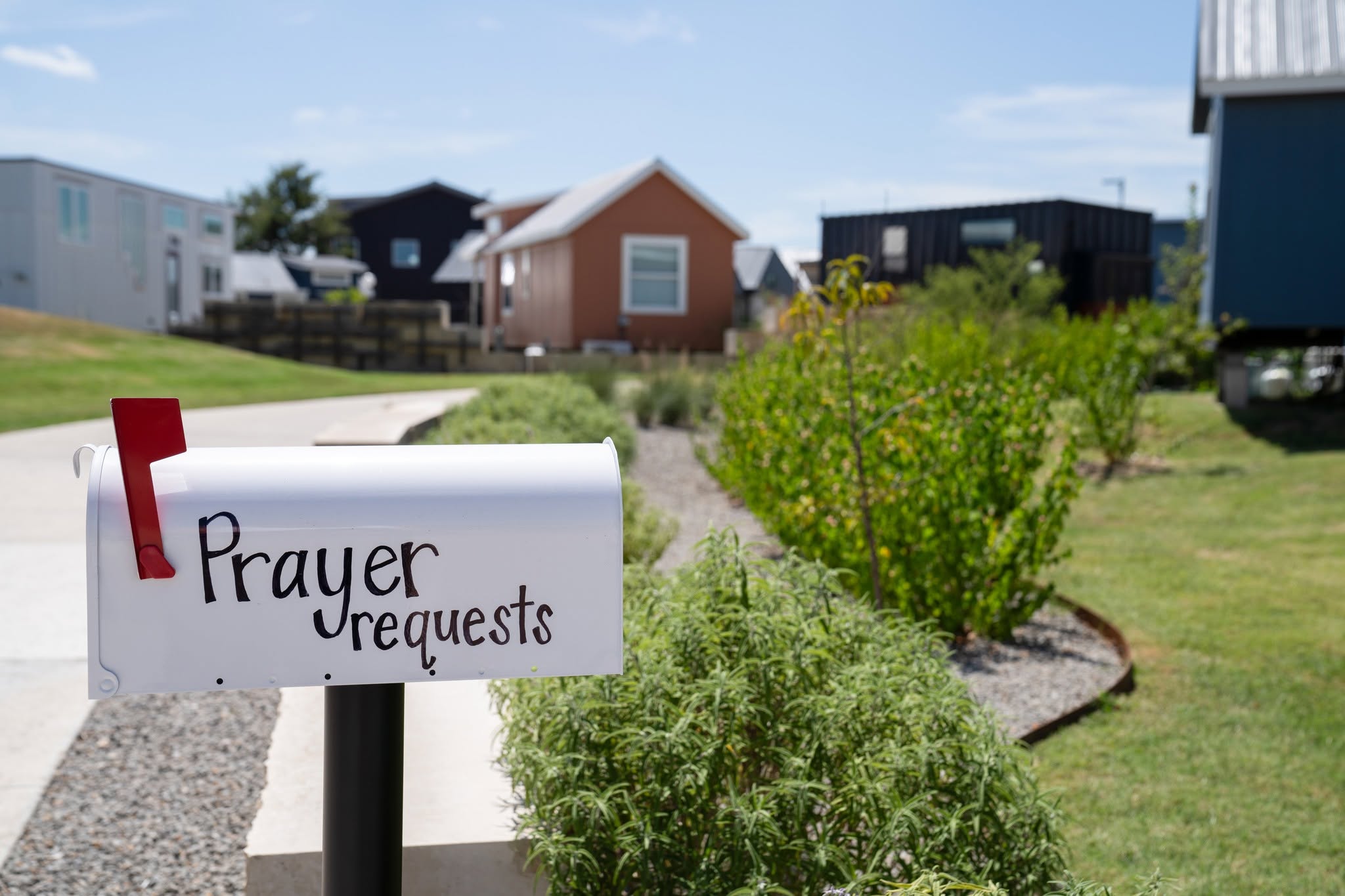
This philosophy is front and center in all aspects of the community’s blueprint. The tiny homes, each between 200 and 400 square feet, were designed to give residents private, secure houses, but that’s only part of what this place aims to accomplish. When the project cut the ribbon in 2015, it sought to offer both physical houses as well as the intangible elements that make them into homes. That includes a sense of permanence, orientation, safety, and belonging.
For Graham, one of the best examples of the power of relationships comes from the medically anomalous town of Roseto, Pennsylvania, which was the subject of a study in the 1960s. Researchers were intrigued by the enclave where residents lived almost entirely free of heart disease, but they found that there was nothing exceptional about the citizens’ diet or fitness.
What turned out to be so magical about the town? “Almost everybody in Roseto had a front porch,” Graham says. Porches, a liminal space between the private home and community, made for stronger social bonds that, in turn, led to a lower mortality rate. “If I were the Housing Czar of the United States of America, I would ban building homes that don’t have ginormous front porches.”
While he can’t outlaw porchless homes nationwide, Graham has effectively banished them from Community First! Village. Each tiny home has a front porch or patio, meant to foster interaction between neighbors.
 A resident enjoys time in the on-site Community Art House.
In many ways, the world of Community First! Village is the wider world in miniature. Neighbors can fish at the village’s stocked pond or shop at the weekly farmer’s market. There’s an on-site clinic, a chapel, a dog park, and even an outdoor movie theater that Alamo Drafthouse helped establish. Community First! also offers neighbors pathways to earn income, which has resulted in an even more robust local economy.
At the Entrepreneur Hub, a neighbor with cropped hair named Ute Dittemer leans over a shaped lump of clay, the early phase of what will eventually become a sculpted figure of St. Francis of Assisi. In addition to figures, she also glazes dishware in bright, geometric patterns. Dittemer sells both through the Community First! Market, a boutique on the premises that stocks everything from branded Mobile Loaves & Fishes merch to handcrafted spoon rests.
Though the summer temperatures outside hover around 100 degrees, the Entrepreneur Hub is already buzzing in anticipation of Christmas. Staff, volunteers, and neighbors have started making gifts that will be available online or in the boutique for the visitors who come through each year to shop at the holiday market and visit the Village of Lights display.
In fact, the 51-acre neighborhood hums with so much Parks and Recreation-style civic energy that it seems to live up to its exclamatory name: Community First! But the “community” here was never meant to refer only to the people who live here. From the beginning, Graham envisioned the project as an undertaking of the larger Austin community-the volunteers, donors, neighbors, and institutions without whom the village could not exist, and who Graham believes are the city’s first and best line of defense against chronic homelessness. Among them are the missional families: people who have not experienced chronic homelessness themselves but choose to live here as a commitment to the village’s mission. Their presence, along with a network of tens of thousands of volunteers, reflects Graham’s governing theory that solving homelessness requires ordinary people to re-enter the work of caring for one another.

Little Houses on the Hillside
Before there was Community First! Village, there was Mobile Loaves & Fishes, a Christian outreach ministry that Graham founded with a group of friends in 1998. Together, with a team of volunteers, they delivered bagged lunches to homeless individuals throughout Austin-first out of a minivan, and then later out of a fleet of catering trucks.
In 2004, the organization graduated from providing food to supplying housing, setting up homeless individuals into private RVs throughout Austin.
Over those years, Graham was refining a bigger vision. He believed that homelessness was caused by a breakdown of a family and community, and that simply providing housing was not enough. Many of the neighbors who eventually arrived at Community First! Village, a reflection of the larger chronically homeless population, have experienced profound trauma within their families of origin. A key part of the project’s goal was not only to provide a roof over their heads, but to create a network of new relationships rooted in stability and mutual responsibility.
Drawing on his own experiences at KOA (Kampgrounds of America) parks-where communal kitchens and shared bathrooms bring people into daily, low-stakes interaction he envisioned a village of mixed housing where formerly homeless individuals could feel a sense of social connection.
 Thoughtful design makes Community First! Village a vibrant, almost idyllic, place to live.
The original village was considered for locations within city limits, including spots near The Domain and airport, but the local backlash against the project was sharp. After a town hall meeting where Graham presented the plans to local homeowners, tensions became so inflamed that the idealistic speaker needed a police escort to his vehicle in the parking lot.
Ultimately, Community First! Village was slated for a 27-acre plot just northeast of the city limits. When the site opened in 2015, it featured a mix of RVs and micro homes clustered around shared outdoor kitchens, bathrooms, and laundry rooms. The neighborhood was designed to be walkable, with lush outdoor spaces.
In 2020, a “second phase” development was added: an additional 310 micro homes over another 24 acres, as well as a “Living Room” community center, where neighbors can grab coffee, access computers, or shoot pool. By then, Mobile Loaves & Fishes had spent five years learning what worked and what didn’t. Residents themselves helped shape the next phase of the village, consulting with designers and architects.
More storage space was among the top requests, so iterations on the home design incorporated clever solutions, including high shelving and fixed porch benches that double as bins.
As it evolved, the organization upgraded the types of RVs on-site, and increased the number of micro homes, which proved to be easier to live in and maintain. ICON, a local tech company, partnered with Mobi le Loaves & Fishes to create 3D-printed homes that mix with more traditional stick-built structures. The range of design styles means that the community looks lived-in and organic, despite how cleverly it’s engineered.
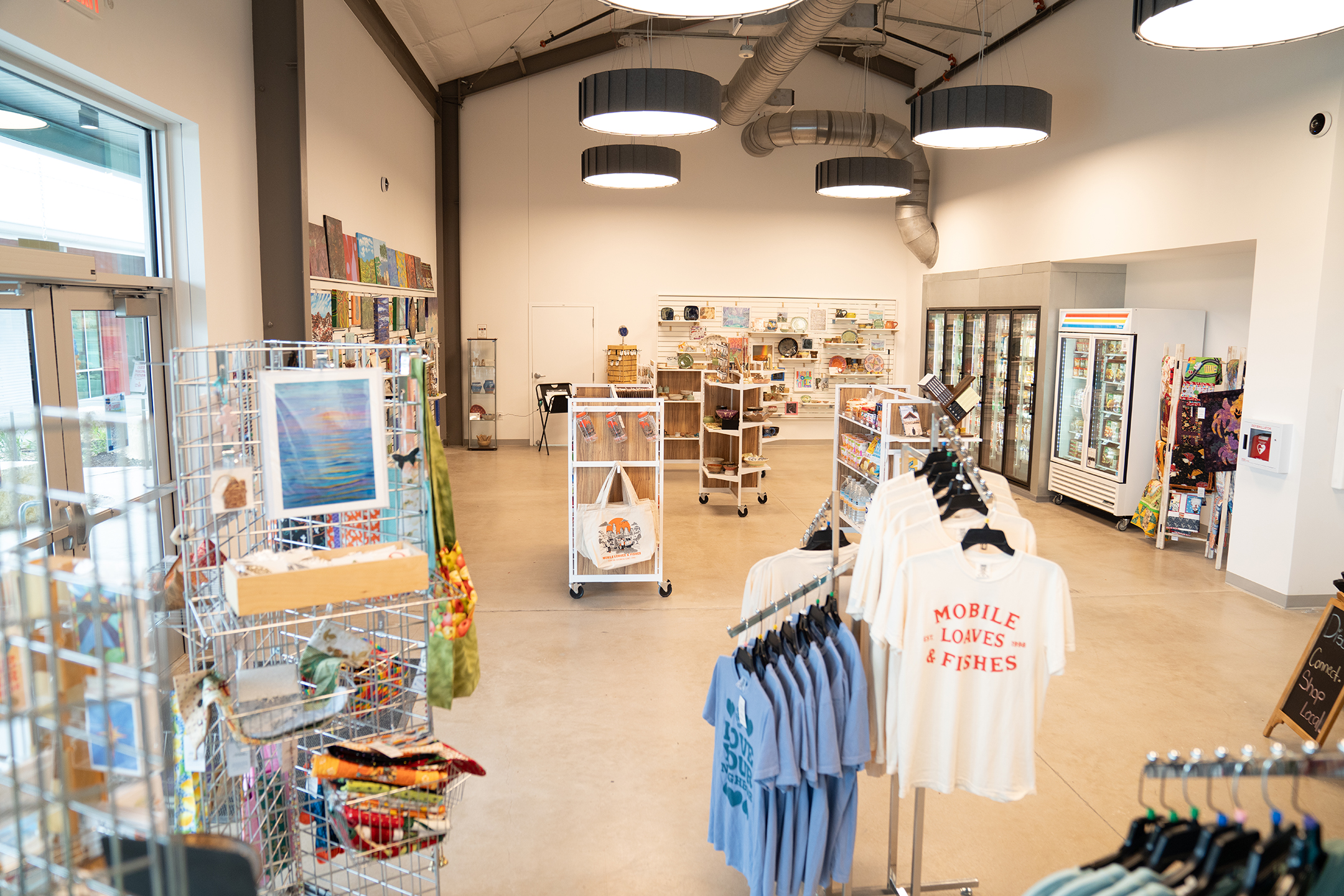 The neighborhood’s gift shop.
An additional 51 acres are slated for expansion. Here, the team has further refined its village planning, organizing houses and kitchens into scalable “Neighborhoods of Knowingness” that make communal spaces even more accessible. When complete, these additional developments will bring the total number of homes to 1,900.
But not all the learnings were architectural. Among the most essential elements of Community First! Village is the Larry “Taz” Williams Memorial Gardens. It’s named for the project’s first resident and features two glossy granite columbariums at the edge of a park, shaded by trees. Neighbors can choose to have their ashes interred here after they die. There are plans to add a third to the existing pair before the year is out.
It seems like a simple dignity, but it’s one often denied to people experiencing homelessness. Unclaimed bodies are often buried in public “indigent” cemeteries, in graves marked only by numbers and sometimes in little more than an industrial-grade plastic bag.
“This part of our ministry has turned out to be an enormous deal,” Graham says. “There’s dignity for the neighbors left behind, as well. They know where to go to remember their friends. If your friend passes away after y’all were behind a dumpster for the evening, they’re just gone. What do you do with that?”
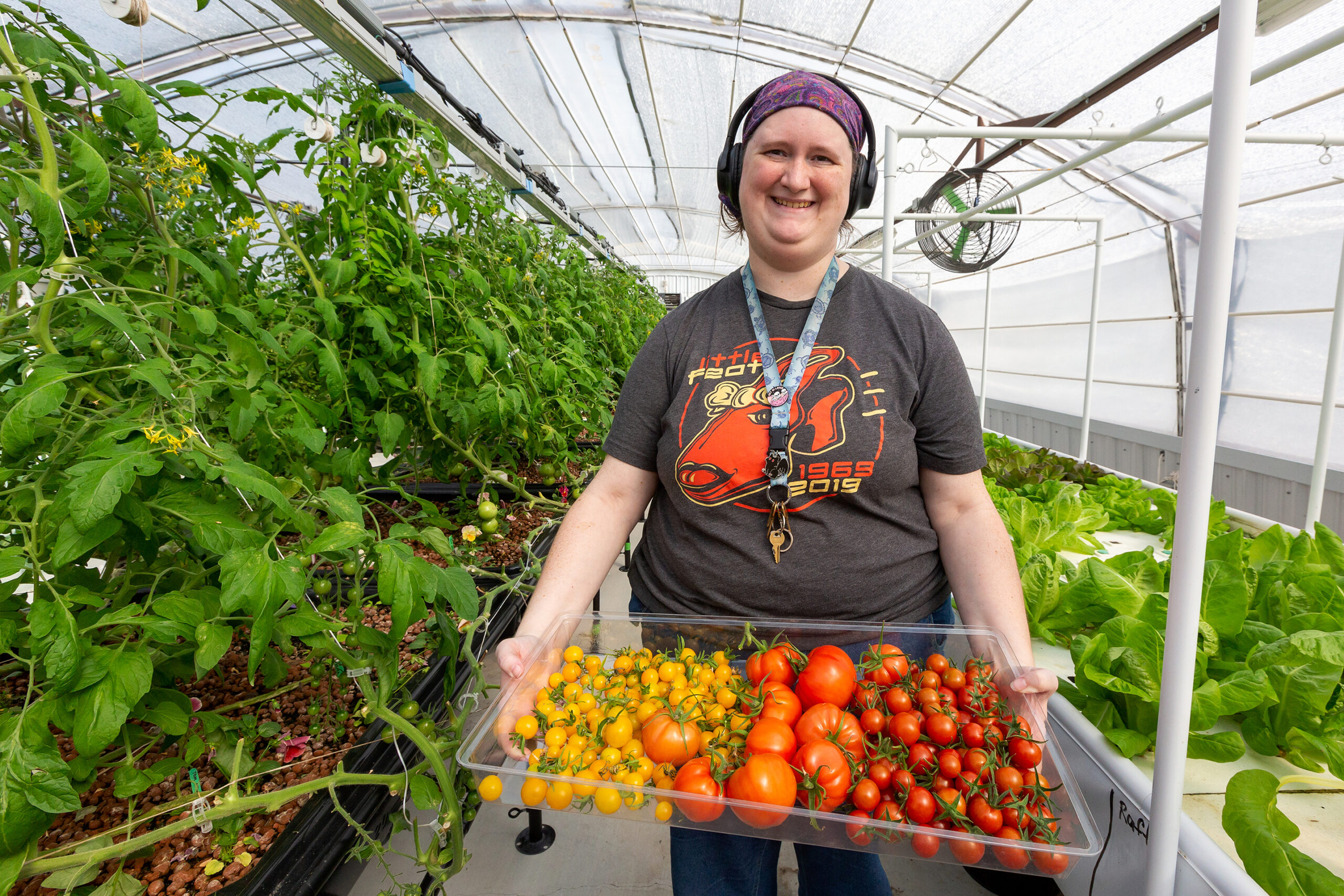 A resident helps gather fresh produce from a communal garden.
Deceased residents are also remembered with colorful portraits, painted by volunteers, that are displayed in the community center. When someone dies on-site, neighbors gather for a brief moment of silence and prayer before the medical examiner departs with the body-a final act of community.
Still, it’s this end-of-life aspect that troubles Graham the most as the project grows. Community First! Village was always intended as permanent housing, not merely a transition between the streets and some other final place. As the village itself has grown more complex, so too have its responsibilities.
“One of the most serious questions that I could ever ask another human being is ‘Who is going to change your diaper?’” Graham says. “We’re not doing that for you here. We don’t have the staff to do that. And where are the resources going to come from?”
“How do you manage people that can no longer care for themselves? This is kind of an unanswered question,” he says. “It’s another thing to figure out how to do.”
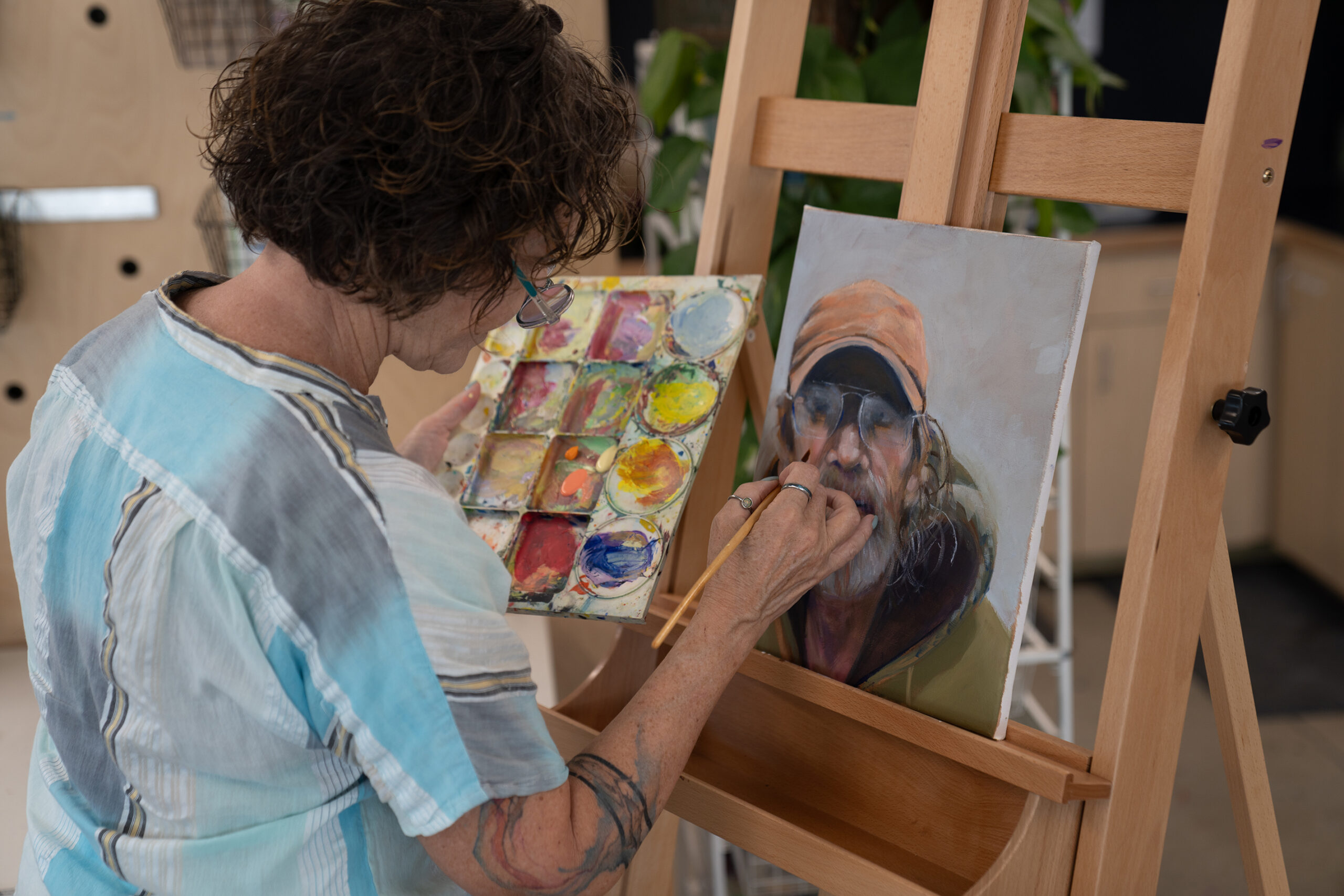 A resident paints.
A Beautiful Day in the Neighborhood
Exploring the clusters of carefully planned homes at Community First! Village, it’s impossible to ignore that this kind of walkable, mixed use city planning is out of reach even for many wealthy Texans. Street names-like “Semper Gumby Lane,” a cheeky reminder to “stay flexible” -feel like optimism borrowed from a bygone era. Even the strong sense of community resembles an old-fashioned luxury, making it tempting to see this place as a vision of utopia.
But Graham isn’t keen to sugarcoat the project. Many residents still struggle with substance abuse, and the neighborhood has its share of sheriff’s calls. While crime here is relatively proportional to Austin developments of similar size (even a bit lower), there is an element of conflict that is an inescapable component of living in relationship with other people.
For decades, homelessness policy has been shaped by the well-evidenced Housing First approach, which prioritizes getting people into stable, safe living accommodations without prerequisites like sobriety or employment. For people experiencing chronic homelessness or with more complex needs, that baseline is paired with additional support, including mental health care, substance use treatment, and financial assistance.
Research suggests that addressing the core need for shelter up front is important because it creates the stability people need to address the challenges that contribute to their homelessness.
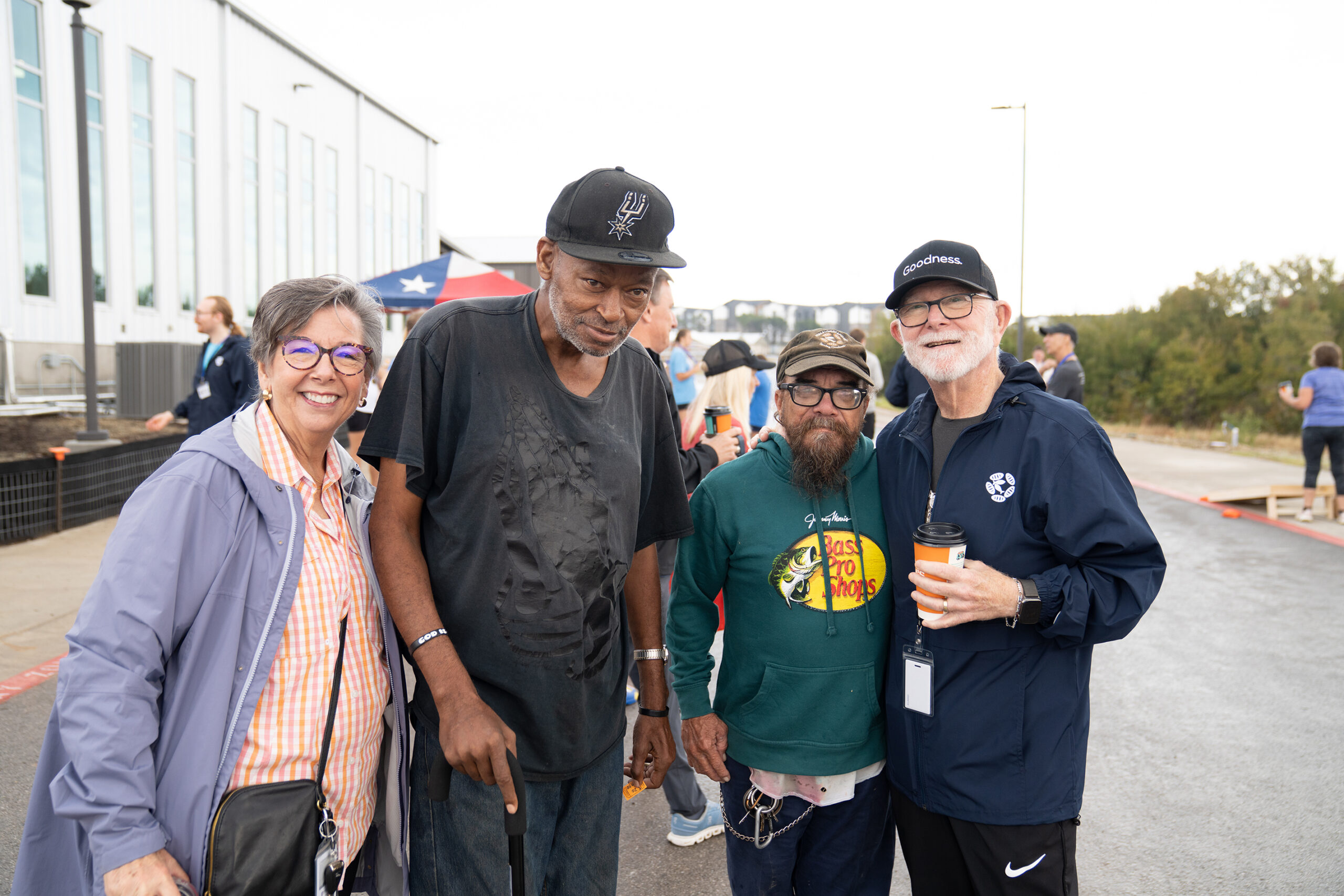 Graham (right) poses for a photo with community residents and staff members.
“Being provided housing, plus a case manager, plus extra cash per month, provides people with the mental bandwidth to focus on other things,” explains Akram Al-Turk, a researcher at the Moritz Center at UT Austin whose research explores how housing insecurity impacts people’s overall well-being. “[It] frees you up to focus on treatment, if you need it, or healthcare, or finding a job, or caring for your children.”
But even when programs are well resourced, another constraint emerges: human attention. The success of supportive housing often depends on people who can develop relationships, coordinate care, and help clients navigate everything from medical appointments to benefits paperwork. Case managers do that work, but across the country, including in Austin, government programs and nonprofits struggle with staffing. Overloaded case managers have less capacity to cultivate the relationships that can make these interventions most effective.
“Trust between a client and a case manager is really important,” Al-Turk says. “It’s something that we probably all intuitively know-you need to really trust somebody before you can have a good working relationship with them-and that can lead to better outcomes.” A program like Community First!, where neighbors and staff are embedded in the same community, creates more opportunities for that trust to develop organically. Al-Turk suggests this may help to explain why Community First! has been able to tackle the complex problem of chronic homelessness.
But Community First! is focused on more than the relationship between residents and case managers. Graham’s grand vision of a neighborhood designed to rebuild social bonds makes sense once you understand that he sees the homelessness epidemic as a crisis downstream of the major social shifts that have happened gradually in America over the past century. The impact of the personal ruptures of individual families becomes amplified when the larger social networks have become frayed and fragmented.
“We’ve created these hermetically sealed, single-family sarcophaguses that we call the American Dream with 8-foot-tall privacy fences, swimming pools, and barbecue pits in our backyards,” says Graham. “We don’t come out and engage with our neighbors.” For him, these everyday relationships don’t just improve the quality of daily life; they’re also the support systems that might help individuals to weather a catastrophic personal crisis.
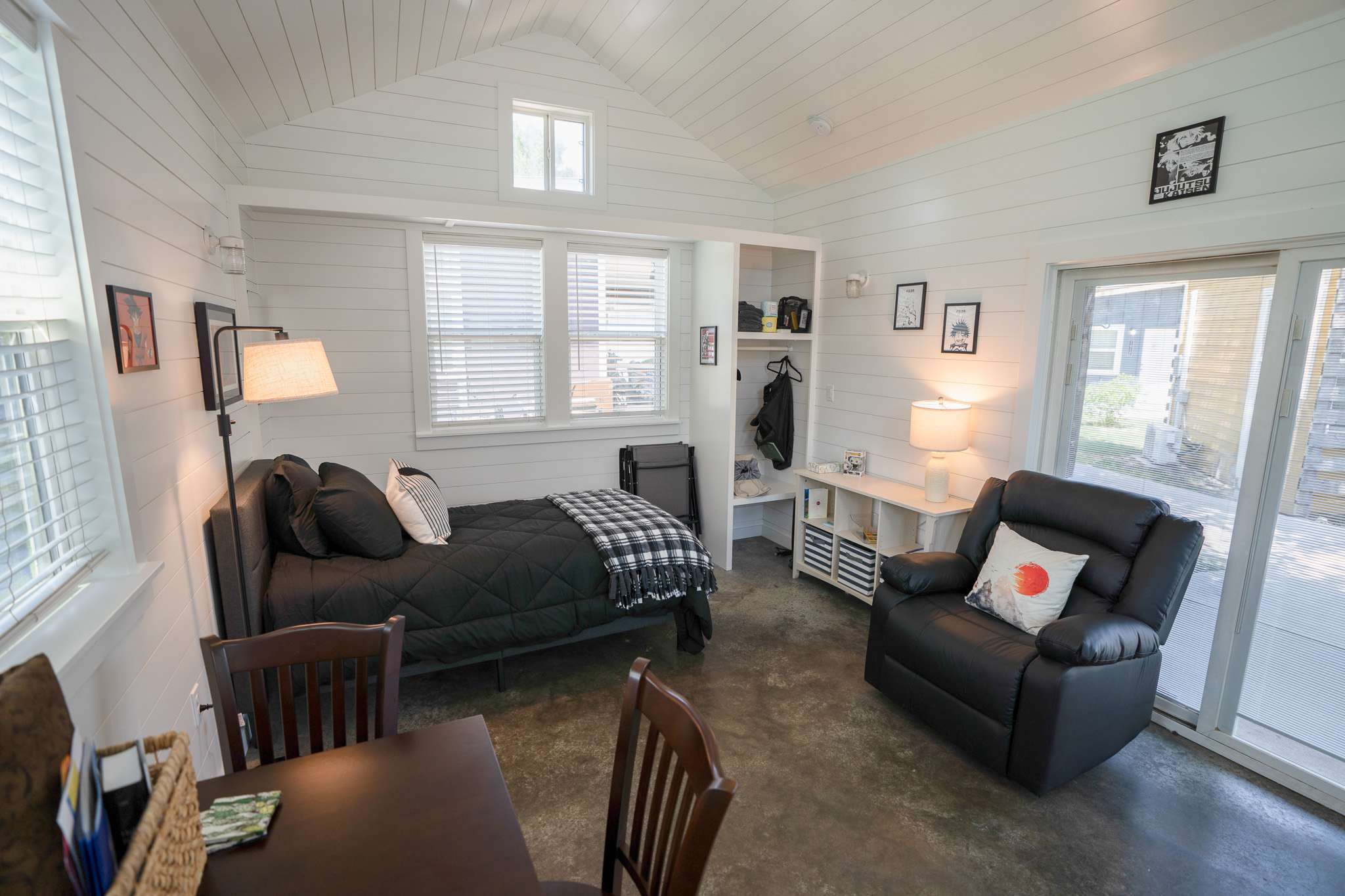 Interior furnishings for some of the residents’ homes.
When describing the future of Community First! Village, both here and at the replica projects that have popped up across the country, he calls back to French thinker Alexander de Tocqueville’s memoirs of traveling through America in 1831. Tocqueville was impressed by the American sense of civic duty, and the way individuals organized to solve community problems, creating infrastructure like hospitals, schools, and railroads. Graham believes that spirit of participation has faded.
“In the 20th century, we began abdicating all these responsibilities to the government,” Graham says. It’s not that he disapproves of the government programs that are working to end homelessness; it’s that he believes the crisis cannot be resolved by the government alone. For him, Community First! Village is a demonstration that ordinary people, who are neither professionals nor philanthropists, play a key role in rebuilding the social fabric.
“You need to be fully and wholly loved, and fully and wholly known. The government is never gonna do that,” the founder says. “Our government provides extraordinary and meaningful things. But we, the people, can make it far more effective if we do our part.”
As he winds his golf cart through the planned expansion, past concrete foundations that have already been laid, Graham zips by ICON’s enormous on-site 3D printer. The machine is running today, and its large mechanical arm traces the outline of an in-progress house, laying down ribbons of concrete that will become the walls of another home.
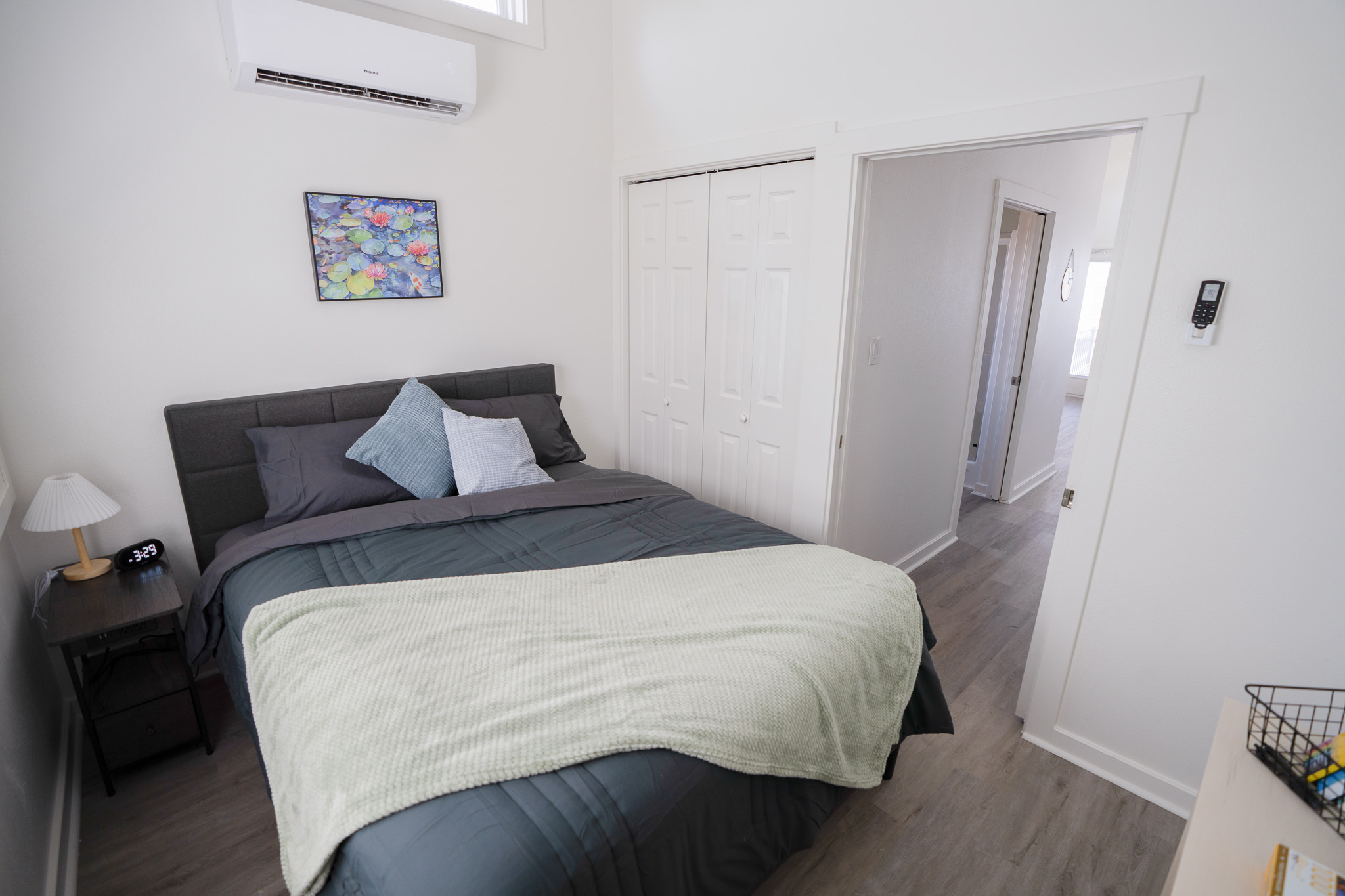 Interior furnishings for some of the residents’ homes.
When the village unveiled six 3D-printed homes in 2020, they became a symbol of technological possibility: proof that new tools could help create housing faster and more efficiently.
Even as the project has grown, Graham has remained hands-on. And it’s impossible to ignore how essential he is to everything that happens here. Many of the residents address Graham as “Papa,” and even more of them, he says, refer to his wife as “Mama.” The nicknames speak to the project’s central premise. If homelessness is more than a loss of housing, relationships like these can help people feel anchored in the world again. But it’s also a detail that exposes the central tension of Community First! Village’s next decade: If relationships are foundational to ending homelessness, who is responsible for building and sustaining them? How does a project built on personal relationships scale beyond the individual?
The high-tech machines on-site can build houses, but what we really need is more Alan Grahams.
Clad in a ballcap, dropping references to The Andy Griffith Show, showing off his incredible memory for the names and personal lives of the people throughout the village-Graham feels like the kind of presence that would be almost impossible to replicate. But while there’s no blueprint for people, Community First! Village’s bet is that it can inspire others to show up and make the community bigger.