
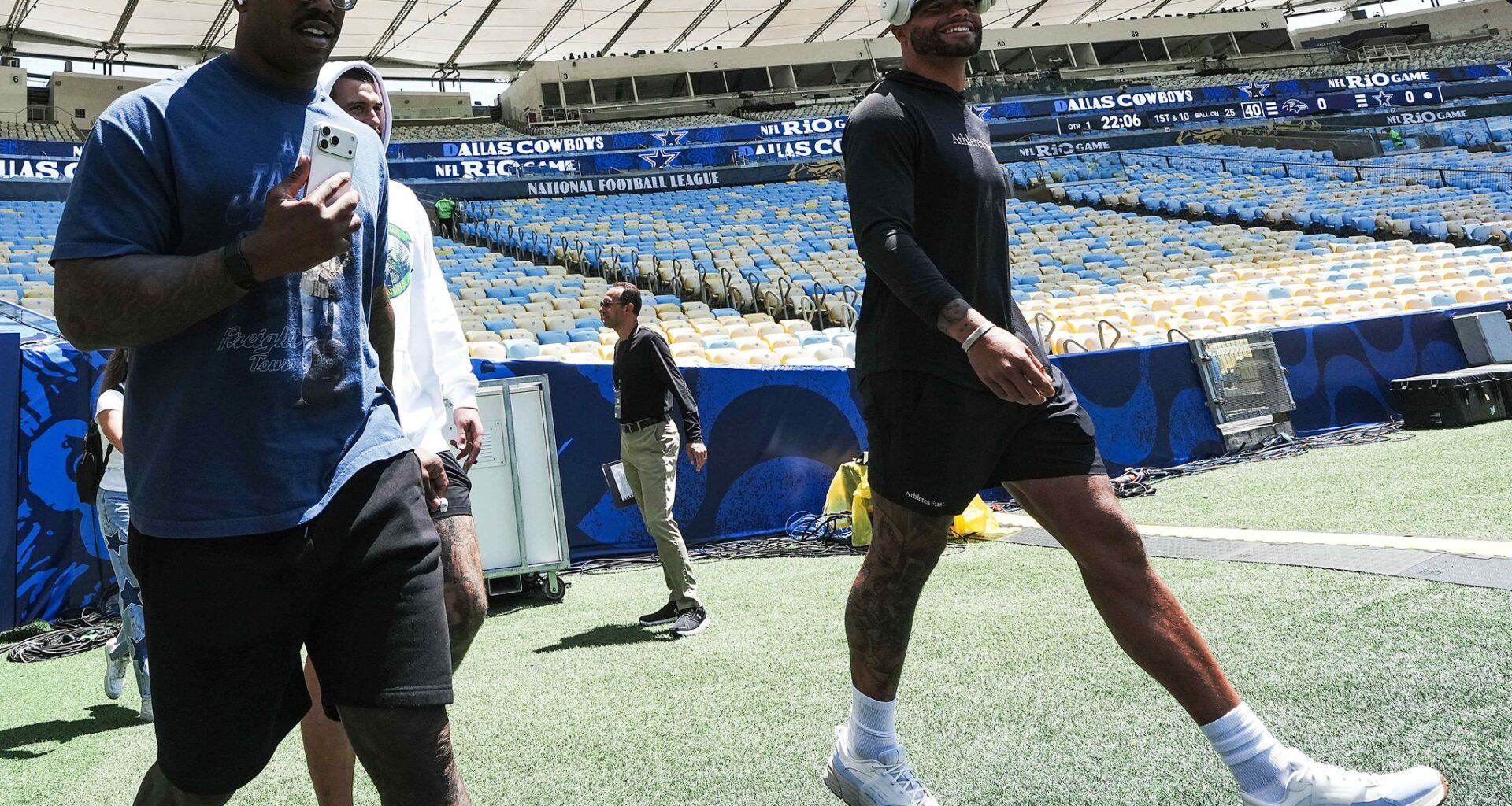
Dallas Cowboys quarterback Dak Prescott (right) and outside linebacker Von Miller participate in a walkthrough at Maracanã Stadium on Saturday, Sept. 26, 2026, in Rio de Janeiro, Brazil. The Cowboys play the Baltimore Ravens on Sunday.
Smiley N. Pool/The Dallas Morning News
RIO DE JANEIRO — Cowboys players and coaches have been asked all week about the concerns stemming from the playing field surface at Maracanã Stadium in Brazil. On Saturday, they got the chance to see for themselves.

Players and coaches arrived on a humid afternoon for a literal walkthrough at Maracanã. There was no practice. Instead, they had the chance to visualize what it’ll be like when they play the Baltimore Ravens on Sunday. They had the chance to get a feel for the field.
Some, like wide receiver CeeDee Lamb, walked barefoot on the re-fortified Bermuda grass. Others, like running back Javonte Williams, brought cleats to see what it would feel like and whether they would need to prepare with multiple options. Tight end Jake Ferguson, recently fined by the league for a shotgunning beer celebration, even picked up some grass and pretended to put some of it in his mouth like tobacco chew. At least we think it was pretend.
Article continues below this ad
Members of the media in attendance weren’t allowed on the playing surface, but the analysis from some players, coaches and other staff members featured a mixture of two reactions: it is what it is, and we’ll see. Some indicated that there were evident patches, rather than a fully flat field. It added to the concerning discourse with just over 24 hours until kickoff.
Workers prepare the field at Maracanã Stadium ahead of an NFL football game between the Dallas Cowboys and the Baltimore Ravens, Saturday, Sept. 26, 2026, in Rio de Janeiro, Brazil.
Smiley N. Pool/The Dallas Morning News
How people feel about the field won’t change anything at this point, however. NFL Field Director Nick Pappas, standing on the field at the time, said Saturday the playing surface passed the joint thresholds to play determined by both the NFL and the NFL Players Association.
“Again, things check out,” Pappas said. “We’ve made additional improvements to the field that we think were just helpful — all around helpful. Things that we felt and brought to the [NFL]PA to say this is what we’re going to do and this is how we’re battling it — the weather, that is — and how we’re improving it. We wanted to bring those items to the [NFL]PA that there was no need to worry.”
NFLPA Executive Director J.C. Tretter released a statement Friday, hours after both teams arrived, to express the organization’s initial concern over the field quality. The NFLPA had a player director in attendance for days prior to the arrival of both teams as well as third-party field experts to analyze the condition. Tretter said the field needed better traction and stability and they recommended reinforced stitching.
Article continues below this ad
Pappas said they brought in GrassMaster stitching machines that “drive synthetic fibers into the ground to help stability.” He said they used the same stitching process last year in São Paulo, where the NFL returned for the second time in two seasons.
Pappas also said there’s been a “perfect storm” of events that have made groundskeeping “challenging” in preparation for Sunday’s game.
Pappas reminded reporters that it may be summer back home in the United States, but it’s currently spring in the southern hemisphere, even though the humidity on Saturday afternoon challenged that idea. That can have an effect on the Bermuda grass field.
“Anyone who manages Bermuda grass back home knows when we come out of winter into spring, we’re getting rid of that overseeded rye grass and going back to pure standard Bermuda. That Bermuda is slow to wake up sometimes,” Pappas said. “That is where we’re at today.”
The field has also been in use over the last few months. Maracanã hosts an average of two games per week, Pappas said. The discourse about the field was mostly sparked by comments from Flamengo goalie Agustin Rossi, who recently told ESPN via GE.com that it’s “unbelievable” they’re playing on the field.
Article continues below this ad
“If you look at it, there are bumps everywhere,” Rossi said.
Patches, according to people who walked the field, were evident on the playing surface. But Pappas said that might not be as big of a concern for the NFL as it is for soccer players.
“Soccer is very focused on ball-surface interaction,” Pappas said. “They want a soccer ball to roll like a billiards table. They want a true roll. They don’t want it to kick or jump one way or another.
“We’re focused on athlete-surface interaction.”
The Cowboys will be prepared with multiple pairs of cleats for players, including some with seven studs that are designed to increase grip on a playing field that could be more slippery.
Article continues below this ad
Dallas Cowboys players footwear ranges from kicker Brandon Aubrey’s cleats to bare feet as they participate in a walkthrough at Maracanã Stadium on Saturday, Sept. 26, 2026, in Rio de Janeiro, Brazil. The Cowboys play the Baltimore Ravens on Sunday.
Smiley N. Pool/The Dallas Morning News
The rain in Brazil, according to Pappas, has also played a role in the perfect storm of challenges. There’s been more rain than expected in Brazil over the last two months due to El Nino effects. It’s a deviation from how much rainfall the area usually sees, Pappas said.
“Apparently this is their dry time,” Pappas said. “We didn’t get that this year.”
Pappas said they put additional contingency plans in place in the time leading up to the game as the increased rainfall became evident. He said the NFL provided tarps for Maracanã Stadium, which is not something they normally have, according to Pappas. It’s mandatory at all open-field stadiums in the NFL, like Maracanã, and could be used Sunday if it rains before kickoff.
Pappas said they also put in practices to improve drainage and stimulate growth and recovery of the Bermuda grass.
Article continues below this ad
“Our fields are where they are today in America because of how long we’ve worked at it,” Pappas said. “Not everywhere we travel is going to have the same resources, same climate, same available type of grass, same tools at their beck and call like we have in the United States. It becomes challenging. How can we put it on a plane and fly it there? Just like the rest of the game: what can we put on a plane, what can we put on a ship, and how do we execute to make it a successful Sunday?”
It’s all led to Sunday’s kickoff between the Cowboys and Ravens, where the true success of the field preparation will show itself.