
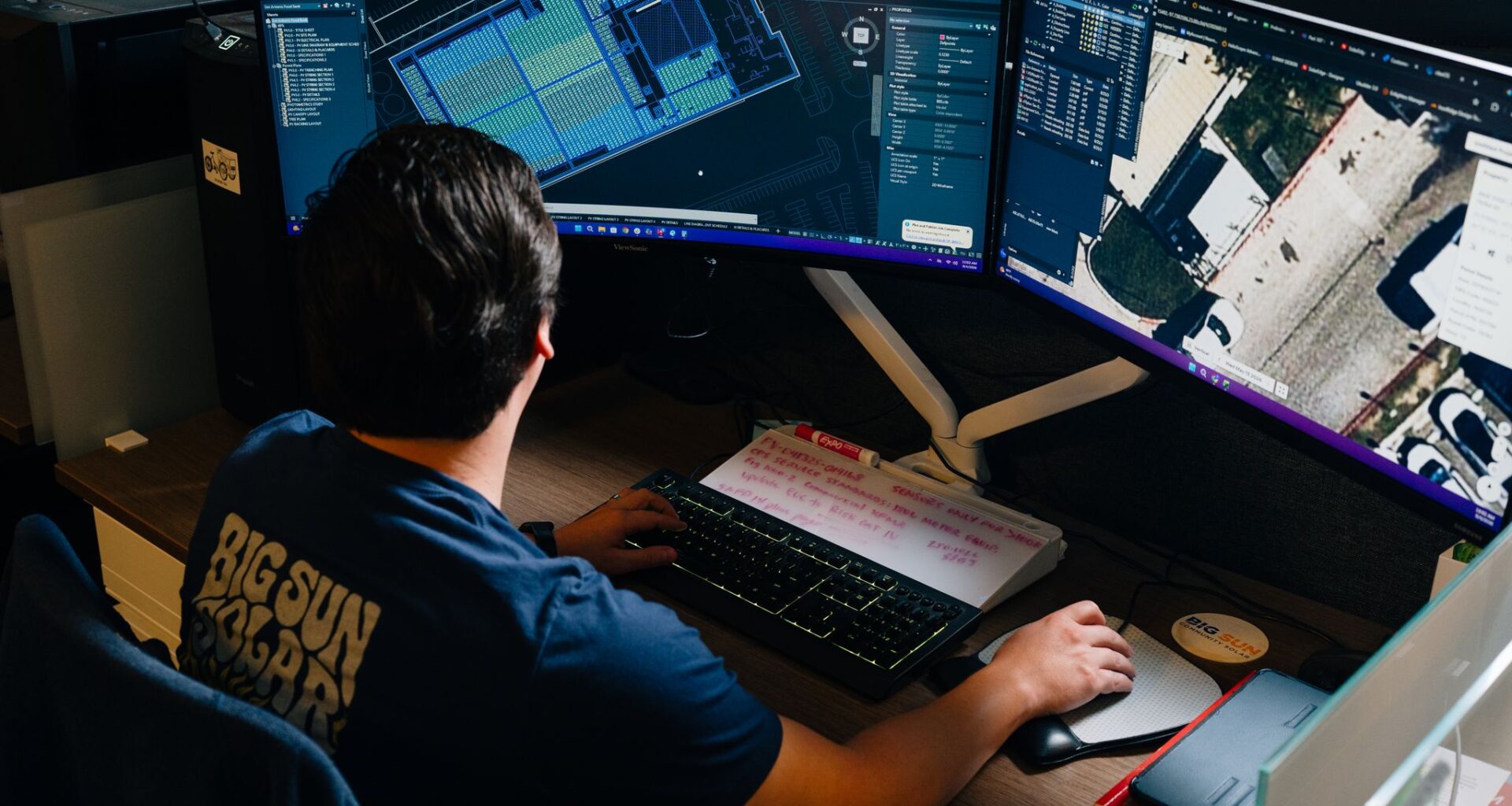
An engineer at Big Sun Solar works on a solar project on CAD in its offices at Pearl.
Brenda Bazán/For the Express-News/Brenda Bazán/For the Express-Ne
The roof of Pearl’s Full Goods building, which houses the Big Sun Solar office, is lined with solar.
Big Sun Solar
An engineer at Big Sun Solar works on a solar project on CAD in its offices at the Pearl.
Brenda Bazán/For the Express-News/Brenda Bazán/For the Express-Ne
The roof of Pearl’s Full Goods building, which houses the Big Sun Solar office, is lined with solar.
Big Sun Solar
Jason Pittman, left, and Robert Miggins, co-founders at Big Sun Solar, look at the wall of boots marking the completion of projects in their offices at the Pearl.
Brenda Bazán/For the Express-News/Brenda Bazán/For the Express-Ne
Robert Miggins, co-founder of Big Sun Solar, sits in the company’s offices at Pearl.
Brenda Bazán/For the Express-News/Brenda Bazán/For the Express-Ne
Ground-mounted solar will make up three of the four solar sites for the first phase of the community solar program that Big Sun Solar and CPS Energy are working on.
Big Sun Solar
Big Sun Solar installed panels on the Jean Yates Community Center as part of the city’s broader effort to reach net-zero energy across municipal buildings by 2040.
Big Sun Solar
Jason Pittman, left, and Robert Miggins, co-founders at Big Sun Solar, in their offices at Pearl in San Antonio, Texas on September 4, 2026.
Brenda Bazán/For the Express-News/Brenda Bazán/For the Express-Ne
Jimmy Casas has waited for his spot in CPS Energy’s community solar program since before the pandemic.

Casas and his wife started looking to offset their electricity bill for their Northwest Side home in 2019. The house is an older residence that can easily rack up a $300 energy bill in the summertime. Solar panels could lessen that monthly burden.
Article continues below this ad
Though he is still months away from seeing the first solar credits on his electricity bill, Casas walked into the Big Sun Solar office at the Pearl last month and put down a deposit for a slot in CPS Energy’s recently reopened community solar program.
The city-owned utility has teamed up with Big Sun Solar on the initiative, which allows customers to benefit from solar power without having to install panels on their own roofs.
READ MORE: CPS Energy is ramping up community solar, seeking proposals to spark program
San Antonio Express News Logo
Make us a Preferred Source on Google to see more of us when you search.
Add Preferred Source
The approach lets customers purchase or rent panels located elsewhere, such as on a business’ rooftop or in a field, while receiving credits on their electricity bills. The CPS program uses a purchase model. It’s a way to offer an opportunity to invest in the renewable energy to those who traditionally are barred from using it — like renters and homeowners who can’t install panels on their roofs.
Article continues below this ad
Big Sun Solar will build 20 megawatts of power in the first phase of the program to expand CPS’ community-generated solar portfolio. That will roughly double the utility’s current 11-megawatt community solar capacity. The first batches of added generation are scheduled to go online early next year.
Casas and his wife had considered rooftop solar years ago, but then a major storm spurred a roof replacement. The solar company they consulted with said they had dodged a bullet. If the panels had been on their roof during the storm, they would have had to pull them off, repair the roof and reinstall the panels.
That prompted them to look into community solar.
“(The panels) are stored off-site and all the maintenance and everything is done for the customer as part of the contract,” Casas said.
Article continues below this ad
RELATED: San Antonio’s latest rooftop solar project keeps city on track for cutting energy bills
CPS last offered community solar in 2019, when Big Sun Solar installed 5 megawatts of solar capacity that was purchased by 475 customers. The program sold out quickly, signaling demand for the model. Casas signed up for it, but the slots were gone.
CPS has been slow to expand the program, despite it being a pillar of the utility’s five-year Sustainable Tomorrow Energy Plan approved in 2022.
Residents like Casas waited more than five years for the program to reopen. He even wondered whether the pilot program had proven to not be financially viable or whether it had been shut down. But a few days before Christmas, he got an email. CPS was preparing to reopen the program and had saved his spot on the list. The utility wanted to know whether he was still interested.
Article continues below this ad
“While it seems like it took a little bit, it really is us doing our due diligence in ensuring that it’s the right fit for our community,” said Ana Lozano, director of technology and product innovation at CPS. “We can never move fast enough.”
Bigger panels, lower prices
Big Sun Community Solar aims to serve 3,000 customers with this rollout, Big Sun Solar CEO and co-founder Robert Miggins said. A few hundred slots already have been filled by customers like Casas.
READ MORE: Renewable energy is a ‘second opportunity’ for some rural Texans
Article continues below this ad
Miggins compares the off-site solar program to a community garden, which offers the benefits of “growing vegetables in this empty piece of land in our neighborhood” to residents.
Customers taking part in this round of community solar are getting a bigger bang for their buck.
The solar panels are literally larger — 620-watt panels, compared with 365-watt panels in the first rollout. They also cost less: $2 a watt compared with $2.40 a watt in 2019.
CPS also is paying customers more for their energy this time around, Lozano said. The previous rate was 9 cents a kilowatt hour, but that has been increased to 10 cents a kilowatt hour.
Article continues below this ad
“We measure how much power is sold and then times 10 cents — that’s what gets dropped on your bill,” Miggins said.
SA INC.: Get the week’s top local business stories in your inbox
Big Sun Solar has been contracted to build up to 50 megawatts of solar for this program — enough energy to power 12,500 homes on a hot summer day. The first phase involves rolling out 20 megawatts of capacity across four different sites. How much capacity is eventually built will depend on demand, Lozano said.
Construction on the first site, the roof of the San Antonio Food Bank, is slated to start this week. The remaining three sites will be ground-mounted solar arrays in fields across Bexar County.
Article continues below this ad
The 20-year lease will give the food bank funds to offer at least 100,000 more meals a year, Miggins said.
How community solar works
Residents like Casas who get a slot in the community solar program sign a 20-year contract, locking in a fixed rate of return on their energy bills.
Because the asset is not physically tied to a home, the credit can follow a customer wherever they move within the CPS service area. If they move outside of the utility’s service area, they can pass their credit to someone else or sell it to one of the customers on the waiting list.
Article continues below this ad
RELATED: Tax credit rules called the ‘perfect checkmate’ against renewable energy
“With rooftop solar, it is an investment. It is on your roof. It is there to stay,” Lozano said. “With this community solar program, it offers customers the flexibility to move … They are able to sell their panels back if they move out of the territory. It minimizes some of the exposure and risk for customers.”
Since customers own the solar panels, they can take possession of them after 20 years. Solar panels have a lifetime of about 30 years, so there’s potential for energy savings beyond the two-decade lease.
Casas was given the option to purchase enough panels to offset his electricity bills by around 50%, 75% or 90%.
Article continues below this ad
He chose to purchase 18 panels to offset his electricity bill by 75%, costing $1,240 per panel. Casas calculates that he’ll break even at the 10-year mark.
Miggins knows that the upfront cost is not an easy check to write. But after that payment, he said, “it’s absolutely nothing more out of your pocket ever.”
READ MORE: CPS expands its energy-savings program to include apartment residents
Big Sun Solar provides routine maintenance and pays to insure the panels. That means if a panel is damaged, it’ll be replaced at no cost to the customer.
Article continues below this ad
Investing in the program can help mitigate ever-increasing electricity bills in the long run, Miggins said.
“The cost of electricity is getting more and more expensive. If you have no solar, then you have 100% exposure to those increasing prices,” Miggins said. “It just makes good financial sense.”
The community solar program also can help the utility cut back its carbon emissions, Miggins said, a concern for his sustainability-driven company.
“When CPS does things like this, it helps them avoid building another gas- or coal-fired power plant,” Miggins said. “If it’s sprinkled around town, they can avoid building that next power plant, which is better for air quality. It’s just better for our community.”
Article continues below this ad
For Casas, CPS’ expansion of the program is giving him a chance to do his part for the community.
“The fact that they’re still doing it and still growing it — it’s pretty cool,” Casas said. “I’m glad they reached back out. We’re excited.”