
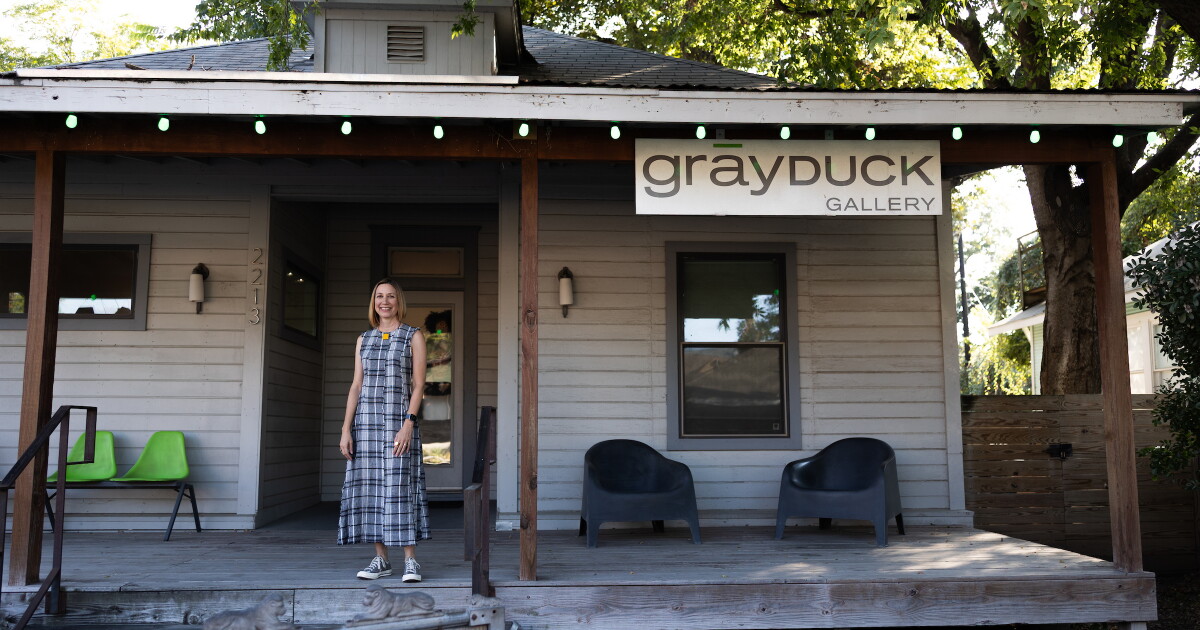
grayDUCK Gallery invited supporters to a wake Saturday night. But there wasn’t much mourning going on inside the compact art space that had carved out a distinct niche on East Cesar Chavez.
More than 100 people passed through over several hours, celebrating owner Jill Schroeder’s 16-year run since opening grayDUCK in an even smaller space off South First Street. What made the evening markedly different from many creative-space farewells in Austin was that Schroeder got to close the gallery on her own terms.
Schroeder and her husband, Mark, bought the property in late 2013, which protected them from being pushed out by rising rent, redevelopment or a landlord ending their lease. After a dozen years and more than 120 exhibitions, Schroeder said it was time to step away from the constant commitment needed to keep the gallery running to its potential.
“I wasn’t getting the same joy as I was before,” Schroeder said the day after the going-away celebration. “I was just ready for a change, ready to not worry about the gallery 24/7.”
Schroeder had said from the start that owning the building would give her more freedom over what grayDUCK could show and how artists could use the space.
Looking back, she said that largely worked out the way she hoped. grayDUCK could reshape the gallery around exhibitions that might have been difficult to stage in a more conventional commercial setting.
“I really am proud of the fact that it could be a place where they could experiment,” Schroeder said. “We could do what we wanted to it, and, you know, we built walls and took them down and did all sorts of stuff for the artists.”
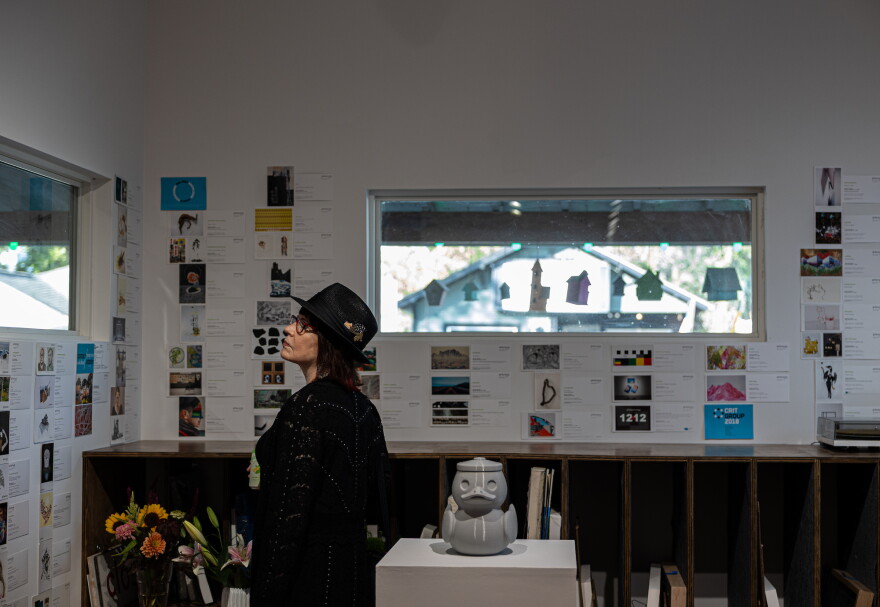
Chris Cherewan looks at postcards from the gallery’s previous exhibits at grayDUCK’s closing party.
San Antonio artist Raul Rene Gonzalez benefited quickly from Schroeder’s artist-first approach. Gonzalez first showed at grayDUCK in 2014, while he was still in graduate school, and continued exhibiting there throughout most of the gallery’s run on East Cesar Chavez.
He said Schroeder gave him room to move away from the abstract work he was making early in his career and to develop more personal pieces about parenting, construction and labor, working across painting, drawing, mixed media, performance art and dance.
“I could really reach out to her if I had something that I was working on, just reach out to her like, ‘Hey, how can we make this work into an exhibition?’” Gonzalez said.
He said grayDUCK’s ongoing, supportive approach gave him a consistent foothold in Austin’s art scene and, when Schroeder told him she was closing, he initially felt like he was losing his “lifeline in Austin.”
Gonzalez said that relationship also helped him become part of Austin’s broader art community. Even though he lives in San Antonio, his work was regularly available at grayDUCK, and Schroeder made repeated trips south to see what he was working on and bring pieces back to Austin to show in the gallery.
“For me, that was really important just to be able to have a place in Austin where I truly felt like I was part of the Austin art scene for a long time,” Gonzalez said.
grayDUCK developed a reputation pretty quickly as a reliable discovery space where collectors could encounter artists they might not otherwise have found.
Austin collector Shalini Ramanathan and her husband started visiting grayDUCK at its original South First location. Ramanathan said they buy from artists who are working now in the communities where they live, and bought a number of pieces through the gallery over the years.
She said Schroeder’s personal point of view stood out, giving artists the latitude to push their work.
“Jill has a very distinctive eye, and she’s very sure of her own taste,” Ramanathan said. “The programming is very personal. It reflects her interests and what catches her eye.”
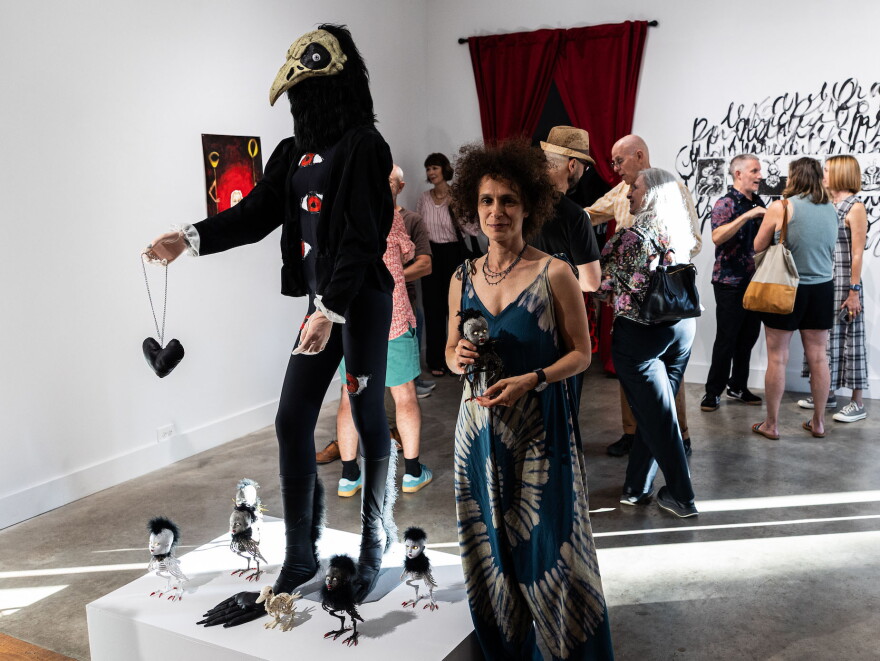
Yuliya Lanina poses in front of her artwork during grayDUCK gallery’s closing party in Austin on Saturday.
Ramanathan said she was often surprised by how dramatically grayDUCK could transform its 1,100 square feet for a show. That could mean a variety of surprises for visitors; the couple would create large display structures if needed to fill the room with ceramics, host musical or performance art events, or build complex video installations to suit an artist’s ambitions.
At Saturday’s gathering, looped animations were projected throughout much of the gallery’s dimly lit back room, adding atmosphere to the gothic-surreal installations and paintings from artist Yuliya Lanina, which took over the walls and floors of the main display area as well.
“They really support the artist’s vision for what they want to do,” Ramanathan said. “It’s always easy to kind of scale things back, and I don’t think they’ve ever done that.”
Schroeder said she’d been thinking about closing for a couple of years and nearly called it around grayDUCK’s 15th anniversary last year. She kept going after discovering a handful of exhibitions she wanted to put on before closing the space.
“I just couldn’t pass them up,” she said. “As soon as I did all the shows that I really, really wanted to do toward the end of my career, then it just felt like it was the perfect time to stop.”
Schroeder and Ramanathan both said they see reasons for optimism in Austin’s gallery scene despite grayDUCK’s departure. Schroeder said the local art community has gone through cycles of galleries opening and closing, but feels more stable now, with strong support from the collecting community.
Ramanathan said grayDUCK’s loss will be felt, while pointing to newer and established galleries that continue to build audiences for local and regional artists. She singled out McLennon Pen Co., Ivester Contemporary and Northern-Southern, calling the latter’s downtown home a “delightfully quirky space” worth keeping an eye on.
With her creative home now closed, Schroeder isn’t planning to disappear from the arts community. She expects to join the board of Women & Their Work and said she would be open to curating shows elsewhere.
But retirement will also mean making room for pursuits that got crowded out by the demands of running a gallery and staying active in the Austin fine art community. Shroeder’s travel plans include a trip to Mexico to see the monarch butterflies at their wintering grounds, and she may eventually return to making art herself.
“I’m going to travel more and kind of rest up and see what else is out there,” she said.