
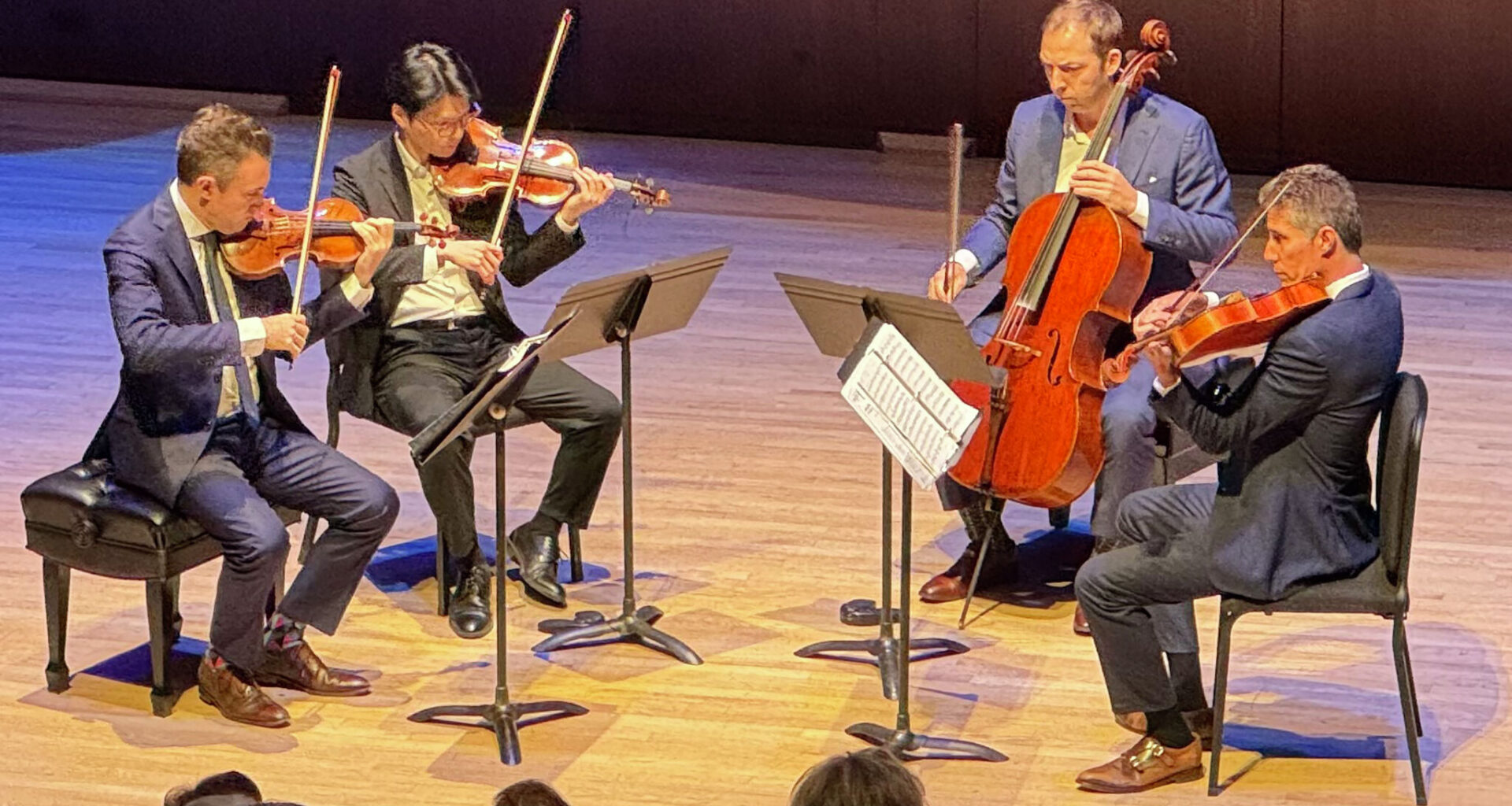
The Escher Quartet (L to R, violinists Adam Barnett-Hart and Bryan Lee, cellist Brook Speltz and violist Pierre Lapointe) performs at Southern Methodist University’s Caruth Auditorium on Sept. 28, 2026.
Scott Cantrell/Special Contributor
What is with all the aggressive string quartet playing these days? In music that doesn’t call for it.

That question occurred repeatedly in the Escher Quartet’s Monday night concert, at Southern Methodist University’s Caruth Auditorium. It opened the 82nd season of the Dallas Chamber Music Society.
An American foursome founded in 2005, the Escher has performed widely in the U.S. and abroad, including for the Chamber Music Society of Lincoln Center and the Santa Fe Chamber Music Festival. A former recipient of an Avery Fisher Career Grant, the ensemble previously held a residency at SMU’s Meadows School of the Arts.
Article continues below this ad
Stringed instruments and playing styles in Mozart’s day yielded less assertive effects than those common today. In Mozart’s D minor Quartet (K. 421), which opened the concert, there’s no marking louder than forte. Even throughout the 19th century, vibrato was considered an ornament, to be applied only subtly on a long note here and there.
But Monday night, from the start, the Escher played that 1783 quartet in a pressurized modern style, with intense vibrato. Although there were subtly nuanced quieter passages, fortes kept pushing into fortissimos. Even if you don’t imitate every aspect of 18th-century playing styles, isn’t it worth at least suggesting the subtler effects of an earlier and quieter time?
Nowhere in the concert was there any question of the Escher’s expert technique or taut ensemble. Whether the music was stylishly served was another matter. More reserved playing could be quite lovely, especially from second violinist Bryan Lee, violist Pierre Lapointe and cellist Brook Speltz, but first violinist Adam Barnett-Hart’s tone too often turned steely.
The outer movements of Sergei Prokofiev’s Second Quartet are among the happiest in the string quartet repertory. Although I’ve known and loved the piece since discovering it many years ago, at intermission I was surprised how many veteran concertgoers had never heard it before.
Article continues below this ad
When Hitler’s forces invaded the Soviet Union in 1941, the government dispatched artists to safety in the Caucasus foothills in the country’s far southwestern corner. While there, they were encouraged to incorporate folk idioms, and Prokofiev used folk tunes in this quartet.
The score does call for a fortissimo here and there, but even then the music dances so happily that Prokofiev surely didn’t intend assaults. Again, though, the Escher’s fortes tended toward fortissimos; the latter were too often of the “anything you can play, I can play louder” variety. Tuneful, toe-tapping music meant to sing and dance sometimes yelled.
It was more of the same in the last of Antonín Dvořák’s string quartets, the Op. 106 in G major — quieter playing warmly contoured, louder music assaultive in ways surely unimaginable, and undesirable, in 1873.
Others obviously, and audibly, felt otherwise. Each piece got enthusiastic applause and whoops — and there was a final standing ovation.
Article continues below this ad
Next on the DCMS series will be a piano recital by Richard Goode at 7:30 p.m. Nov. 16 at Temple Emanu-El’s Stern Chapel, 8500 Hillcrest Road. 214-864-1993, dallaschambermusic.org.