
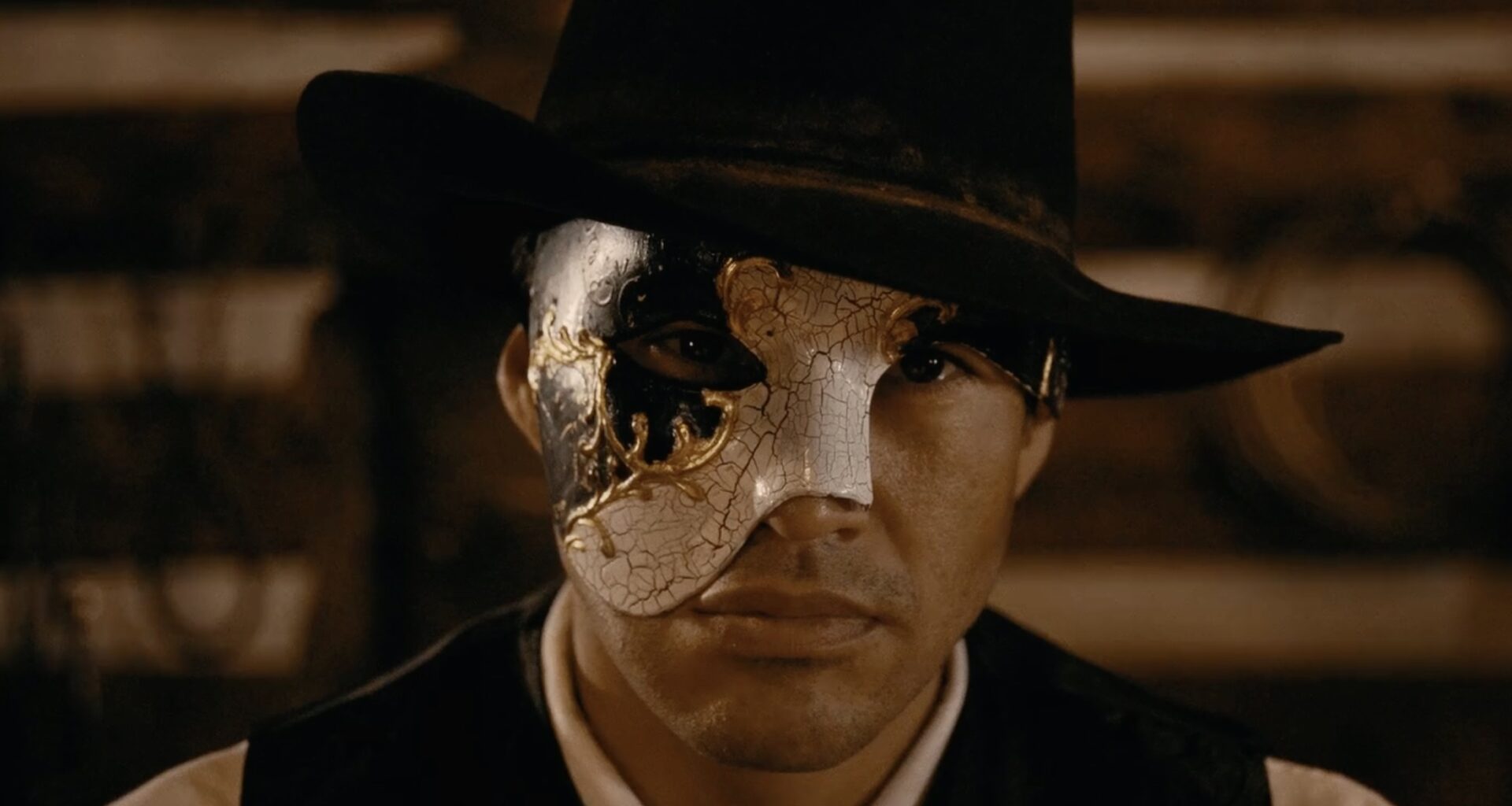
You can tell a lot about a filmmaker by what Westerns they like, and you can tell what kind of Western that Austin-based filmmaker Brock Harris was going to make by the same measure.
“I love Once Upon a Time in the West,” he said, “Definitely the Sergio Leones. Fistful of Dollars, The Good, The Bad, and the Ugly, the Clint Eastwoods, and going in that line, Unforgiven is really great, a more prestigious sort of Western. And I love Jim Jarmusch’s Dead Man, which is a little bit more of an art house Western – a peyote Western if you will. And gosh, I’ve got to say The Cowboys. All those John Wayne movies are iconic. I tend to be more in that 1970s grouping, but I like a little bit of everything.”
One particular subgenre he loves are the B-Westerns directed by Budd Boetticher, who made seven films produced by Randolph Scott and Harry Joe Brown under their Ranown shingle. They underwent a resurgence of interest when Criterion released them in a box set in 2023 but are still little known, even to most fans of cowboy flicks. Harris said, “They’re bite size. They’re usually only about 50 to 70 minutes long, and they had great performers. The stunt men would do absolutely crazy things that they would never do today, and you could really see it. It’s the old Hong Kong, Jackie Chan action-type movie, where you’re watching a guy really jump off a building. That kind of stuff was happening in those 1950s Budd Boetticher movies too.”
Those gritty, violent influences have undoubtedly sunk their fangs into Cottonmouth, Harris’ bloody tale of vengeance that premiered at the Round Top Film Festival last weekend and is now available on VOD. Set in Oklahoma in 1895, the story follows an innocent man, Ed Dantes (Martin Sensmeier), as he is subjected to cruel injustice by his supposed friend (Jonathan Sadowski), only to become just as vicious in his quest for revenge.
Yet it’s not quite revenge at any cost. For Harris, what unifies those films that influenced him are that the characters may not be moral in the strictest sense of the word, but they have a code. “There’s a common thread of amorality,” he said, “but each character has a code, and they live by it. That’s true for the villains, and that’s true for the good guys.”
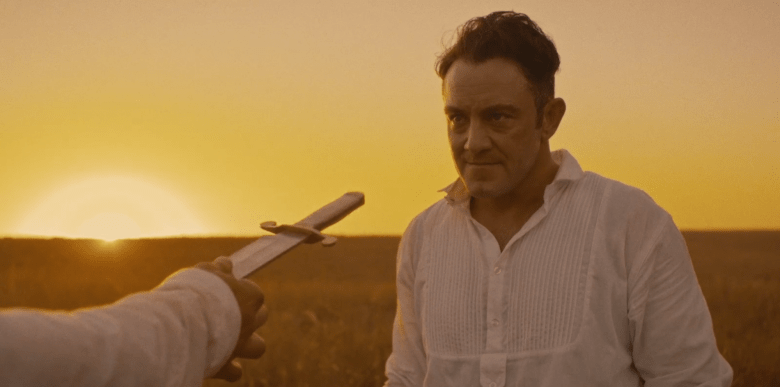 Jonathan Sadowski as Frank Ferrin Credit: Cineverse Entertainment
Of course, stories of the West and the movies have always gone hand-in-hand, with their eras overlapping. Some of the earliest Western stars grew up on the range and worked on ranches, like pioneering stuntman Yakima Canutt and silent movie star Tom Mix: Buffalo Bill went one better, playing himself in 1912’s The Life of Buffalo Bill. “Real Western folklore figures were consulting on those projects at the beginning of Hollywood,” Harris said. “We’re not that far removed from that history. … In 1895, people were starting to use telephones. There were cars being invented. So it wasn’t so different to the world we know today.”
Getting precise period set dressing absolutely correct was less of a concern for Harris than getting the cultural details of the era correct, especially when talking about turn-of-the-century Oklahoma. In 1895, it was still 12 years from statehood and split in half between the easterly Oklahoma Territory under federal jurisdiction, and the independent Indian Territory to the west. He picked the state in part because, even though he was born in Texas, he was raised there, and he picked the year because it was the height of the Oklahoma land rush. In this free-for-all environment with law enforcement often days away. “it became an outlaw haven because it wasn’t officially a state yet. So all these people who were outlaws throughout the country started rushing all into Oklahoma. … Everybody has their Wild West story as a state identity, and that’s ours. Towards the end of it all, we were that last frontier for outlaw hideouts.”
However, Cottonmouth is not just the story of black-hatted gunslingers. Harris explained, “When we had our state history lessons, there’s such an emphasis on the natives being moved to Oklahoma.”
Harris actually shot the film within the borders of the Cherokee Nation, at Prairie Song Pioneer Village near the Missouri state line, close to where his family had a cabin when he was a boy. It’s definitely not the kind of arid terrain that people who grew up on either classic Hollywood or Spaghetti Westerns would expect cowboys to traverse. “It’s swampy creeks and hills and caves and open prairie, too.”
However, he didn’t want the area to simply be set dressing. He wanted to take the history of the First Nations in the area into account, so he actually consulted with the Cherokee Film Commission about the realities of life within the Cherokee Territory. Like the terrain, the reality may surprise viewers who grew up on old Hollywood depictions of the First Nations. “They had their own police stations, they had their own schools, they were doing business, and a lot of people don’t understand that.” Harris pointed to the depiction of another Oklahoma tribe, the Osage Nation, in Martin Scorsese’s Killers of the Flower Moon. “Those people were only 30, 40 miles from each other, and they were engaging in oil rights and the cattle industry, and there is an entire history that we forget about because they have been stereotyped and troped so much.”
Those consultations became increasingly vital to the script as some of the characters in Cottonmouth are based on real historical figures. He said, “A lot of them have people still living, and they wanted me to change certain things because, ‘Look, we see her at the market still, and we don’t think they’re going to like you spinning her grandma’s story.’ Oh, gosh, I hadn’t thought about that.”
Cottonmouth is available on VOD now.
A note to readers: Bold and uncensored, The Austin Chronicle has been Austin’s independent news source for over 40 years, expressing the community’s political and environmental concerns and supporting its active cultural scene. Now more than ever, we need your support to continue supplying Austin with independent, free press. If real news is important to you, please consider making a donation of $5, $10 or whatever you can afford, to help keep our journalism on stands.