
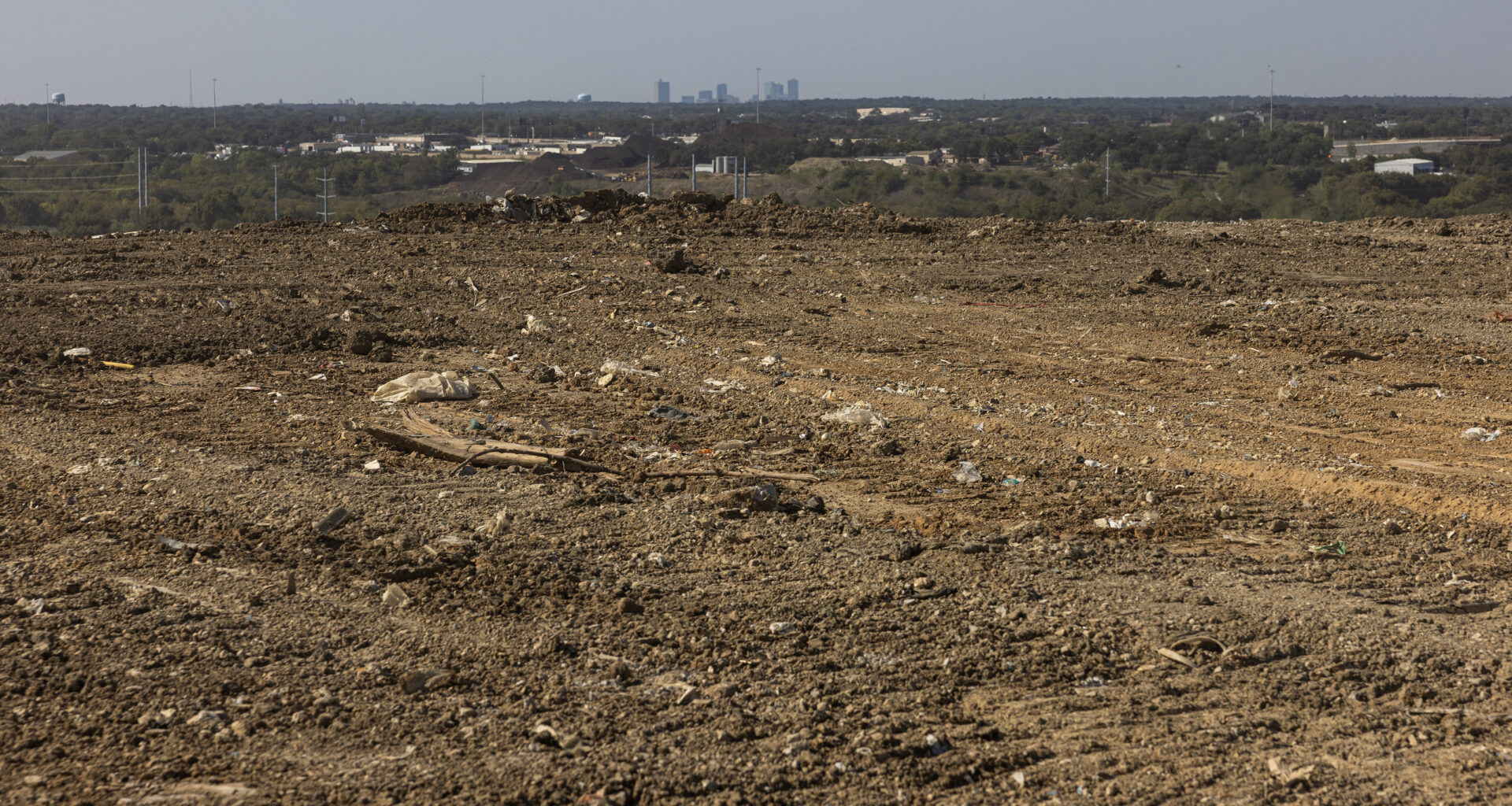
Fort Worth officials expect to have a renewable natural gas plant built at the city’s landfill within the next two years, capturing gases and producing more funds to support long-term waste planning.
Environmental services officials finalized an agreement in 2025 with Archaea Energy Operating LLC — a subsidiary of natural gas producer Archaea Energy Inc. — to convert the landfill’s emissions into renewable natural gas through a conversion system, according to city documents.
The conversion of the landfill’s methane into renewable energy will bring the city $2.5 million to $5 million annually toward solid waste planning, according to a report presented Tuesday to city council members. The funds will also advance Fort Worth’s programs for conserving green space and other environmental projects.
Remarking upon the city’s plans for the remaining decade of its landfill’s life, environmental services director Cody Whittenburg said in a statement to the Fort Worth Report, “Renewable natural gas revenue is earmarked to support future solid waste solutions, as we work together as a community.”
Construction on the facility is expected to begin by July 2027, with the plant anticipated to be up and running by December 2028, city documents show.
Landfill-produced emissions are the result of decomposing organic matter and waste, according to the Environmental Protection Agency. About 50% of gases emitted from landfills consist of methane while the other 50% is carbon dioxide.
Many landfills are built with infrastructure to treat and capture methane — a driver of smog and climate change — to mitigate the release of harmful emissions into the environment and turn the gas into a renewable source of energy, according to the EPA.
Fort Worth’s landfill is currently equipped with infrastructure to collect and manage methane through flaring, the process of burning the gases.
Solid waste landfills are the third-largest human-produced source of methane in the United States, accounting for just over 14% of the country’s methane emissions in 2022, according to data from the EPA.
The looming deadline on the longevity of Fort Worth’s landfill prompted officials in the past few years to plan for its closure and address increased waste streams brought on by the city’s population growth.
In January, Whittenburg presented to city council members an updated approach to long-term solid waste planning, detailing how staff are planning to preserve the landfill’s life and divert growing trash away from the site.
The city was also planning a focus group to provide feedback on Fort Worth’s solid waste budget, documents from January stated.
Of Fort Worth’s recently approved $3.3 billion budget for 2027, over $15 million in city revenues are dedicated to solid waste management.
The department’s budget increased from 2026 by nearly $10 million, with $9.4 million of that surge to solely fund long-term waste planning.
As a result, residential solid waste rates also increased, allowing the city to plan “responsibly for future landfill capacity and long-term” needs, budget documents state.
Whittenburg previously told the Report that waste transfer stations, additional recycling centers and new landfills were also possible solutions to Fort Worth’s growth-driven waste.
With the landfill’s life and remaining volume a priority for the department, environmental staffers are looking for other disposal options to meet future demands and increase recycling, city documents show.
“While specific, future solid waste strategies are being developed as a part of the city’s long-range solid waste planning effort, waste diversion is always supported and encouraged,” Whittenburg told the Report.
Nicole Lopez is the environment reporter for the Fort Worth Report. Contact her at nicole.lopez@fortworthreport.org.
The Report’s environment coverage is supported by the Marilyn Brachman Hoffman Foundation.
At the Fort Worth Report, news decisions are made independently of our board members and financial supporters. Read more about our editorial independence policy here.
This <a target=”_blank” href=”https://fortworthreport.org/2026/09/29/renewable-energy-plant-will-convert-landfill-emissions-support-fort-worths-trash-demands/”>article</a> first appeared on <a target=”_blank” href=”https://fortworthreport.org”>Fort Worth Report</a> and is republished here under a <a target=”_blank” href=”https://creativecommons.org/licenses/by-nd/4.0/”>Creative Commons Attribution-NoDerivatives 4.0 International License</a>.<img src=”https://i0.wp.com/fortworthreport.org/wp-content/uploads/2021/04/cropped-favicon.png?resize=150%2C150&ssl=1″ style=”width:1em;height:1em;margin-left:10px;”>
<img id=”republication-tracker-tool-source” src=”https://fortworthreport.org/?republication-pixel=true&post=808163&ga4=2820184429″ style=”width:1px;height:1px;”><script> PARSELY = { autotrack: false, onload: function() { PARSELY.beacon.trackPageView({ url: “https://fortworthreport.org/2026/09/29/renewable-energy-plant-will-convert-landfill-emissions-support-fort-worths-trash-demands/”, urlref: window.location.href }); } } </script> <script id=”parsely-cfg” src=”//cdn.parsely.com/keys/fortworthreport.org/p.js”></script>