
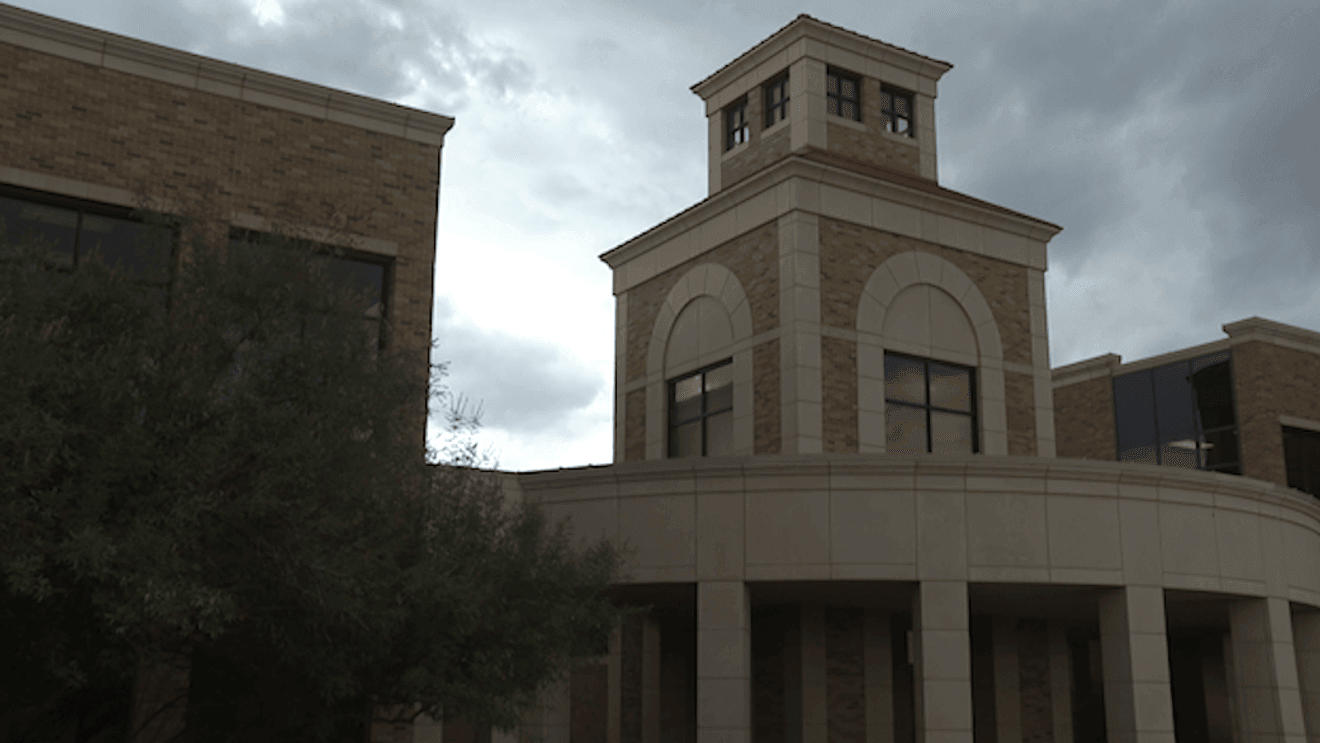
ABILENE, Texas — Texas Tech University Health Sciences Center has received a $24.5 million, five-year National Institutes of Health grant that will establish a research center spanning the university’s campuses and the 121 counties it serves across West Texas.
The U54 cooperative agreement is described by TTUHSC as the largest grant in Texas Tech history. Rather than funding a single research project, the award will build the infrastructure for a research center with dedicated staff.
Texas Tech University Health Sciences Center has received a $24.5 million, five-year National Institutes of Health grant (KTXS/Briannagh Dennehy).
Julie St. John, a professor in TTUHSC’s School of Health Professions and one of three principal investigators, described the distinction as consequential to the center’s scope.
“It’s not one research project. It’s for a center,” she said. “We’re going to be able to expand our infrastructure to do a lot of different activities and research.”

The U54 cooperative agreement is described by TTUHSC as the largest grant in Texas Tech history (KTXS/Briannagh Dennehy).
St. John will co-lead the center alongside Dr. Lance McMahon and Dr. Naima Moustaid-Moussa, creating a leadership structure that connects TTUHSC’s Abilene and Lubbock campuses.
“The structure that’s set up will include multiple principal investigators,” St. John said. “There are three of us. There’s myself, Dr. Lance McMahon, and Dr. Naima Moustaid-Moussa.”

The award will build the infrastructure for a research center with dedicated staff (KTXS/Briannagh Dennehy).
With the investment extending across numerous campuses, the scope of the center raises questions about how the funding will reach the communities TTUHSC serves.
KTXS asked, “How will TTUHSC ensure that this $24.5 million investment benefits communities beyond Abilene?”
St. John highlighted TTUHSC’s regional footprint.
“We’re spread across multiple campuses. So, we serve 121 counties in West Texas,” St. John said. “The way this will work is we have faculty on all of our campuses. The center will reach all of our campuses, and people will be involved in all of them. So, we’ll have new positions that are hiring in Abilene, and we will work and serve the Big Country, the Abilene community, Amarillo, Lubbock, the Permian Basin, and Dallas. So, it’s really a center that’s going to impact all of the communities and areas that we serve.”