
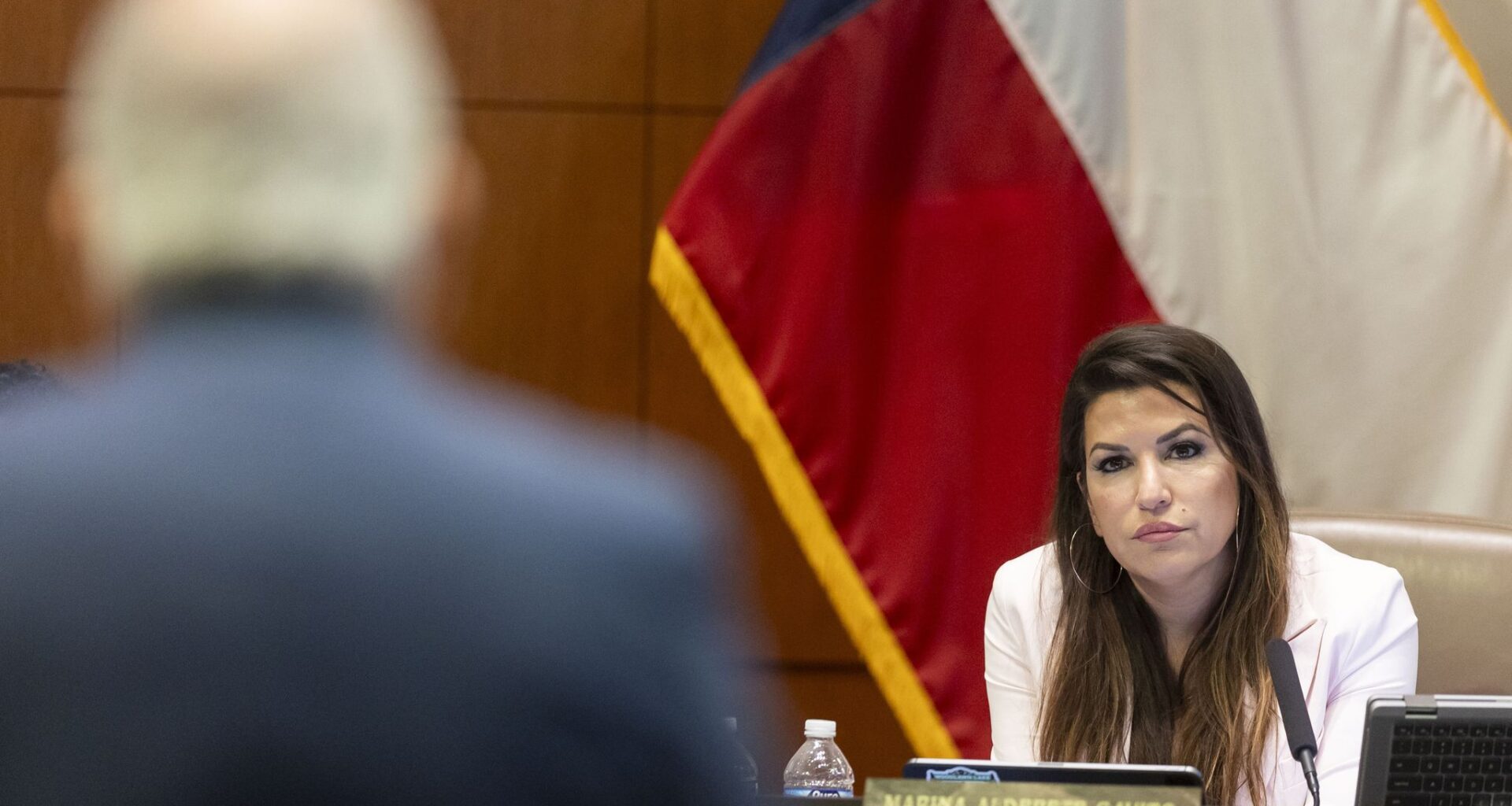
Councilwoman Marina Alderete Gavito listens as SAWS CEO Robert Puente speaks during a meeting in May.
Katina Zentz/San Antonio Express-News
The San Antonio Water System’s rate hike proposal on Wednesday got a friendlier reception from City Council after a three-month delay, though it’s still not clear if the utility will have enough votes to pass it next week.

SAWS is seeking to raise rates every year from 2027 through 2030, with a total increase of 23.7% to 30%. Because the utility is owned by the city, the council has the final say.
Article continues below this ad
In June, the council voted 6-5 to delay that decision until October, a move made after several council members sent a list of questions and demands for changes to SAWS and said they needed more time to get answers.
During a council meeting Wednesday, three of those six council members — Marina Alderete Gavito, Edward Mungia and Sukh Kaur — appeared more open to a rate increase, though none committed to supporting it. It would take just one of them to join the five who were on board with the proposal in June to pass it when it comes to the council again next Thursday.
READ MORE: A North Side subdivision got $2 million for its septic crisis. Now it wants a fee break.
The Oct. 8 vote will come less than a month after the council voted 7-4 to raise the city’s property tax rate for the first time in more than three decades.
Article continues below this ad
SAWS is proposing fixed increases of 6.9% in 2027 and 6.5% in 2028. The rates would then increase between 4.5% and 7% in 2029 and between 4% to 6.6% in 2030. That’s the same ceiling proposed earlier this year, but trustees voted in September to lower the floor for those two years.
The exact amount within those ranges would be determined by SAWS and city staff. The utility would have to justify any amount above the minimum and get approval from the city’s public utilities office. It wouldn’t return to the council unless SAWS proposed raising rates above the approved maximum.
If the plan is approved, it would take the average residential customer’s bill from its current $56.68 per month to somewhere between $70.13 and $73.61 in 2030, depending on where the final rate increase lands.
Article continues below this ad
Troy Elliott, the city’s chief financial officer, told the council Wednesday that city staffers have reviewed SAWS’ request and recommend approving it, as they did in June.
Alderete Gavito, who represents District 7, referenced the property tax increase — which she voted against — during the meeting, saying that she wants to push to get to a lower rate “however we can.”
But she also praised SAWS CEO Robert Puente’s “willingness to work with us” in recent months. She said the delay gave the council time to “make sure that SAWS has what they need to do what you all do for our community, but also for us, to make sure that we’re getting the best bet for our residents.”
Article continues below this ad
She said her staff compared SAWS’ planned water main replacements in her district to their own list of locations where residents most often report leaks and said the two maps “aligned perfectly.”
“SAWS is hitting the nail on the head with where the problem areas are,” Alderete Gavito said. But she said she still wants to make “one more push for us to get a lower bill,” leaving it unclear how she’ll ultimately vote next week.
She and Mungia have both publicly said they contributed to the late-night email Kaur sent to Puente before the June meeting, which Puente referred to as “the infamous list of questions.”
Mungia on Wednesday asked Jelynne LeBlanc Jamison, chairwoman of the SAWS board, to address three of the items on that list:
Article continues below this ad
Expansion of the Uplift affordability program to renters in multi-family housing
Changes to the utility’s impact fee policy for new development
A contract with Second Nature Compost to process biosolids — the material left over after sewage is treated.
“What’s important to me is making sure the board, you know, bought into certain policy ideas in the long term,” Mungia said.
SAWS is still working on solutions to the Uplift program, Jamison said. The issue is complicated because most renters in San Antonio don’t directly receive water bills, instead paying their landlords, making it impossible for SAWS to offer a discount directly to those tenants.
She said the SAWS board has heard clearly that council wants changes to the impact fee policy and that conversations are ongoing about that, and that the board will also consider whether to renew the biosolids contract when it ends later this year.
Article continues below this ad
Mungia thanked Jamison for “buying into those things and for having a long-term strategy and vision for accomplishing them.”
Kaur also praised some of SAWS’ responses to her concerns, but asked for more details ahead of next week’s meeting, including annual targets for expanding Uplift over the next four years and more data about how the rate increase would affect customers using more and less water than the average amount provided by the utility.
She also asked Puente for more details about how the utility will address a recent efficiency study that identified ways for SAWS to improve communication and stakeholder engagement — and repeated a frequent concern about needing to improve communication on major construction projects that affect drivers and residents.
McKee-Rodriguez, who was critical of Puente and of SAWS’ proposal in June, didn’t address the rate hike during the meeting. Neither did Councilwoman Misty Spears, though she spoke extensively in support of another item on the agenda, a request to waive $415,575 in SAWS fees for a North Side neighborhood outside city limits.
Article continues below this ad
Councilman Marc Whyte, who voted for the delay, said SAWS and city staff did well to reduce the minimum increases, but like Alderete Gavito, said he’s going to “keep pushing” for even lower rates.
“There’s 11 people elected by the citizens of San Antonio to watch over their money, and I think it’s incumbent upon all of us to do what we can to continue to try and keep more of their money in their pockets,” he said.
Council members who were supportive of the rate hike in June — Phyllis Viagran, Teri Castillo, Ric Galvan and Ivalis Meza Gonzalez — didn’t indicate during the meeting that they’ve changed their mind. Nor did Mayor Gina Ortiz Jones, who was one of the most vocal advocates for the increase earlier this year and remained supportive of it Wednesday.
Article continues below this ad