
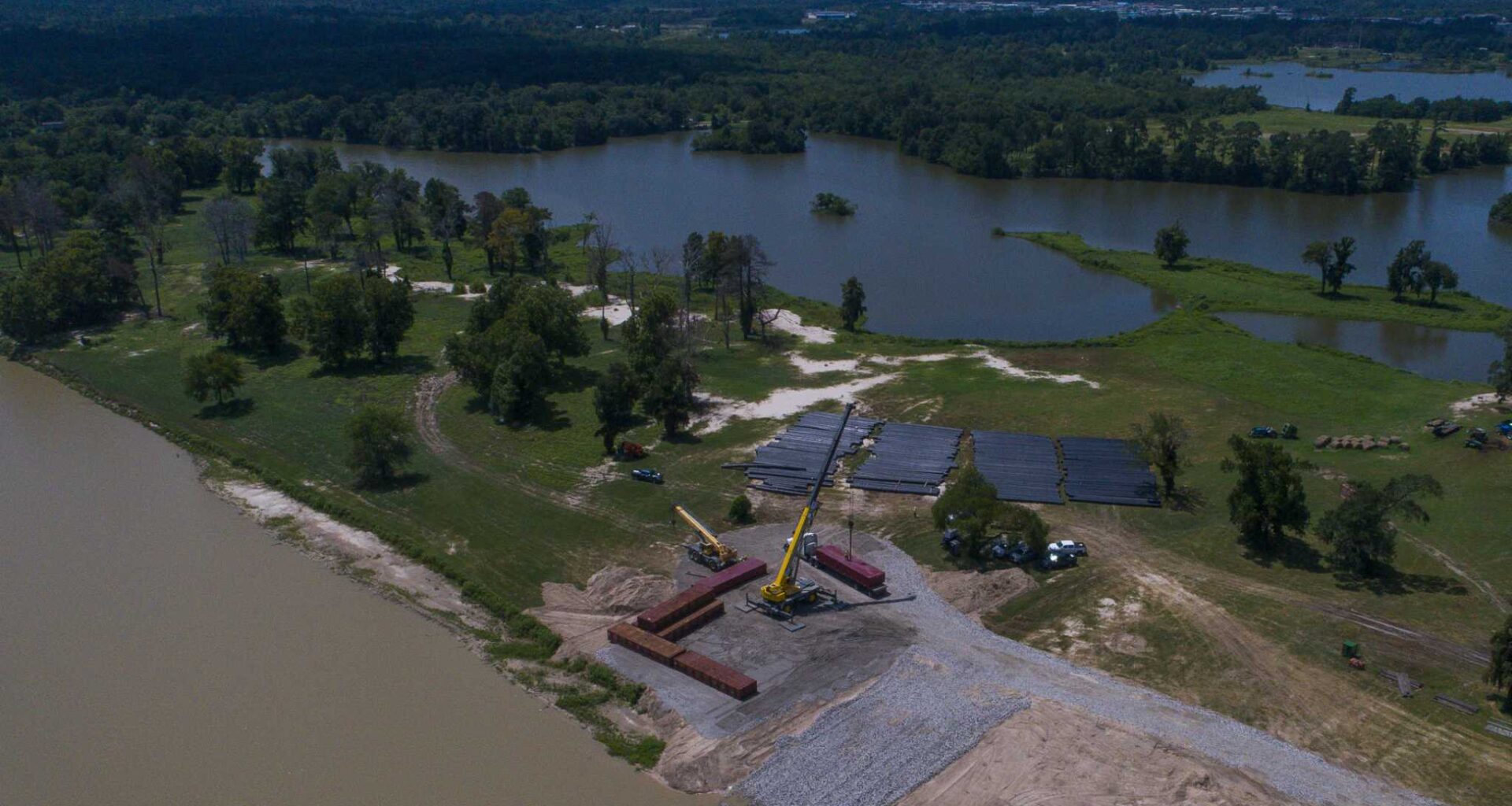
Contractors stage equipment for the Army Corps of Engineers’ planned dredging of the West Fork of the San Jacinto River east of Highway 59 in Humble in August 2018.
Mark Mulligan/Staff photographer
A new agency in northeast Harris County hopes to reduce flooding in the vulnerable neighborhoods around Lake Houston by dredging the lake and the San Jacinto River that feeds it, removing built-up sediment that has worsened repeated floods.
By routinely reducing these buildups, the new Lake Houston Dredging and Maintenance District could increase the capacity of the river and lake, lessening the kind of damage that occurred during Hurricane Harvey, when floodwaters spilled over the riverbanks and into thousands of homes.
The Legislature created the dredging district last year to help keep the worst disasters from striking again. By selling the materials the agency dredges up, the operation could at least partially pay for itself, without levying new taxes.
Article continues below this ad
But the fledgling agency has more mundane details to tackle before it can get dredgers in the field.
At just their second meeting last week, district board members — who are appointed by the city of Houston and Harris County Flood Control District — discussed opening a bank account, creating a website and agreeing on a seal.
READ MORE: As sand shrinks river capacity, Kingwood residents feel like ‘sitting ducks’ for floods
They were able to accomplish the last of those three, at least, opting for a blue sigil with a dredger and the silhouette of Lake Houston superimposed onto the Texas map.
Article continues below this ad
Board members hope the vision reflected on their seal can be made reality as soon as possible.
“In the past, the dredging of Lake Houston has been done on a post-disaster, reactionary basis, not a deliberate, planned basis,” said Bill Simpson, the agency’s board chair. “This district really is that missing link.”
A ‘gold mine’ in Lake Houston
Kingwood resident Bob Rehak was driving back from Minnesota when Harvey hit Texas, forcing him to hunker down in Oklahoma City while the storm passed. He didn’t know whether his wife, who lost cell and Internet service, was alive. She survived, but Rehak said 13 others within a mile of his house did not.
“Being newly retired, I said ‘here’s what I do in my retirement,’” Rehak said.
Article continues below this ad
Rehak, who studied journalism in college, devoted himself to researching why floods had worsened during his decades in Kingwood and started reduceflooding.com to post his findings. He rented helicopters to survey Lake Houston and found “tremendous sand deposits” accumulating in the west fork of the San Jacinto River, blocking most of the river’s flow.
Buildups of sand, silt and other sediments can occur naturally in moving water, especially after major storms reshape rivers and lakebeds. Rehak and others believe the issue is worsened by a proliferation of sand mines in the area that dig out the raw construction materials fueling the Houston area’s growth, something the Texas Aggregates and Concrete Association has denied.
Whatever the reason, studies had warned for decades that Lake Houston and its tributaries were steadily losing significant capacity to sediment deposits, and Harvey was not the first storm to cause devastating floods. Finding a long-term solution, however, had proved difficult.
Crews begin dredging work in the San Jacinto River in September 2018.
Courtesy of the U.S. Army Corps of Engineers
A number of governmental bodies have some level of oversight of the lake or its tributaries, but none are specifically responsible for routine dredging.
Article continues below this ad
The Army Corps of Engineers dredged the lake back to pre-Harvey levels after the storm but told local stakeholders it could dig no further. Former state Rep. Dan Huberty, R-Humble, repeatedly tried and failed to get a dredging district signed into law.
Huberty’s replacement, Rep. Charles Cunningham, R-Humble, took up his predecessor’s efforts in 2025 and added a condition that finally got the bill across the line: the new district could issue bonds and accept funds from other governments, but it could not establish new taxes.
Instead, the district will sell dredged sand, which is used in the creation of building materials, to help pay for its work.
“(The lake) is a gold mine,” Cunningham said. “It has all kinds of sand – concrete sand, mortar sand, cement stabilization sand, black sand, common sand. All of that has a price tag.”
District seeks seed funding
Before the dredging district can sell off the treasures of Lake Houston, though, it needs money to get off the ground.
Article continues below this ad
Houston City Council Member Fred Flickinger, who represents the Kingwood area, said at last week’s board meeting that he could donate some of his district funds once the dredging district opens a bank account.
Cunningham, too, told the board members he “needed a number” to bring to state budget writers when the Legislature convenes in January.
“Continue to lean on me,” Cunningham told the board.
PHOTO GALLERY: Then-and-now photos show how Hurricane Harvey flooded Houston
Board members discussed hiring an attorney, bookkeeper and engineering firm and producing a master plan to guide its dredging work.
Simpson, the board chair, said the district must have its groundwork in place by the time it receives funding.
“We have to be nimble to be able to dredge as soon as we have the money,” Simpson said.