
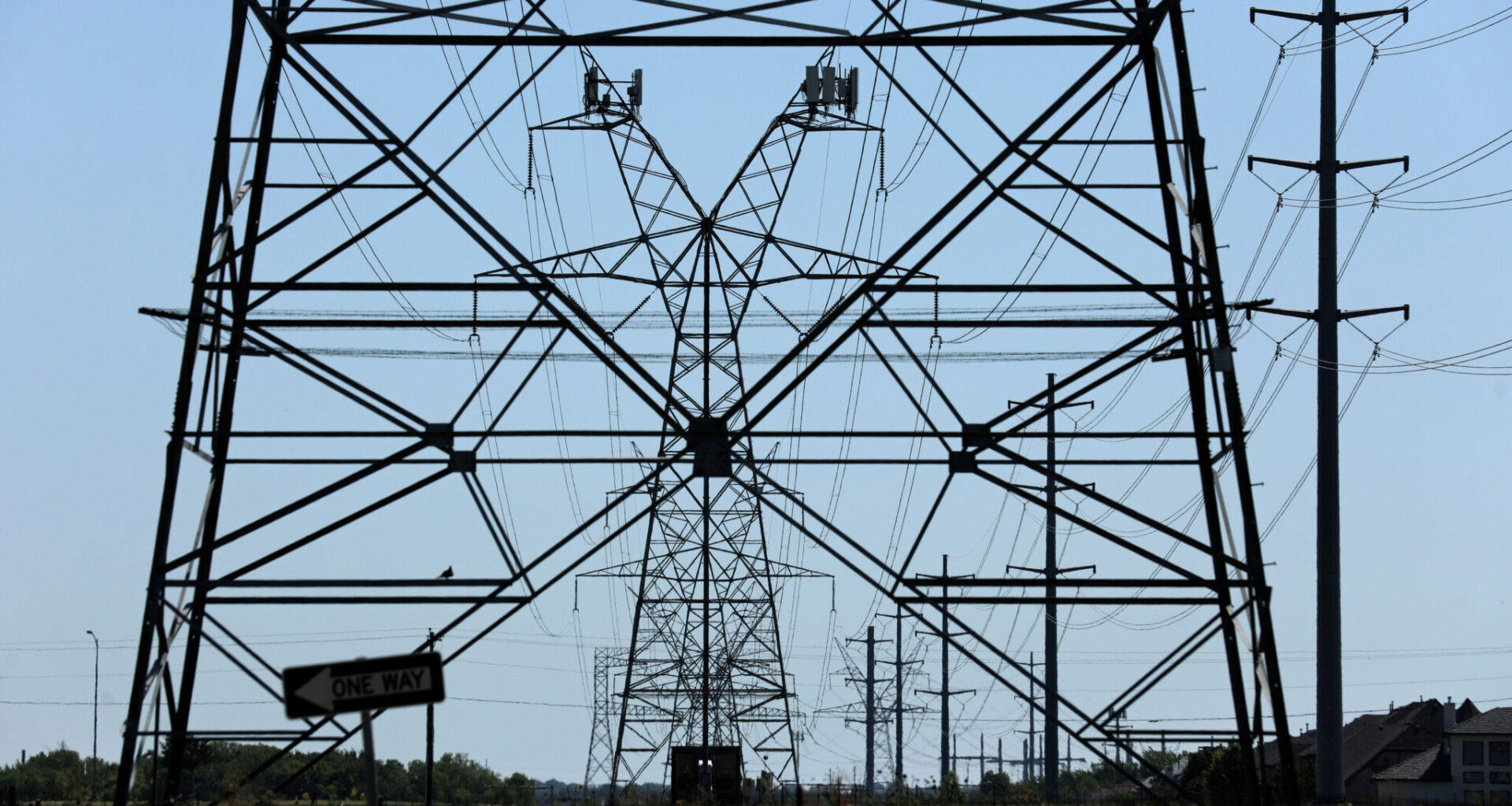
Texas regulators recently approved new transmission line projects for the Permian Basin. Building too little transmission can constrain economic growth and threaten grid reliability. Building too much could leave Texans paying for underused infrastructure, writes Claire Carroll.
Tom Fox/Dallas Morning News
Texas is about to undertake one of the largest expansions of the state’s electric grid in its history. But every new transmission line has to go somewhere, and, for many Texas landowners, that could be across their property.
In August, the Public Utility Commission of Texas approved more than 400 miles of new 765-kilovolt transmission lines — voltage never before used in Texas — as part of the state’s effort to move enormous amounts of electricity into the Permian Basin. Additional major transmission projects have been approved, with still more expected.
The scale of what Texas is contemplating reflects a fundamental change in the state’s electricity needs. Population growth, industrial expansion, oil and gas operations and, increasingly, massive data centers supporting artificial intelligence are creating demand for electricity at a pace our existing transmission system was not designed to accommodate.
Article continues below this ad
The challenge is not simply generating enough electricity. We also have to get that electricity where it is needed.
It is impossible to forecast exactly how much new demand will materialize, particularly because not every proposed data center or development will actually be built. However, even conservative projections anticipate dramatic growth. Texas therefore faces a difficult infrastructure problem: transmission lines can take years to plan, approve, secure rights of way for and construct. If the state waits until demand arrives, the infrastructure may arrive too late.
That has consequences for economic development and reliability. A company considering a multibillion-dollar data center, manufacturing facility or other power-intensive investment must know not only whether Texas can generate enough electricity, but whether sufficient transmission capacity exists to deliver it to the proposed site.
But building transmission lines carries costs of its own.
The Permian Basin Reliability Plan alone has been estimated at nearly $14 billion for its 765-kV option and associated upgrades. Those costs ultimately become part of the cost of operating Texas’ electric system. As Texas considers billions more in transmission investment, regulators must continually evaluate whether projects are appropriately sized and whether rapidly changing load forecasts justify the infrastructure being proposed. Building too little transmission can constrain growth and reliability. Building too much — or building it before demand materializes — can leave Texans paying for infrastructure that is underused.
Article continues below this ad
There is another cost that receives less attention: the impact on Texans whose land lies between where electricity is generated and where it is needed.
For the landowners whose property falls along a proposed route, the consequences can extend well beyond the acreage occupied by a transmission easement. A line can affect access to a property, where buildings or other improvements can be located, existing business or tenant operations and plans for future development. For commercial property in particular, a route can change not only the ongoing feasibility of a property’s current use, but whether and how property can be redeveloped in the future. As Texas builds more transmission lines, the process by which routes are selected becomes increasingly important for landowners.
For landowners, that makes understanding the PUC’s routing process extraordinarily important. The PUC’s process determines where a new transmission line may be built. Unlike a typical condemnation case, where the route is already set and the landowner dispute is largely about compensation, a PUC proceeding gives landowners affected by a proposed transmission line an opportunity to be heard before the route is final. During that proceeding, alternative routes are considered and the commission determines which route will ultimately be constructed. Once that decision is made, the question generally shifts from where the line should go to how the utility will acquire the easements necessary to build it.
The volume of transmission projects now moving through the PUC makes meaningful participation in that process more important, not less.
Texas unquestionably needs additional electric infrastructure. Our economic success has created an enviable problem: businesses and people want to locate here, and increasingly they require extraordinary amounts of power. Transmission availability may become one of the factors determining which communities capture the next generation of data centers, advanced manufacturing and other major investments.
Article continues below this ad
But speed and due process are not mutually exclusive.
The state’s task is to build a transmission system capable of supporting Texas’ next several decades of growth while ensuring that the Texans being asked to bear the physical burden of that infrastructure have a meaningful opportunity to be heard.
The PUC’s recent approvals are significant for more than the 400-plus miles of transmission lines they authorize. They signal the beginning of a much larger transformation of the Texas landscape and electric grid.
The question is no longer whether Texas will build more transmission.
Article continues below this ad
It is how we will build it — and how carefully we balance the economic benefits of that infrastructure with the impact on the Texans whose property makes that growth possible.
Claire Carroll is a Munsch Hardt shareholder whose practice focuses on complex real estate litigation.