
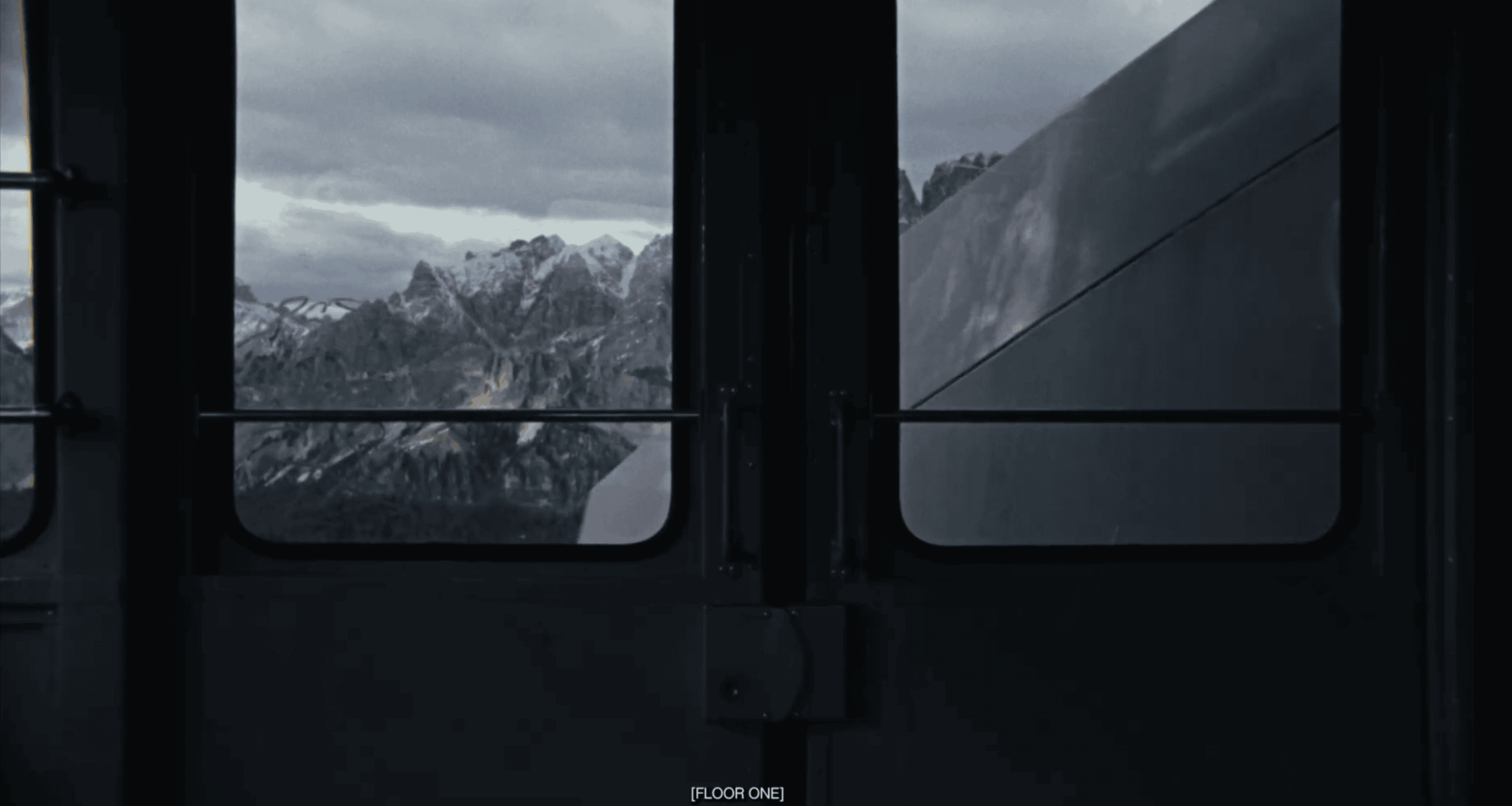
‘‘The skier is the artist, the mountain is the canvas, and movement becomes sculpture.’’
A skier moves through a mountain landscape, but we never see the skier. Instead, we see only the marks they leave behind: lines carved into snow, fleeting gestures across an immense white surface. The skier remains absent. Only an impermanent trace exists. By removing the identity of the artist, the viewer is asked to encounter the form before its authorship – to look before knowing. The gallery visit becomes primarily an act of observation, temporarily separating what is seen from any existing knowledge of who created it. The film exists in two forms: a short version for those who prefer a brief visit, and a longer version for those who wish to remain with each artwork. Both can be experienced with either a gallery guide or simply the ambient sounds of the space.
[The mountain becomes a gallery.]
Within this landscape, three exhibition spaces emerge. One is permanent – Forms as a Contingency – occupied by sculptures. Two are temporary: a second space, Trace as Trends, inhabited by paintings, and a third space containing installations named decommissioned forms. Like erosion shaping a landscape, movement produces forms that are never entirely fixed. The mountain is therefore not simply the setting of the work but an active participant in its creation: simultaneously gallery, material and archive.
[Movement produces form, Form produces image, Image becomes trend.]
The Mountain Gallery acts as the generator for ‘The Unseen Trend of Erosion,’ an ongoing project following a single extracted shape as it moves beyond the mountain and across different creative disciplines, including art, fashion, sculpture and architecture. A form born through movement is observed, isolated from its original context and captured. Once extracted, it is placed within another environment, where its material changes and its meaning is reassigned. Through garments, furniture and objects, the same form becomes concrete in different ways. What began as a temporary trace in snow is translated into something that can be worn, occupied, photographed or preserved. This process reflects the way trends themselves emerge.
Trends are rarely created ex nihilo. They develop through observation, extraction, reinterpretation and replication. Something is seen – consciously or subconsciously – removed from one environment, transformed within another, circulated, desired and eventually replaced. Yet its disappearance does not necessarily mark its end. Elements of it remain and become material for what follows. The ski trace becomes a physical metaphor for this cycle, while simultaneously mirroring the natural processes of erosion and transformation. Both trends and landscapes are shaped by their surrounding environments. Neither remains fixed; each exists through continuous adaptation.
[The skier is the artist, the mountain is the canvas, and movement becomes sculpture.]
The desirability of the ski trace lies partly in its impermanence. Like a trend, it appears, circulates and disappears. The impulse to capture it – to photograph it, sculpt it, wear it or build from it – is an attempt to solidify something that was never intended to remain still. Within this metaphorical gallery, this is where its beauty resides. Temporality does not diminish its value; it initiates and enforces its desirability. Preservation, however, does not end the cycle. Once extracted, the form begins another life and becomes vulnerable to reinterpretation again. Its new context changes how it is seen, just as the environment originally shaped the form itself. What appears to have been preserved has simply entered another stage of transformation.
What we perceive as innovation may therefore be less an act of creating from nothing than a continuous act of seeing. Forms pass between nature, image, art, fashion and architecture, repeatedly extracted and transformed by their surroundings. Vision itself is shaped by the environment; what we create is influenced by what we have already encountered, consciously or subconsciously. The mountain gallery eventually disappears. Snow falls, traces dissolve and the exhibition erodes. But its forms continue elsewhere. Extracted from the landscape and materialised through the eyes of the
ZUOI™ Gallery, they become part of an ongoing cycle of observation, translation and transformation. The gallery disappears. The unseen trend continues.