
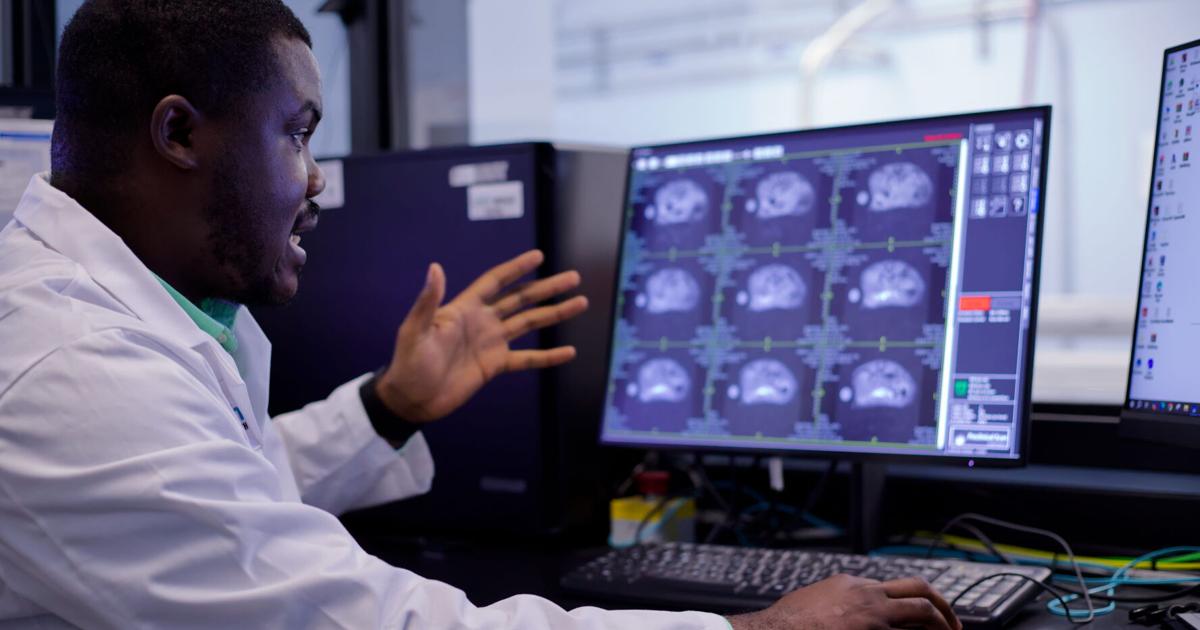
UNT Health Fort Worth officially welcomed its first cohort of students into the new accelerated Pharmaceutical Sciences Ph.D. program.
The program is the first of its kind in the Dallas-Fort Worth metroplex, with the program itself emphasizing drug discovery and development with interdisciplinary training. After a long, five-year effort, the program was officially approved in June of this year, accepting its first class featuring four students.
“We have students working on their master’s in drug discovery and development that want to further their education,” said Rebecca Cunningham, senior associate dean for research and a professor of the program. “But when they looked in the area of North Texas, there was no Ph.D. available in this area of pharmaceuticals.”
This accelerated program comes at a time when the pharmaceutical sciences field is experiencing a huge growth in Texas. Since 2019, the pharmaceuticals subsector has grown 56.2 percent in employers, with the Texas bioscience industry employing more than 130,000 individuals across 9,000 establishments in 2023.
“When you look around the Dallas area, this is the only pharmaceutical science program,” said Lama Hamdan, a first-year pharmaceutical Ph.D. student. “So I find this opportunity very helpful for me since I’m living nearby.”
In order to support this growth, UNT Health Fort Worth’s Ph.D. program is accelerated. This makes the time to graduate three to four years less than the average five to seven years it normally takes to earn a Ph.D.
“The growth has been immense,” Cunningham said. “To be able to support that growth, we need to have individuals that have the education to step into that workforce.”
Due to being an accelerated program, students who want to apply and be considered will need to have completed a master’s or a PharmD — a doctoral degree meaning Doctor of Pharmacy — before applying.
However, students do not necessarily need a master’s within pharmaceutical sciences to be considered.
“It would be wonderful if we could be getting some of our Ph.D. candidates out of Denton,” said Evan Robinson, College of Pharmacy dean and professor. “If we could find someone with a master’s degree in nearly almost anything, and then have them decide that they want to do this, that would be amazing.”
The program also emphasizes students leaving with real-world experience they can take directly to the workforce.
“The most useful thing for me has been the practical lab experiments,” Hamdan said. “I’m starting my first lab rotation and it’s been very helpful getting to learn a lot of new things and receiving practical workforce training.”
As a requirement, one Ph.D. committee member has to be a clinical faculty member in the Department of Pharmacotherapy.
This requires one of the PharmD and residency-prepared faculty to teach in the clinical program and take students into experimental rotations to have an understanding of application.
“That is powerful,” Robinson said. “That brings us to an understanding of translational science in a way that’s very different from a lot of Ph.D. programs.”
The college’s research facilities feature a pharmaceutical analysis core lab and different mass specs, a tool that quantifies molecules, and other instrumentation provided through the program.
Research being conducted right now includes, but is not limited to, insight into eye diseases and drug delivery to the eye, metabolic dysfunctions, cancer and nanoparticle delivery.
“So it’s not one thing that we’re looking at,” Cunningham said. “But the bonus of that is that means that an applicant can come in and they can get exposed to many different areas of science and see what strikes them as their passion.”
The program’s goal is to accept five new students into each cohort, meaning a maximum of twenty students will be in the program at any given time. Applications for the Fall 2027 cohorts will open up to five new students this November and close on March 1, 2027. Applicants will receive their decisions in late spring.
Additional requirements and information about how to apply can be found on the UNT Health Fort Worth’s College of Pharmacy admissions page.
“If this is something that matches your passion, come find us,” Cunningham said. “We’re here, and we’re going to help you on the path that you want to go through.”