
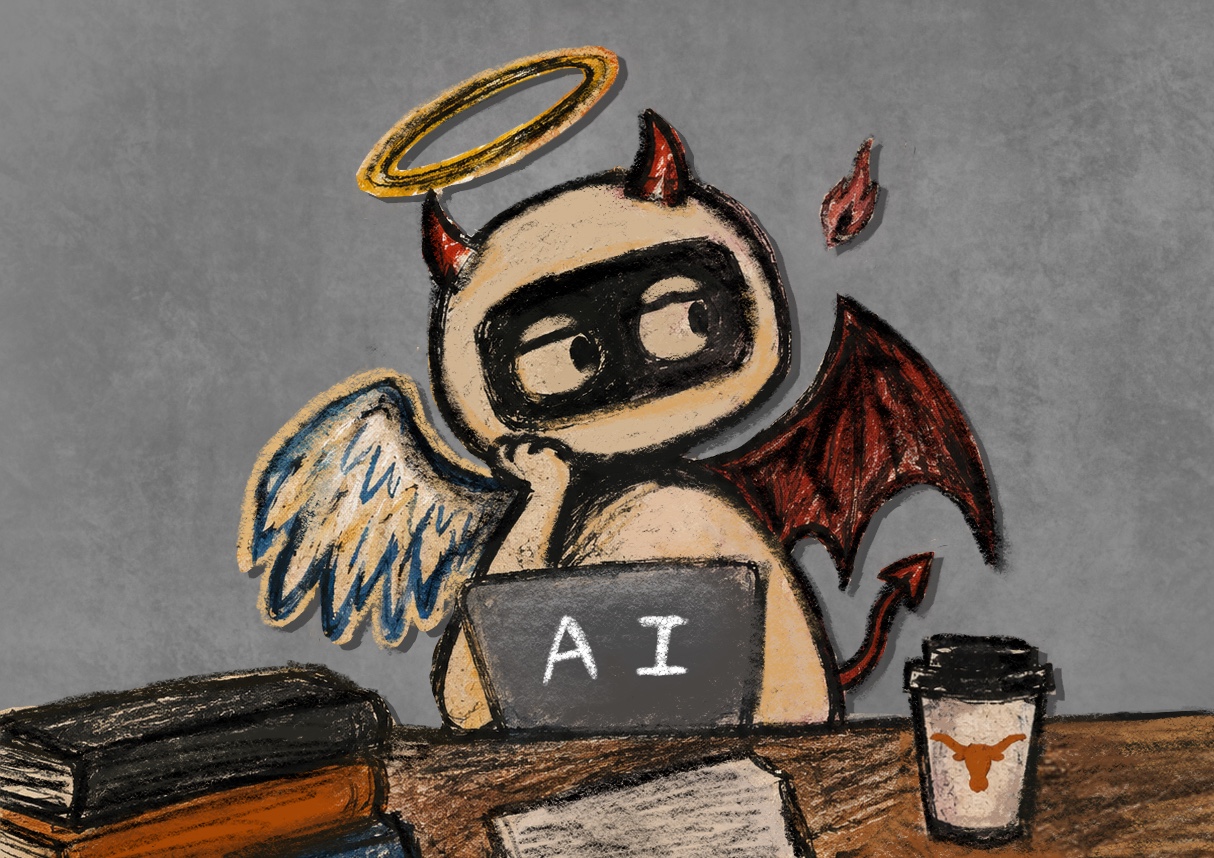
This past semester, UT officialized the incorporation of AI by giving every student, faculty and staff member on campus access to ChatGPT and Claude EDU.
Mario Guerra, UT’s associate vice president of AI platforms and innovation, said Enterprise Technology’s goal is to provide all students with the same technological resources.
While this is reasonable, it is unfortunately also an unfinished project. UT solved the aforementioned access problem but left a usage issue for thousands of professors and students to sort out on their own — one syllabus at a time.
To be fair, Enterprise Technology was not ignoring the issue. The provost’s office currently mandates all syllabi state a clear AI policy regarding how and when AI is permitted. That’s progress, but a syllabus line discussing appropriate AI usage is not nearly the same as UT telling students what responsible use actually looks like. As a result, some students opt out not because AI isn’t useful — it certainly can be — but because of the fine line between integrity and dishonesty that no one defines.
“(Students) don’t know when to use (AI) and when not to use it,” Guerra said. “So they’re choosing not to use it because they don’t want to be accused of cheating.”
Guerra said the University has allocated plentiful funds to negotiate campus-wide licenses and an advisory committee.
Additionally, he was clear about where he and his office set the boundaries: promotion of AI outside the classroom yet discretion inside it. He encourages UT professors to control the utilization of ChatGPT and Claude EDU by their students, which is fair. A computer science class and a Jane Austen UGS course should not have the same rules. However, there is a major contrast between professors determining what’s allowed for their discipline and leaving what counts as cheating undefined campus-wide. UT can keep the first without abandoning the second.
This additional standard should indicate AI as a means of augmented support rather than a substitute for original thought.
“I wouldn’t encourage AI, but I definitely think it’s acceptable in terms of using it to help enhance my learning and for extra practice or explaining parts of the class that I’m confused about,” neuroscience sophomore Kristin Arreola said.
However, heavily leaning on AI dulls the skills college is supposed to build. Struggling through a hard problem, sitting with confusion, fixing your own bad draft — that friction is where learning happens. Outsource enough of it and students risk becoming fluent in prompting and unpracticed in critical thinking.
I take that seriously. But the answer to a real risk is a standard, not silence. Lack of regulation doesn’t stop students from using these tools. It just stops them from using them consistently. The provost office’s own “4D framework” — delegate, describe, discern, diligence — is a starting answer to that critique if UT enforces it instead of burying it in an optional module.
UT already requires a policy line in every syllabus, but it should pair it with a campus-wide statement of principle taught at orientation emphasizing that AI is here to support your work, not replace it. Let professors set specifics for their discipline, but don’t leave the philosophy undefined — because right now, UT’s actions ask students to embrace these tools while its silence causes students to fear them.
Rodriguez is a psychology and philosophy junior from Houston, Texas.