
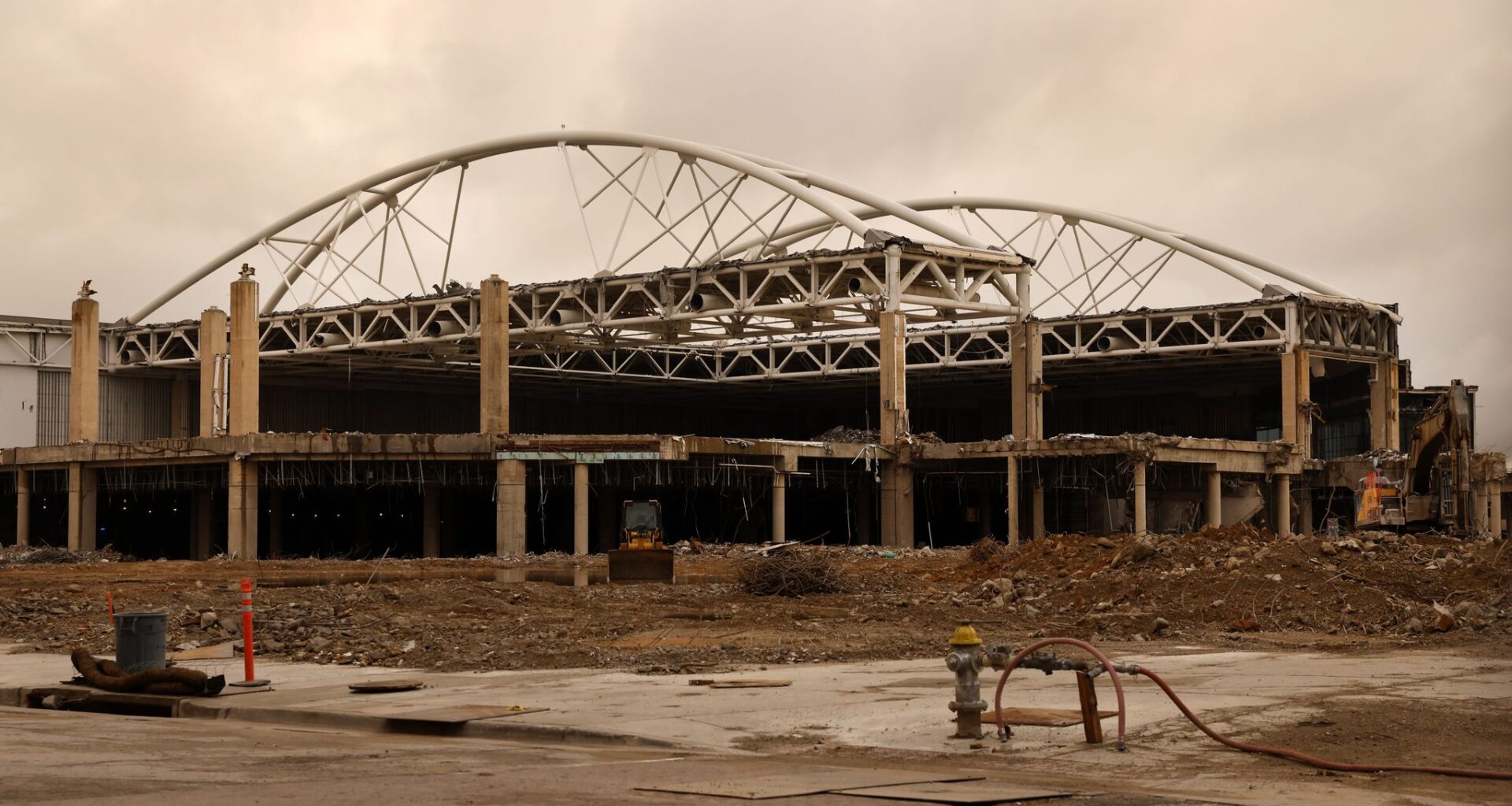
Few among us are shedding tears over the demolition, now underway, of downtown’s Kay Bailey Hutchison Convention Center. Architecturally, there isn’t much to recommend that sprawling concrete beast, beyond George Dahl’s original Memorial Auditorium. There is one other element of that complex worth preserving: the twin steel structural arches that soar above its largest exhibition space, or what’s left of it.
You can get a good look at them, at least for the moment, from the Houston Street Viaduct. They stand atop what used to be the building’s roof, a pair of 400-foot-long, 50-foot-tall parabolic arches painted bright white. They bear an unmistakable likeness to Santiago Calatrava’s nearby Margaret McDermott Bridge, though they predate it by more than a decade. They also happen to be far more delicate in their swooping, sculptural design.
The idea of saving the arches began circulating through design circles last week, prompted by local architect Robert Meckfessel, who had a eureka moment while looking out at the arches from a window on the third floor of the Omni Hotel. “I’ve always liked them from the time they went up,” he says. “They are just starkly beautiful.”
Behind closed doors, Inspire Dallas, the development group charged by the city with rebuilding the convention center, has also looked into saving the arches. “While structural, budget and schedule considerations, along with required approvals from Union Pacific Railroad, present challenges,” Angela Daniel of Inspire Dallas said in a statement, “the team is committed to salvaging significant portions of the arches for reimagined public art.”
The arches were built as part of the 2002 expansion of the convention center, and designed by the legendary Dallas structural engineer Thomas Taylor, who died in July at the age of 89. Like much of Taylor’s work, their design was a creative solution to a challenging technical problem: the demand for an enormous exhibition space unobstructed by columns. When it was completed, it was among the largest column-free exhibition spaces in the world, and widely covered in the engineering press. Taylor himself wrote about the design in an essay titled “The Epitome of Form & Function.”
“He just loved those arches,” says his widow, Dane Nelson Taylor. “I think he would be very proud and happy to have another use for them.”
Meckfessel’s proposal calls for disassembling the trusses and then moving them to a local park, where they could be rebuilt as both an art installation and a monument to Taylor, who contributed to the design of the Perot Museum, the Nasher Sculpture Center and Thanks-Giving Square. “He had such an influence on so many projects across Dallas that it would be great to honor him,” says Meckfessel.
Exactly where the arches might go is an open question. “It is an interesting idea if an appropriate location can be found to display them,” says City Council member Paul Ridley. One intriguing option would be to reuse them as a ceremonial gateway to the Dallas Water Commons, the park along the Trinity River being developed by Jack Matthews, the figure behind Inspire Dallas. Who would pay for such a project is, like the potential relocation, unresolved.
But a decision will have to come soon. The demolition of the convention center continues, with the arches scheduled to come down in mid November.