
David Carranza wasn’t sure where we should start the driving tour. Maybe at the nearby property with the creek running behind it, where a neighbor recently found rotting cattle carcasses and rusted oil barrels amongst other illegally dumped detritus. Or maybe the crack house around the corner, where, he said, the owner allows sex workers and the unsheltered to crash during the day.
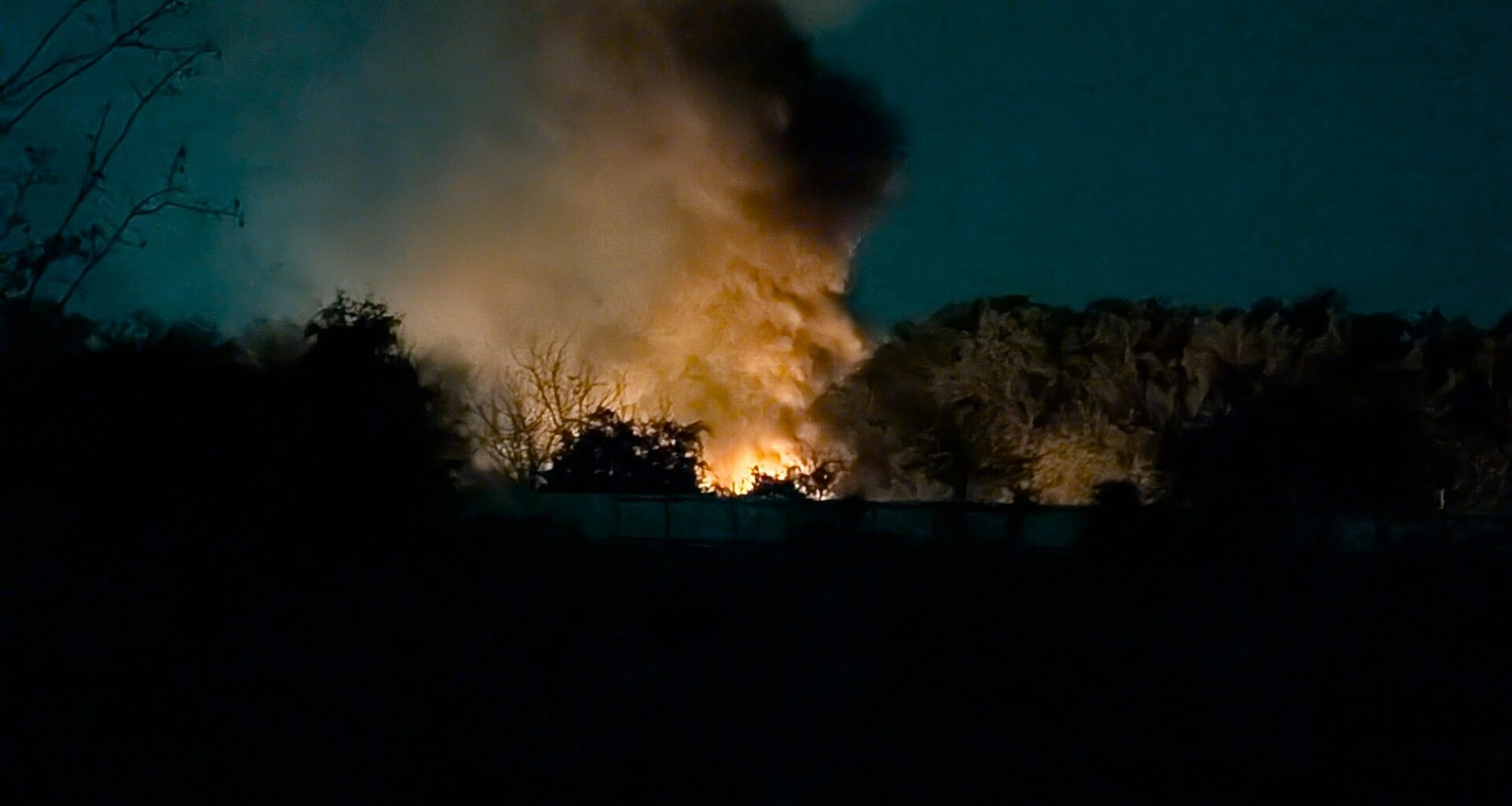
Or maybe we’ll start with the sewage pipes that run across the creek adjacent to a small, long-planned pocket park. Or at the new Auto Zone built where a century-old home was razed without permits. Or the new gas station they went to City Hall to protest. Or the indefinitely shuttered library. Or the enormous piles of trash — like, doors and car bumpers and bricks — on nearly every street. Or the salvage yard that caught fire over the weekend.
Or just all of it. Every beautiful, rotten, wonderful, contaminated stretch of the land called Kleberg, where Carranza is president of the neighborhood association and crime watch.
“This was my getaway, the country close enough to the city,” the 62-year-old former Oak Cliff resident said as we sat Wednesday morning at his dining room table. “Peaceful. Quiet. The slow-paced life. I thought.” He laughed.
Article continues below this ad
Then he told me about the fire over the weekend that he feared would burn the seven head of cattle grazing the eight-acre pasture behind his home off Kleberg Road, where there’s a monitoring well, a left over from when this was downstream from lead-contaminated Dal-Tile land. Carranza at first thought it was just the usual random gunfire — which, out here, he said, sounds like a war zone, the unceasing pop-pop-pop of assault rifles. Then he saw the flames.
David Carranza lives two properties over from the salvage yard that was investigated by the Texas Commission on Environmental Quality and sued by the city of Dallas. There are no open cases, but Dallas City Council member Lorie Blair said an investigation is taking place following Saturday night’s fire.
Robert Wilonsky/Staff writer
A Dallas Fire-Rescue spokesperson told me later firefighters didn’t think the cows were imperiled. But it did take them three hours — and an additional Dallas County tanker — to douse the blaze.
This part of the city — and it is part of the city — has been the southeasternmost slice of Dallas since voters in both cities approved annexation in early 1978. Kleberg, where working farms sit alongside single-family homes, is but 15 miles southeast of Dallas City Hall, a 30-minute drive down C.F. Hawn Freeway from downtown in afternoon traffic. Some of this is city land; some, Dallas County property. Residents say they might as well be on the moon.
“It’s perfect out here,” Marla Hogarth said Wednesday morning as we stood in her driveway, peering over the pastureland that stretches toward a treeline hiding the creek that floods her land whenever it rains because it’s filled with trash and animal remains.
Article continues below this ad
“I just wish it weren’t so …” She paused, looking up at the sky filling with rarely seen rain clouds. “Stressful. Why does it have to be so difficult?”
Hogarth is Dallas City Council member Lorie Blair’s appointee to the Citizen Homelessness Commission. She and her family moved here 11 years ago from New Hampshire, after time spent living in California and New Zealand. She said if she knew then what she knows now about Kleberg, she never would have moved here.
It was the fire that brought me out to Kleberg for the first time in a long time — probably since the early 2000s, back when city staffers were prepping one of a number of Kleberg plans killing time on the city’s website. Over the weekend I’d received a vexed text from Kathryn Guerra, chair of the city’s Environmental Commission, who got her own tour of Kleberg just last Friday. That was the day before the GD Star Auto Salvage caught fire.
The Trust for Public Land plans to install a green space near this stretch of Hickory Creek, where David Carranza explained Wednesday that these sewage pipes occasionally leak.
Robert Wilonsky/Staff writer
“Residents told me that they’re tired of the city’s laws going unenforced and that they want the level of city services that other folks in the more central areas of the city enjoy,” Guerra said later. “Despite living in a rural part of the city, they still live in and pay taxes to the city of Dallas.”
Article continues below this ad
City Hall is well aware of that salvage lot: In June 2024, the City Attorney’s Office sued its numerous owners, claiming, among dozens of other alleged violations, that it was crushing cars — some stolen, according to Dallas police — without a certificate of occupancy on land zoned for residential and agricultural use.
Worse still, said the city: “The Property has a waterway running through it, into which Defendants are depositing vehicle parts, tires, debris, and chemicals from vehicles.” That waterway is called Hickory Creek, which flows into the Trinity River.
The Texas Commission on Environmental Quality had investigated similar complaints at the end of 2023, and found the salvage yard was operating without the proper stormwater permits, but closed the case in two months. Five months later came city attorneys trying to shut down the salvage yard and hoping the court would appoint a receiver to clean it up. The owners of the salvage yard denied every allegation.
Trial dates were set, but before the case reached a courtroom, a settlement was reached in February 2025, with the city insisting the land had been cleaned and that the copious other violations had been abated.
During Wednesday’s tour, a city Code Compliance officer was investigating a homeless encampment tucked into this overgrown land next to a new apartment complex off C.F. Hawn Freeway.
Robert Wilonsky/Staff writer
Which came as news to Blair when I called her Wednesday to talk about the state of Kleberg.
Article continues below this ad
“I don’t know exactly what’s going on, but I have had a conversation with the City Attorney’s Office,” she said. “Right now, I can’t say much other than there is an investigation going on surrounding that property and the fire.”
Blair, who served as this area’s plan commissioner before becoming its council member, spent a lot of time Wednesday making sure I knew the city hadn’t abandoned Kleberg. She said the library, flooded after a freeze, would eventually reopen. She said streets near schools that were to have been widened with old bond dollars will eventually be remade. And she said long-ago promised trails, stretching from Pleasant Grove to Seagoville, would eventually get paved.
“The challenge with Kleberg is it wants to be rural with urban amenities,” Blair said. “It still wants large lots, which means the least amount of residents, but it wants all the amenities of urbanism — roads that are paved, the infrastructure you would get in the most dense areas of the city.”
It’s all coming, she said. Just as soon as the repair estimates come in. And after the eminent domain condemnation proceedings are wrapped up. And after this broke city can find the money.
David Carranza wasn’t aware there was a monitoring well on his eight-acre property until long after he bought it. It was installed once it was discovered that Dal-Tile contaminated a lot of southern Dallas County land, for which it was fined $1 million in 1991.
Robert Wilonsky/Staff writer
Which reminded me of something Marcus Wood, a longtime commercial real estate man, told me this week: “The city basically treats Kleberg not like mañana, but next week, next month, next year, next decade. Sure. They’ll get to it. Eventually.”
Article continues below this ad
Like, say, a long-promised $600,000 greenspace the Trust for Public Land hopes to plant at the end of the narrow Echo Lake Drive within the next 18 months, said Molly Morgan, the TPL’s Texas State Director — near new houses and Hickory Creek and those exposed sewage lines kids use as a pedestrian bridge. In Kleberg, it seems, it’s always a little good with the less so.
“It’s not like it’s the middle of nowhere, but it’s at the end of the city,” Blair said. Which means, she said: “It has its unique characteristics …”
I interrupted, “You mean challenges?”
“I didn’t want to say challenges,” Blair said. “Unique characteristics.”
Article continues below this ad
It’s not like any of this is new. Only months after the 1978 annexation, the Dallas Times Herald ran a story: “Kleberg leaders claim Dallas broke promises.” In this town, history just means running the same headline over and over and over. Until, maybe, something changes.