
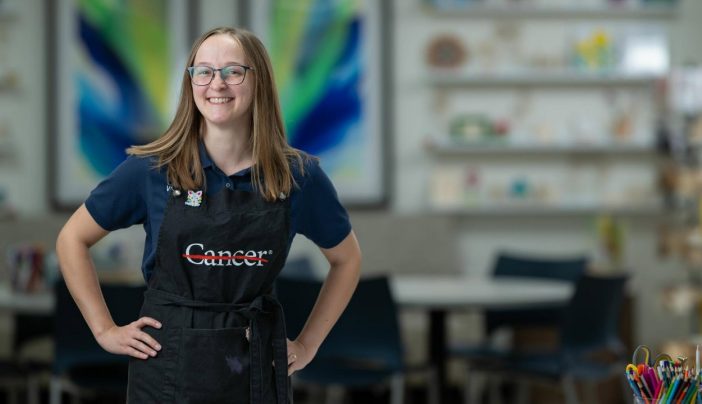
How do you connect with patients and caregivers?
People who’ve visited the Art Space before usually know what they want to work on. But the Art Space can be a little overwhelming for new visitors who may be unsure of where to start. So, I’ll walk up to them, introduce myself and welcome them to the Art Space. Then I’ll show them all of the art supplies and projects we have, including our to-go kits if they need to leave to get to an appointment.
Sometimes, a patient or caregiver will come in, and I can tell immediately something is bothering them. I’ll usually say, “Let’s get you set up with some paint, markers and a canvas.” The Art Space provides them a safe space to work out their feelings or frustrations on an art project.
There are other times when patients come in and just want somebody to talk to. That’s why I usually work at one of the tables where patients sit. That way, if they want to chat, we can chat. That’s really the best way to connect with them. Not every patient needs that, but for the ones who do, I am here for them.
What do you enjoy most about volunteering in the Art Space?
It’s amazing when patients recognize that art has more purpose than just drawing something ‘perfectly.’ They can really get relief from creating art, even if they don’t consider themselves artsy. I love seeing people realize that art is helpful for them.
I understand you’re enrolled in the Medical Dosimetry program through UT MD Anderson’s School of Health Professions. What interested you in that program?
Medical dosimetrists use computer software to help create customized treatment plans for cancer patients and determine where exactly the radiation should go, while protecting as much healthy tissue as possible.
My mom had radiation therapy as part of her cancer treatment. Seeing how much that improved her quality of life motivated me to pursue a career where I could do something like that to help others.
At the time, I was working at UT MD Anderson in the specimen processing lab. And a coworker who was already in the Medical Dosimetry program told me about it and said it would be right up my alley. She encouraged me to apply. It’s a very competitive program, and I’m so thankful I was accepted. I started in August 2025.
Is there anything you can glean from volunteering that might help you in your career?
Medical dosimetrists look at scans and then contour, or outline, organs such as the heart or liver. This helps the radiation oncology team calculate and plan the safest and most effective radiation dosage. That is one aspect where my experience with drawing would be helpful.
But I think what will be even more impactful is my genuine care for others. I won’t look at a scan as being just another scan. For me, each scan represents someone’s loved one – a mother, a grandmother, a son. I’ll think back to how I felt when my mom was receiving radiation. I’ll also think about the many patients I’ve talked to in the Art Space who shared what they were feeling before a radiation appointment or those who were considering that kind of treatment. I can draw from those experiences even when I’m behind a screen.
What else would you like to share?
I’m married with two fur babies – a cat and a dog. My mom moved to Houston two years ago, and I love having her close by.
Volunteering at the Art Space has brought me a lot of joy. Drawing on those canvases and seeing the impact it’s had on people has helped me stay motivated as I continue my journey at UT MD Anderson.