
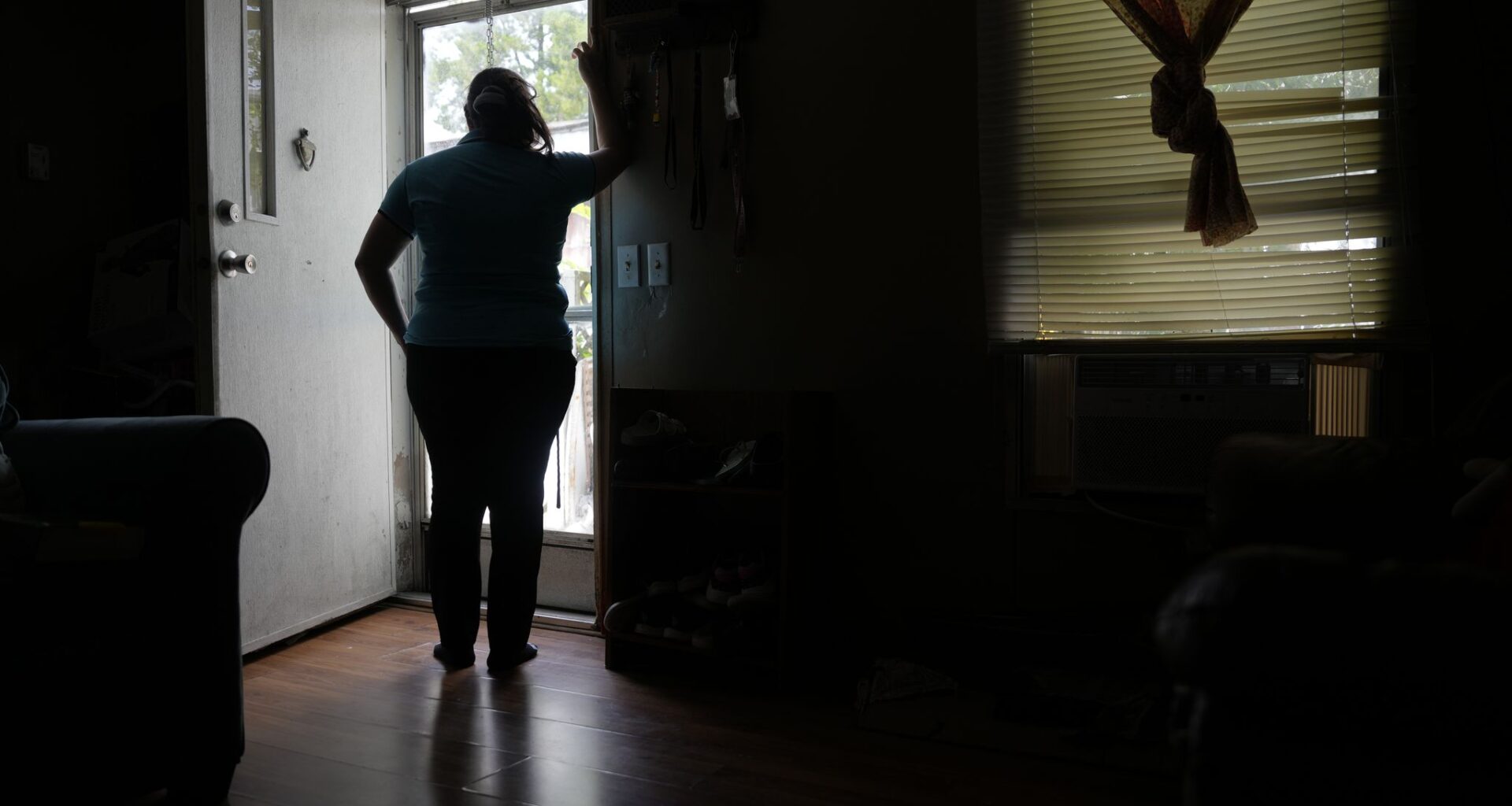
Claudia is shown at her home on Wednesday, Sept. 30, 2026. The Salvadoran mother is among Temporary Protected Status recipients awaiting a decision from the Trump administration.
Melissa Phillip/Houston Chronicle
Most mornings, Claudia gets up at 5 a.m., tying on a black apron and wrapping pupusas in aluminum foil for her daughters’ lunch. But on the morning of Sept. 9, she was still in bed.
She was frantically refreshing the news on her phone. Then, she stopped on one video announcing the cancellation of Temporary Protected Status, a humanitarian program that allowed her and thousands of other Salvadorans to temporarily live and work in the U.S.
A few minutes into the video, an attorney explained it in simple terms: The program had expired, but there was no official termination date yet.
Article continues below this ad
Her three daughters climbed into bed beside her as she listened. “Did they cancel it or not?” she remembered thinking.
For Claudia and others protected under the program, the decision can determine whether they can remain in the U.S. or have to return to their home countries, where violence and instability continue.
She told her daughters what she heard, and they began to cry.
“ No mami, y ahora qué vamos a hacer?” they asked. “What is going to happen to us?”
Article continues below this ad
Her oldest daughter, 15, had spent years getting ahead in school and started earning college credits this year. But that morning she told her mom the credits didn’t matter if they meant being separated from her.
But Claudia could only offer them the same words that she’s carried over the last 25 years, words inspired by her own mom: “We have to keep going.”
WIDE NET: This Bellaire family voted for Trump. Now his immigration crackdown could separate them.
She is one of 170,000 Salvadorans whose futures remain uncertain as they wait for the Trump administration to decide whether to renew or end TPS, which allows people from countries facing war, natural disasters, or other extraordinary conditions to temporarily remain and work in the U.S. The program was set to expire for El Salvador on Sept. 9, but the Department of Homeland Security said recipients would remain protected while an announcement was pending — leaving families like Claudia’s in limbo.
The Houston Chronicle is identifying Claudia by her first name because of the uncertainty around TPS and fears of deportation and family separation.
Article continues below this ad
For Houston, the stakes are close to home. Harris County has the second-largest Salvadoran population in the country, with over 110,000 Salvadorans, behind only Los Angeles County. Claudia became part of that community in 2001, though Texas wasn’t in her future plans.
A betta fish named Miracle follows Claudia’s finger at her home on Wednesday, Sept. 30, 2026. The Salvadoran mother is among Temporary Protected Status recipients awaiting a decision from the Trump administration.
Melissa Phillip/Houston Chronicle
Her journey to Texas
The gang violence that surged in El Salvador in the late 1990s had already driven her two siblings out.
But one encounter convinced her mother that Claudia, then 19, had to leave, too. Claudia pointed to her left cheekbone, then her neck and chest, tracing the places where a gang member had held a machete.
Article continues below this ad
“I wasn’t safe there anymore,” she said in Spanish. “So she made the decision, ‘No, you have to go, even if it means we give you the only thing we have.’”
Her parents took out a loan against their home to complete her journey. Claudia understood what they were risking: if she didn’t pay it back, they could lose the only home they had.
In 2001, she traveled north with a cousin and several women from her hometown, the group watching over each other along the way. At one point, Claudia was crammed into the storage compartment at the bottom of a bus, near the tires. Several hours passed and when she finally climbed out, her legs buckled, and a man had to help her up.
Her journey took her to Arizona, California and eventually Houston. She remembers studying the roads, cars and signs around her before making her way to her brother’s home. By the next day, she was cleaning houses.
OPINION: America helped drive Salvadorans from home. We can’t expel them again.
Article continues below this ad
How El Salvador got TPS
By the time Claudia arrived in Houston in 2001, generations of Central American immigrants had already put down roots. Neighborhoods such as Gulfton became gathering places for families from El Salvador, Honduras and Guatemala, while organizations like CRECEN grew out of an earlier wave of migration during armed conflicts in Central America.
Congress created TPS through the Immigration Act of 1990, and El Salvador was the first country designated under the program as its civil war continued. That initial protection lasted 18 months.
A decade later, after two devastating earthquakes struck the country in 2001, the U.S. gave El Salvador TPS status again, which has spanned nearly all of Claudia’s adult life.
The debate over how long the protection should continue has followed TPS holders for years. In 2017, the Department of Homeland Security had planned to strip TPS from Salvadorans the following year, but litigation blocked that decision and the Biden administration eventually rescinded it in 2023.
Now, the Trump administration is targeting TPS again as it wages its immigration crackdown. Haiti’s designation was scheduled to end Feb. 3, 2026, but a federal court temporarily blocked the decision. After a Supreme Court ruling in June, the termination took effect July 27.
Houston became ‘less temporary’ and more like home
After a few months in Houston and juggling three jobs, Claudia accomplished her mission: she paid her parents’ debt off.
She went from managing her week selling perfume, jewelry and clothes to cleaning homes and working in a restaurant — a job that she has now held for 25 years. Claudia even sent additional money to help rebuild her family’s ideal home and helped them buy a cow, something she had once dreamed about.
Looking back on the work it took to get there, she came to a conclusion: “Valió la pena.” It had been worth it.
Shoes belonging to Claudia’s children are stacked beside the door of their home on Wednesday, Sept. 30, 2026. Claudia, a Salvadoran mother, is among Temporary Protected Status recipients awaiting a decision from the Trump administration.
Melissa Phillip/Houston Chronicle
Houston is also where she became a mom to her three U.S.-born daughters.
Some mornings she would wake up early to knock on doors, praying for someone she trusted enough to watch over them. One day, the girls stayed with a sitter for as long as 14 hours, so Claudia could pick up an extra shift.
“I had to,” she said. “Because I needed the work to get them ahead.”
One summer, she asked a teacher to enroll her oldest in summer school even though her daughter was one of the top students in her class. Claudia needed somewhere safe for her daughter to go while she was at work.
Her life now revolves around work, school drop-offs, church and her daughters’ activities. She volunteers through her church, including teaching in her prayer group, and has spent about three years involved with CRECEN, making room in her busy schedule for meetings and rallies.
What comes next
Only now, as a mother herself, does Claudia understand the bravery it took for her parents to decide between staying together and separating to keep their three children safe.
It’s that same courage, she says, that she wants to show her own daughters as they navigate this new uncertainty.
Rose Gondiez, an attorney with the Immigrant Legal Resource Center, said part of the issue is the lack of a formal federal decision about what will happen for Salvadorans with TPS.
COMMUNITY PROFILE: Gulfton is the ‘Ellis Island of Houston.’ Residents say fear of ICE is hurting the neighborhood
“In the absence of an official decision,” Gondiez said, “thousands of families are unclear about decisions about their jobs and their families and their futures,” including whether they can continue to feel safe in the country.
Gondiez said TPS holders should consult with an immigration attorney about whether they might qualify for another form of relief. She also recommends that families begin making preparedness plans rather than waiting until all protections are lost.
“While we’re in this limbo period, it’s just a good thing to do regardless,” she said. “I would also say they should stay alert to changes in workers’ employment authorization.”
Claudia holds her study Bible at her home on Wednesday, Sept. 30, 2026. The Salvadoran mother is among Temporary Protected Status recipients awaiting a decision from the Trump administration.
Melissa Phillip/Houston Chronicle
Claudia has started preparing at home, organizing her daughters’ passports and other documents alongside a list of family contacts. She’s pushed her 15-year-old to get her driver’s license. “You have to learn how to drive,” Claudia told her. “Maybe you won’t be able to take the house with you, but at least take the car.”
The days leading up to Sept. 9, she spent an evening with her kids and they discussed their options. Stay in the country, or leave for El Salvador.
Claudia has decided that if her protected status does end, she’ll leave on her own rather than face the risk of being deported or worse, detained.
Houston has seen a sharp increase in ICE enforcement this year. Claudia’s neighborhood has seen it, too. She’s heard from multiple neighbors about ICE sightings in places she frequents.
ALSO READ: Houston is becoming a destination for a new wave of Cuban migrants. Here’s why.
It’s a fear she holds as she waits for the government’s decision. Despite her own fears, Claudia still drives her daughters to school, goes to work and shows up to protests. Staying home in fear, she said, won’t teach her daughters to stand and fight back.
“I can’t put my fear into them,” she said. “My fear, I keep it inside.”
She has watched her 15-year-old become more passionate about advocating, informing other TPS holders of their rights and protesting at rallies. Her daughter now understands why her mother brings her along, and she has begun to tell Claudia that she wants to defend her.
“I don’t know if I’m always going to be here with you,” Claudia told her. “You have to learn how to stand up for yourselves.”
So, that morning on Sept. 9, Claudia first comforted her girls crying beside her in bed. But a few hours later, the family headed together to a vigil. Her oldest stood beside her two younger sisters, holding blue-lettered signs that spelled out TPS.
Claudia joined the crowd as they marched on the sidewalks of Gulfton.