
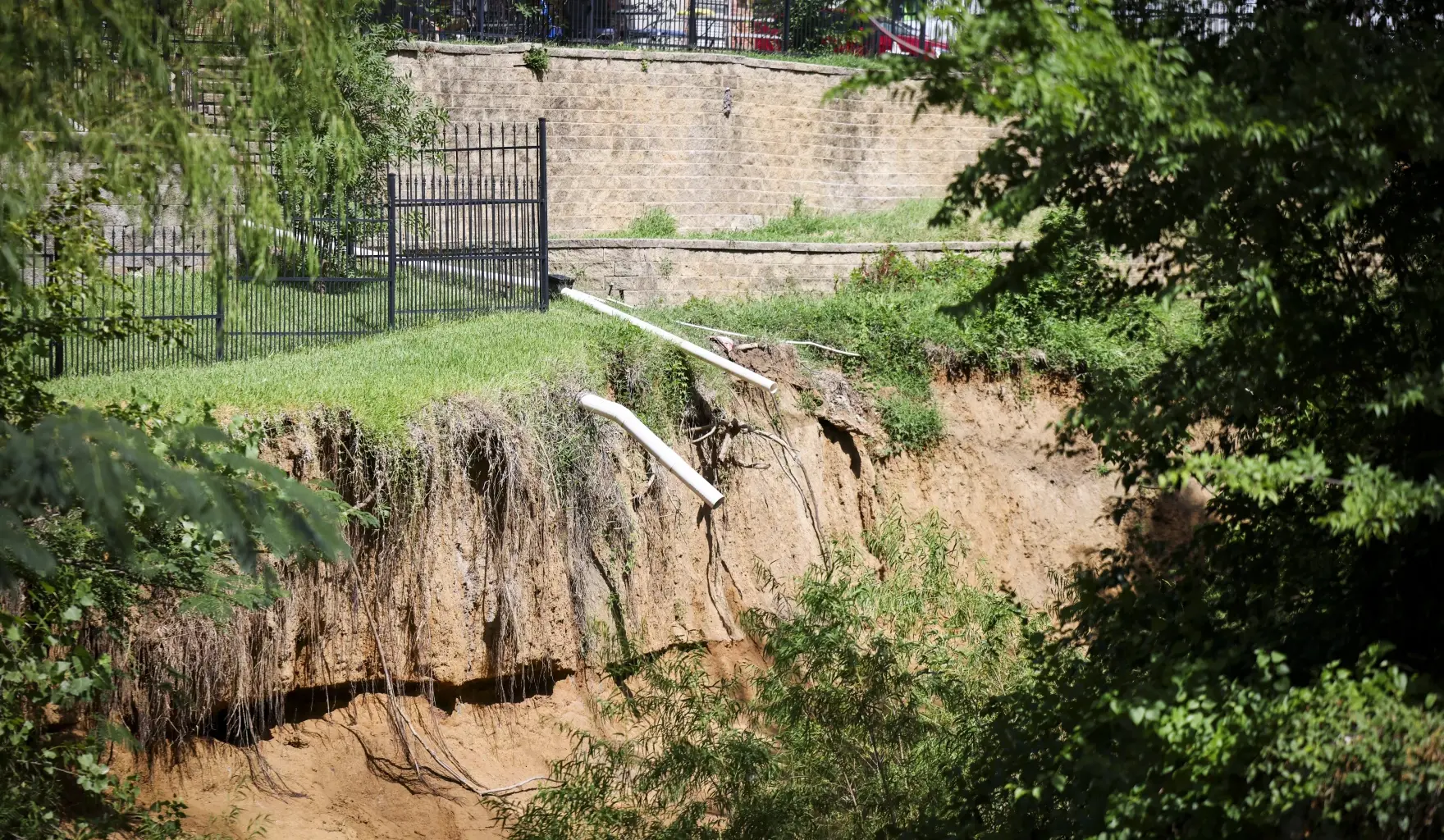
Several Arlington city council members want the city to do something about residents’ backyards being washed away by creeks.
Multiple experts previously told KERA the city could face a crisis with erosion and flooding if issues with stormwater runoff and creek erosion aren’t addressed quickly.
Arlington has 140 miles of creeks and streams, according to Assistant Director of Public Works Amy Cannon. That number is up from August, when the city estimated 112 miles of natural waterways.
According to a presentation Cannon shared with the council Tuesday, only 28 of those 140 miles are classified by the city as “stable.”
Around 23 miles of the creeks are classified by the city as “highly unstable,” with a price tag to fix them sitting around $534 million, according to Cannon’s presentation. Another 61 miles classified as “moderately unstable” would cost about $548 million to stabilize while 28 miles of “moderately stable” creek banks would come with a bill for $74 million.
Mauricio Galante, who represents District 1 on city council, said he’s seen an increase in emails from residents concerned about erosion.
“I myself visited more than a dozen locations where people are losing their backyard,” Galante said.
He said some residents are losing swimming pools and several face threats to their house’s foundation because of erosion.
He wants the city to find a way to help residents cover the costs of preventing more damage and possibly helping to reverse the harm erosion has already done.
An expensive proposition
According to Cannon, it would cost the city around $1.16 billion to stabilize all the creeks in the city.
The city’s current utility fee structure, $10 a month for residential property and fees based on the amount of impervious land for commercial, provides around $20 million a year, Cannon said. But that money is typically devoted to flood mitigation, not erosion.
Much of that creek system cuts through backyards and private business property. In August, the city said only 43 miles of the creeks are on public land.
Those 43 miles are what the city is responsible for maintaining, Cannon said. The rest is up to property owners.
That means homeowners are responsible for all the costs associated with repairing damage and mitigating the risk of future erosion.
But residents told KERA the quotes for even a simple retaining wall can run into the hundreds of thousands — sometimes as expensive as the home itself.
District 2 Council member Raul Gonzalez echoed Galante in that he’s seen more residents reach out recently with erosion concerns.
“I’m really shocked at how many emails we’ve gotten regarding, you know, trying to help Arlington families with the erosion issues,” Gonzalez said.
He said some cases are a result of residents or Homeowners Associations (HOAs) neglecting their responsibility to maintain creeks through their own erosion mitigation and lakes in the neighborhood by dredging them.
Residents in the Prestonwood West neighborhood experienced something like that in 2018, when Prestonwood Lake became too filled with sediment brought from upstream. The city broke the dam, which created a lake out of the creek that runs through some backyards, to get rid of the flooding.
Residents said they weren’t aware it was their responsibility to dredge the lake and that breaching the dam not only removed a water feature from their neighborhood but also led to fast-flowing water in the creek practically dissolving their backyards.
Gonzalez noted it may “cost each home $100,000” in an HOA to dredge a lake like Prestonwood Lake, but that the city can’t get pay the bill for them because the lakes aren’t publicly accessible and don’t benefit the city as a whole.
“I hate to say it but it’s not my problem if you don’t want to pay for it,” Gonzalez said.
Experts said the two issues are interconnected.
Adnan Rajib, who lives in South Arlington and is an engineer, hydrologist and director of the Hydrology & Hydroinformatics Innovation Lab at UT Arlington, previously told KERA News erosion and flooding are interconnected.
Soil carried off from creek banks has to end up somewhere. That erosion becomes sediment, and when it’s deposited somewhere else it can build up and reduce the depth of a creek bed, pond or lake.
“It’s a cascading effect, both in our drinking water, recreational water sources, as well as flooding,” Rajib said.
When soil is eroded upstream and deposited in a lake or portions of the creek downstream, it increases pushes more water into other parts of the stream. The increase in speed and volume speeds up that erosion process.
Residents argue that lake dredging should become the city’s problem when it impacts those without responsibilities, or even rights, to maintain waterways and lakes on someone else’s property.
What other cities do
Cannon said the city does try to help residents who are facing erosion problems but doesn’t pay the bill for the work needed.
“The property owners are still responsible for finding an inspector and sending us the reports,” Cannon said. “We’ll work with property owners on a case-by-case basis on how to fix the issues if there are any.”
She told the council some other cities have programs to assist residents with erosion mitigation and repair, but many are rethinking those programs. She reached out to other cities to get more information on what they do when residents report serious erosion issues, including Dallas, Fort Worth, Austin, San Antonio, Grand Prairie and Irving.
According to the responses, Cannon said most cities prioritize addressing erosion that impacts public infrastructure, are limited by factors including severity and that some cities offer voluntary buyouts for property facing serious damage.
She highlighted cost-sharing programs like one in Garland and Plano; a program in Dallas that uses general obligation bonds to fund erosion projects and help offered by McKinney to residents, including paying construction costs, if the primary structure is at risk.
Buyouts could be an option, Cannon said.
It’s something the city has done in the past for property at high risk of flooding, spending around $29 million to buy out 93 high-risk properties since 2009.
She said Dallas and Grand Prairie currently both have voluntary buyout programs for erosion damage, both requiring the primary structure to be at risk, but that Grand Prairie is considering suspending its program over budget challenges.
She also noted that these projects take time and creeks can change shape during the process. That could require homeowners to make changes to the design, slowing the process, while permitting, inspections and permission from FEMA add to the timeline.
Assistance in Arlington
Fixing the city’s problems with erosion comes with a hefty price tag, but Galante said that’s one reason he wants to see the city step in and provide assistance in any way it can.
“I’m not in favor of the city taking over this because it’s a private matter, but I’ll be happy to see if we can create some sort of mechanism that they can help them funding,” Galante said. “This is their responsibility, but if there’s a way through FEMA federal money through state money or through programs just for the neighborhood that is affected by that erosion, not city-wide, something like that, right? That can be fair.”
Several residents previously told KERA “fair” is what they’re looking for. Between the way issues upstream and development have impacted the creeks, they said the city may not have a legal responsibility to get involved but does have an ethical obligation to do something.
Specifically, they pointed to the way Arlington’s population has grown and its land has been developed.
Rajib said development has likely played a role in the issues residents face now — especially commercial development. Parking lots, buildings and landscaping create impermeable surfaces that prevent rainwater from soaking into the ground and instead send it to the city’s waterways.
“I’m not saying commercial development is bad,” Rajib said. “It’s the need of society, but there has to be a balance between how much we can take away from nature and how much you need for our benefit.”
City Manager Trey Yelverton said the city has some options that range in complexity and cost.
The simplest and cheapest would be to maintain the city’s current policy, he said. The most complex would be for Arlington to ask voters to approve a bond.
Yelverton said sending a bond to voters comes with risk. The bond could compete with others for things like roads, fire stations, police facilities and other public infrastructure.
“I don’t think we want to do that,” Yelverton told the council.
He said the middle-of-the-road options are expensive, too, and pointed to the other cities Cannon mentioned and their experiences.
“I think what they’ve learned is it’s a very expensive proposition, not only the flood control being very expensive, but then the siltation erosion being kind of complimentarily very expensive,” Yelverton said. “So how do you fund that? ”
He advised against using money from the general fund because, like bonds, there are “too many competing interests.” Using funds raised through utility fees is also an option, but one Yelverton warned could weaken the city’s flood mitigation efforts.
“To me, the logical conclusion, if you’re inclined to take on a more community-based responsibility, is it’s a large initiative so it requires dedicated and significant funding which, to me, is a complimentary fee kind of like what you have with the stormwater utility,” Yelverton said.
If the city went that route, Yelverton advised council it would likely want to have two different divisions for flooding and erosion,
“Then you would have some dedicated funding to start addressing some of these things that I know you all are worried about,” he said.
Still, with the vast majority of Arlington’s 140 miles of creeks needing some level of attention, Yelverton said it would be a long process. If the city creates a new fee that brings in $5 million or even $10 million, it won’t be enough.
“It’s a significant cost shift but if we’re going to do it the best way to do is to have a dedicated program to focus on it prioritize it and dedicate resources that are funded with it,” he said.
This <a target=”_blank” href=”https://fortworthreport.org/2026/10/02/some-arlington-backyards-disappear-bit-by-bit-each-time-it-rains-what-can-the-city-do/”>article</a> first appeared on <a target=”_blank” href=”https://fortworthreport.org”>Arlington Report</a> and is republished here under a <a target=”_blank” href=”https://creativecommons.org/licenses/by-nd/4.0/”>Creative Commons Attribution-NoDerivatives 4.0 International License</a>.<img src=”https://i0.wp.com/fortworthreport.org/wp-content/uploads/2021/04/cropped-favicon.png?resize=150%2C150&ssl=1″ style=”width:1em;height:1em;margin-left:10px;”>
<img id=”republication-tracker-tool-source” src=”https://fortworthreport.org/?republication-pixel=true&post=812201&ga4=2820184429″ style=”width:1px;height:1px;”><script> PARSELY = { autotrack: false, onload: function() { PARSELY.beacon.trackPageView({ url: “https://fortworthreport.org/2026/10/02/some-arlington-backyards-disappear-bit-by-bit-each-time-it-rains-what-can-the-city-do/”, urlref: window.location.href }); } } </script> <script id=”parsely-cfg” src=”//cdn.parsely.com/keys/fortworthreport.org/p.js”></script>