
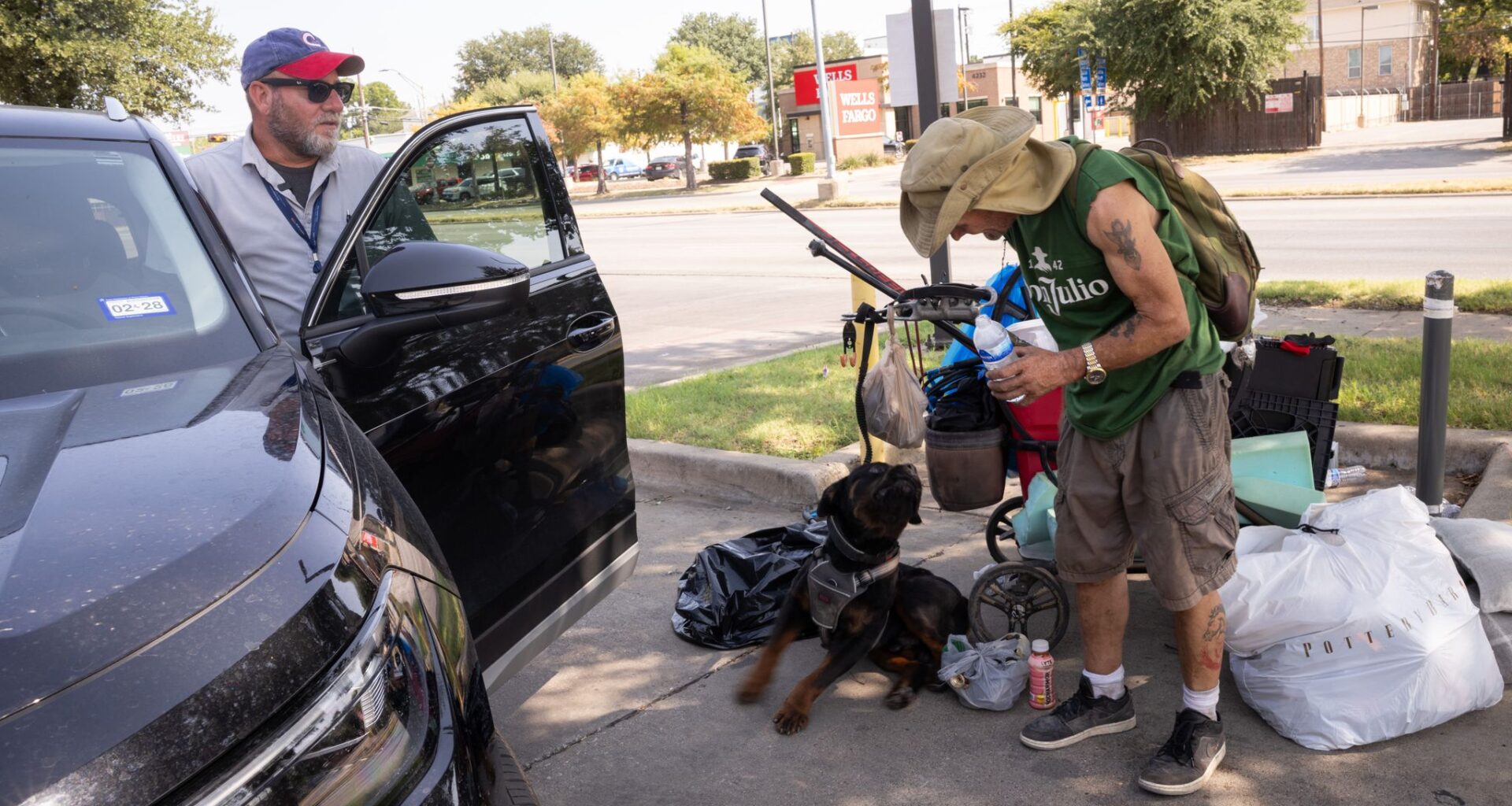
Rob Farmer, a community case manager at Oak Lawn United Methodist Church, a member of Housing Forward’s All Neighbors Coalition, speaks Aug. 5 with James Rathburn with his dog, Bear, on Lemmon Avenue in Dallas. The coalition conducts outreach and provides support for the homelessness.
Juan Figueroa/The Dallas Morning News
Dallas County voters will decide whether to raise property taxes to generate about $100 million a year for homelessness services before the county works out the service contract, performance goals and spending oversight.
The proposition on the Nov. 3 ballot would add 2.4 cents per $100 of assessed valuation on top of an already increased tax rate county commissioners approved for this year. The homeless levy, which has no defined end date, would put the overall county rate 15.4% above last year’s.
Housing Forward, the nonprofit leading the region’s homeless response, developed the proposal, which would fund street outreach, rental assistance, supportive housing, mental-health services and crisis hubs where people could be stabilized instead of jailed.
Advocates say the investment could break the cycle of homelessness and improve the region’s economy and quality of life.
“It’s completely unacceptable to let people wait on our streets while we’re getting people stable and self-sufficient,” Housing Forward CEO Sarah Kahn said.
Sarah Kahn, president and CEO of Housing Forward, at a presentation in May at the Winspear Opera House in Dallas.
Juan Figueroa/The Dallas Morning News

Opponents say the proposal, unveiled only two months ago, makes unsubstantiated promises without providing enough detail before the election about how spending and results would be tracked.
Article continues below this ad
“Our residents deserve accountability, and more importantly, our residents deserve a clear path with results, and I honestly don’t see this in this proposal,” County Commissioner Elba Garcia said in August before voting against placing the measure on the ballot.
At stake is a major expansion of Dallas County’s role in fighting homelessness, paid for indefinitely through higher property taxes until county officials vote to end it. For the median homestead, the homelessness tax levy would add $89 this year over last year’s rate.
If voters approve the tax, commissioners would then determine how contracts are awarded, initiatives are rolled out and outcomes are measured.
Housing Forward has proposed it would receive and distribute the money under an initial five-year contract with the county in which renewals are based on meeting performance goals. It is pledging to eliminate street sleeping for every person within its first year and prevent any more people from falling into homelessness.
County Administrator Darryl Martin said that a contract likely would not require bidding because Housing Forward is the region’s federally designated lead agency for homeless services.
Commissioner John Wiley Price, who opposes the tax, said the county should put the agreement out for competitive proposals before entrusting one organization with so much public money.
A lasting tax
The levy has no sunset. The $100 million annual allocation for homeless aid would remain part of the county’s annual budgets unless commissioners later voted to reduce the tax rate and wind down the program.
Article continues below this ad
Other large communities, including Los Angeles County and Seattle, have dedicated taxes for housing and homelessness programs, but many rely on sales taxes or time-limited levies.
Dallas County Judge Clay Lewis Jenkins speaks on a panel at a State of Homelessness program in May at the Winspear Opera House in Dallas.
Juan Figueroa/The Dallas Morning News
Three of Dallas County’s five Democratic commissioners support Housing Forward’s proposal.
Kahn said Housing Forward’s work clearing downtown Dallas encampments with a coalition of partners offers proof the approach can work countywide. She said downtown street homelessness has declined more 80% since 2021, based on counts conducted by Downtown Dallas Inc.
The key has been combining street outreach with mental-health care and connections to housing, Kahn said in an appearance before The Dallas Morning News editorial board.
County Judge Clay Lewis Jenkins said that approach should be expanded countywide to reach all 11,000 people he said enter homelessness in Dallas County each year and to reduce unnecessary jail and emergency-room costs.
“It’s a county issue,” he said. “Even if two or three cities really made it a priority, found the funding to make it a priority, it would just be dispersing homeless persons out to other surrounding cities in Dallas County.”
Kahn said the $100 million each year would help about 4,500 households experiencing homelessness or at risk of losing their housing annually – the remaining population existing resources cannot serve.
Price said that pledge relies too heavily on Housing Forward’s internal estimates and variables the county cannot control.
Helping 4,500 households, he said, would depend on housing availability, landlord cooperation, treatment capacity and provider performance.
“There’s too many questions that are out there,” he said.
Article continues below this ad
Booker Campbell, right, hugs Housing Forward outreach coordinator Haley Walton after moving into a Dallas apartment Aug. 28, 2024. Campbell was among more than 100 people housed through the Street to Home operation.
Juan Figueroa/Dallas Morning News
In year one of the levy, about $68 million would be allocated for up to 12 months of rental or employment help, while $8 million would fund longer-term housing and treatment for up to five years, according to the proposal. Rental units would be spread countywide, Kahn said.
About $4 million would go toward short-term expenses to get someone off the streets quickly, like travel expenses to connect with friends or family.
The proposal would divide the county into six zones, with hubs connecting people to medical care, crisis stabilization and other services for $20 million in the first year.
That would incorporate a $25 million, 100-bed deflection center already in planning by the county, where police could take people for stabilization instead of arresting them for nonviolent, low-level offenses.
The initiative’s reach would depend not only on available housing, willing landlords and treatment capacity but also voluntary participation because Texas law generally prevents compelled treatment.
Running against it
A slide on efforts to address homelessness is displayed at a presentation in May hosted by Housing Forward at the Winspear Opera House in Dallas.
Juan Figueroa/The Dallas Morning News
The tax debate also has drawn scrutiny in two county races.
Republicans Mike Immler, a former business executive challenging Jenkins, and attorney Barry Wernick, running against County Commissioner Andrew Sommerman, oppose the measure and have made its cost and unfinished oversight part of their campaigns.
Immler said homeless aid should not be funded by taxpayers but by corporate philanthropy and private giving in coordination with local government.
Article continues below this ad
He favors longer-term behavioral health services that help individuals avoid jail and called Housing Forward’s plan “a Band-Aid without any solution.”
Wernick calls it Sommerman’s “permanent homeless tax,” citing its lack of a sunset and safeguards that won’t be formalized until after voters cast their ballots.
He said it’s an unvetted and expensive proposal coming at a time when residents are struggling to afford gas and groceries. “We’re basically taxing people out of their homes because the commissioner wants to virtue signal,” Wernick said.
Sommerman has disputed that, saying taxpayers are already bearing the cost with homeless individuals cycling through jails, emergency rooms and county resources.
He said the tax would fund a coordinated response required to show results that would pay dividends for residents. Voters can “pay for failure or invest in success,” Sommerman said.
Tracking progress
Jenkins said the contract with Housing Forward would include performance metrics tied to renewals and oversight by county officials, though those details wouldn’t be defined until after the election.
Article continues below this ad
“We’ll want to make sure that there is a layer of government accountability, because this is taxpayer dollars, but not a layer of bureaucratic paralysis,” he said.
City code compliance workers clear belongings from a downtown Dallas encampment in September 2024. The Street to Home operation, a partnership between Dallas and the Housing Forward-led All Neighbors Coalition, helped more than 100 people move into permanent housing.
Juan Figueroa/Dallas Morning News
Of the 25,000 clients Housing Forward and partners have helped since 2021, fewer than 10% have returned to the homeless response system, according to Kahn.
Some opponents question whether the nonprofit’s self-reported figures provide enough evidence to justify a permanent tax increase.
Betty Culbreath, a longtime Dallas County housing advocate, said it is difficult to reconcile the reported progress with encampments and street sleeping she continues to see around Dallas.
“I’m not against funding services for homeless people, I’m against squandering money in the name of homeless people,” she said.
Jenkins could not say how long such a levy would need to be in place if it passes. Unless thousands of new people stop falling into homelessness every year, “the program will be necessary,” he said.