
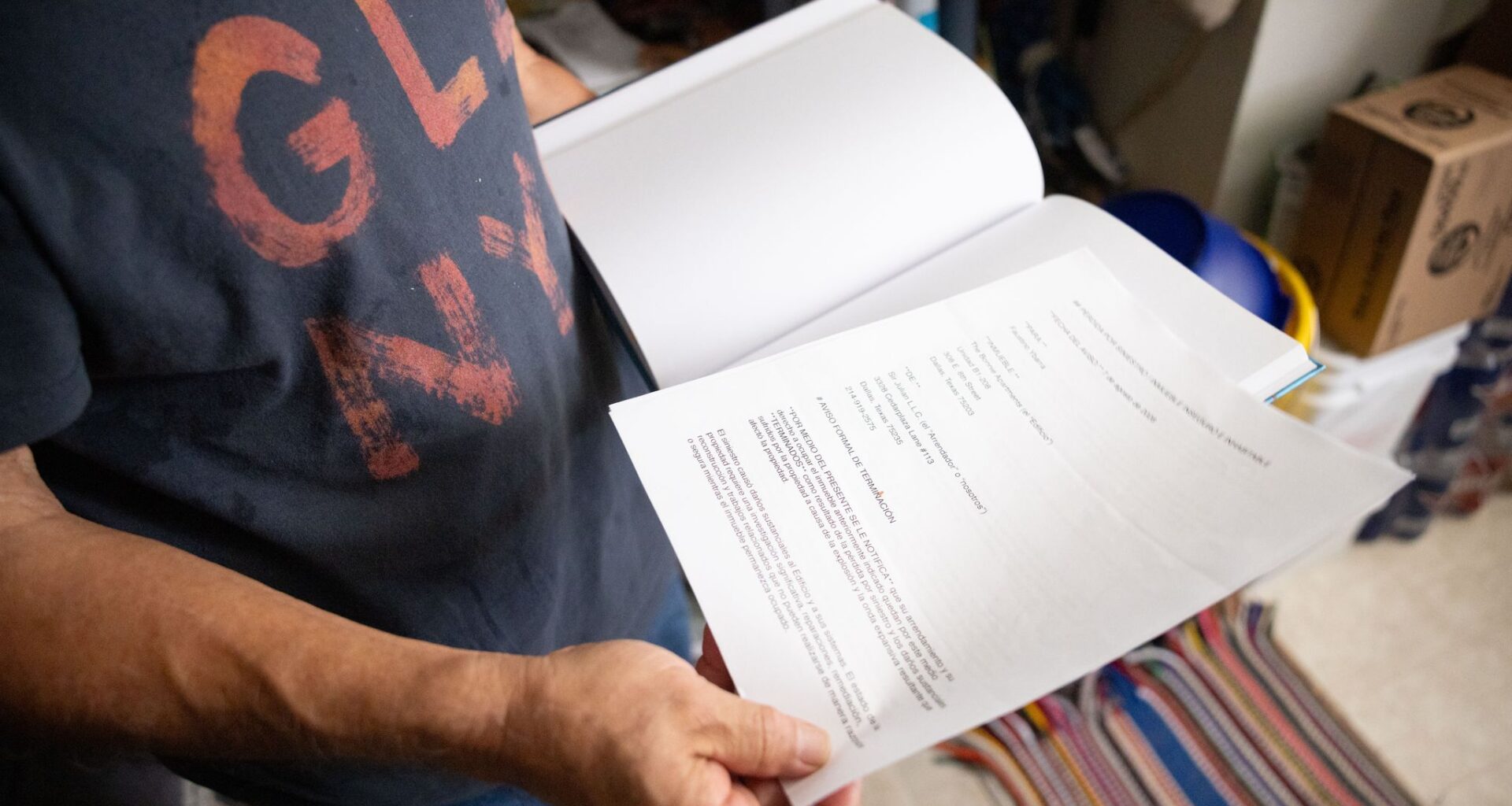
Faustino Ybarra shows the lease termination letter he received at Bonnie Apartments in Dallas’ Oak Cliff neighborhood, Tuesday, Aug. 11, 2026. This budget cycle, the city landed on $500,000 for eviction defense, but signaled it could be reluctant to do so again.
Juan Figueroa/The Dallas Morning News
Dallas has changed if and how it funds eviction defense several times over the past few years. This budget cycle, the city landed on $500,000 for eviction defense, but signaled it could be reluctant to do so again.

Government funding for eviction defense — where lawyers represent residents facing eviction in court — in Dallas has been in flux for years.
First, federal funds were devoted to eviction defense efforts during the COVID-19 pandemic. Those funds were used up. In February, Dallas asked organizations to submit plans for an eviction advocacy program, but funds never reached organizations.
Article continues below this ad
Then in September, Dallas City Council approved a record $6 billion budget, including $500,000 to support eviction legal services for Dallas tenants.
Related: ‘Hard choices’: Dallas’ $6 billion budget exposes a council divided over what the city can afford
Throughout the saga, eviction defense organizations have been applying for funding and advocating for their work. Some city officials believe the legal aid should be funded by the city, while others think it should come from philanthropic and county sources.
Mark Melton, a founder of the Dallas Eviction Advocacy Center, said government and private funders would each prefer that the other fund the efforts.
“The unfortunate reality is there are limited sources out there to go find money for anything, and it’s not as if the city doesn’t contribute to the kitty that someone else just automatically will,” Melton said.
Article continues below this ad
At a budget meeting in early September, City Manager Kimberly Bizor Tolbert said she drafted a revision to the budget after a majority of City Council members asked about funding for eviction defense. The funding won’t be permanent, she said, unless the council indicates otherwise.
“I would not commit that this is going to be an ongoing expense on the general fund and we should be sending a message very loud and clear that council wants to use 2027 as a bridge year,” Tolbert said. “And beyond that we should be looking at having this being done outside the city.”
Despite the end-of-budget decision, the question of whether Dallas should support eviction defense efforts with city funds remains ongoing.
Pandemic aid ended
The city has distributed funds for tenant aid in the past.
Article continues below this ad
Dallas had a previous eviction assistance initiative meant to help tenants impacted by COVID-19, which was funded by the American Rescue Plan Act. The initiative was a partnership between the City of Dallas Office of Equity and Inclusion and Legal Aid of NorthWest Texas.
COVID-19-related tenant support programs like the Texas Rent Relief Program — which used federal funds to provide assistance for tenants at risk of eviction because of the pandemic — ended in 2023 after all of the available funds were distributed, according to the Texas State Law Library.
Related: Here’s what you should know if you’re facing eviction in the Dallas area
Informational handouts about eviction help at Harmony Community Development Center on Thursday, June 24, 2021, in Dallas.
Juan Figueroa/Staff Photographer
Jason Simon, vice president of government affairs for the Apartment Association of Greater Dallas, said the association advocated for rental assistance policies during the pandemic. He said it is the best policy solution.
Article continues below this ad
“Our belief may be that most tenants facing eviction don’t necessarily need a lawyer, they need rent money,” Simon said “And lawyers aren’t rent. Our perspective was if we could get dollars into the hands of renters to pay their rent, that would be the best kind of policy solution.”
Simon said legal defense isn’t a core function of government. He said rental assistance helps people pay rent and keeps clients housed while eviction defense delays the process.
Melton said this isn’t an either-or situation. He said Dallas isn’t currently considering a rental assistance program and those efforts work better in tandem with eviction defense initiatives. During COVID-19, lawyers stopped evictions and ensured that landlords took the rental assistance, he said.
Following the pandemic, thousands of Dallas County residents face evictions every year. Eviction filings in Dallas County rose to their highest level in 2024, reaching about 50,000, according to a report from the Child Poverty Action Lab.
Article continues below this ad
Related: Eviction filings in Dallas County surged in 2024 as housing costs spiked, report says
A previous rejection
The city put out a call for proposals to fund eviction defense efforts in February, but the funding never reached organizations.
Dallas had previously allocated money to launch a $1 million program for eviction defense and requested that organizations submit proposals in February.
The Dallas Eviction Advocacy Center, Legal Aid of NorthWest Texas and Need a Break Inc. submitted bids for the program, according to city records.
Article continues below this ad
However, City Council voted in June to reject proposals for the program, following a recommendation from city staff.
During the June meeting, Thor Erickson, director of the Office of Housing and Community Empowerment, said the applications were being rejected because the office needed to establish stronger performance standards. Those included ensuring a certain number of people were being served and organizations were set up in Dallas courts.
The city had awarded recommendations for two vendors, Juanita Ortiz, director of the Office of Procurement Services, said. One vendor didn’t agree to the terms, and the city wasn’t able to reach an agreement with the other vendor, Ortiz said. That’s when the city realized it had gaps in the program that needed to be addressed, she said.
The two primary pro bono legal aid providers in Dallas are the Dallas Eviction Advocacy Center and Legal Aid of NorthWest Texas, Ashley Flores, senior director of the Child Poverty Action Lab, said.
Melton said he was expecting the Dallas Eviction Advocacy Center to get the full funding allocated for eviction defense in the 2026 budget.
Lenita Dunlap (left), vice president of operations at Dallas-based Abide Women’s Health Services, speaks with Mark Melton, lawyer and housing advocate with the Dallas Eviction Advocacy Center, about helping residents receive assistance after an overnight fire at their apartment complex on Tuesday, July 19, 2022.
Liesbeth Powers/Staff Photographer
He said he had gone to the city asking them to contribute funds to the organization’s eviction defense efforts. Later, the city asked organizations to submit proposals for funding.
After submitting for the funding, Melton said he was told by the city that his organization would be awarded $500,000, instead of the full $1 million. He said it surprised him that the city would allocate half of the money to another group when his organization was doing the majority of the work.
“We’re already doing all of it,” Melton said. “We’re already in every court every day, standing up and ready to represent every single tenant that walks through the door.”
The center represented tenants in about 8,300 cases over a 12-month period ending in June, according to Melton.
Related: Dallas County tenants with legal help find better eviction outcomes, study reveals
Flores said the lab used to run a court observation program with SMU law students, and during that program the advocacy center represented the largest share of tenants.
When the proposals were rejected, Melton said the advocacy center was left with a $1 million hole that it needed to fill. The center’s budget is about $2.5 million, Melton said. Other funding for the center usually comes from Dallas County and private sources.
Without funds, Melton said he may have to lay off staff members, which would mean fewer people are being represented in court.
“This operation doesn’t operate on magic,” Melton said. “It operates on cash.”
Merrit Klapperich, a deputy director and attorney at Legal Aid of NorthWest Texas, said the city’s decision not to fund their application during that funding cycle was disappointing news. Klapperich said the organization is evaluating other funding opportunities and partnerships to sustain its work.
Claiming the bill
The September budget revision took $500,000 in funding that was originally allocated to street outreach and moved it to eviction advocacy.
The city had allocated more funds than its current contract for street outreach, Erickson said. The contract is nearly $700,000, and the additional funding would have been used to help the program grow.
That contract will stay funded and $500,000 from the additional funding will now be used for eviction defense instead, he said.
Council members also considered taking funds from the city’s election fund or from Flock camera funding, but only approved the city manager’s revision.
Council member Cara Mendelsohn said during the meeting that eviction defense isn’t a city function, but people on the street, who first responders are sent to help, is a city issue.
In making the budget, Tolbert said this funding wasn’t originally included because the city determined that eviction advocacy work could be supported through nonprofits and Dallas County funds.
Dallas County Government Center where Justice of the Peace, Precinct 2-1 are, Wednesday, September 7, 2022 in Garland, Texas.
Rebecca Slezak/Staff Photographer
When the Dallas Eviction Advocacy Center first started, it only took private dollars, Melton said.
The center’s goal is to help people facing eviction, regardless of factors such as where they live or their income. Government funding can come with red tape that requires an intake process to ensure someone qualifies, he said. In the minutes before an eviction hearing that isn’t always possible, he said.
Philanthropic funders want organizations to seek a more permanent funding source after proving an initial concept, he said. Meanwhile, government sources want programs that benefit the area to be funded through philanthropy.
In search of permanent funding sources, the center received its first government grant from Dallas County about two years ago, he said. The center submitted a proposal to the city hoping to continue to find funding.
The county allocated $1 million to the center last year and the contract is up for renewal soon, Melton said. Although the organization serves the entire county, about 60% of the tenants the center serves in Dallas County are from the city of Dallas.
He said other cities could theoretically contribute, but they only represent a small fraction of the overall cases compared to Dallas. He said the center relies on being able to represent every person in the room and can’t get into a situation where cities are asking that specific funds go to its residents.
Dallas City Council ultimately included $500,000 for eviction defense in its budget. The city could put out a request for proposals once again as it allocates those funds.
Now that funding has been included, Melton said he looks forward to working with the city, but continues to be frustrated by the process.