
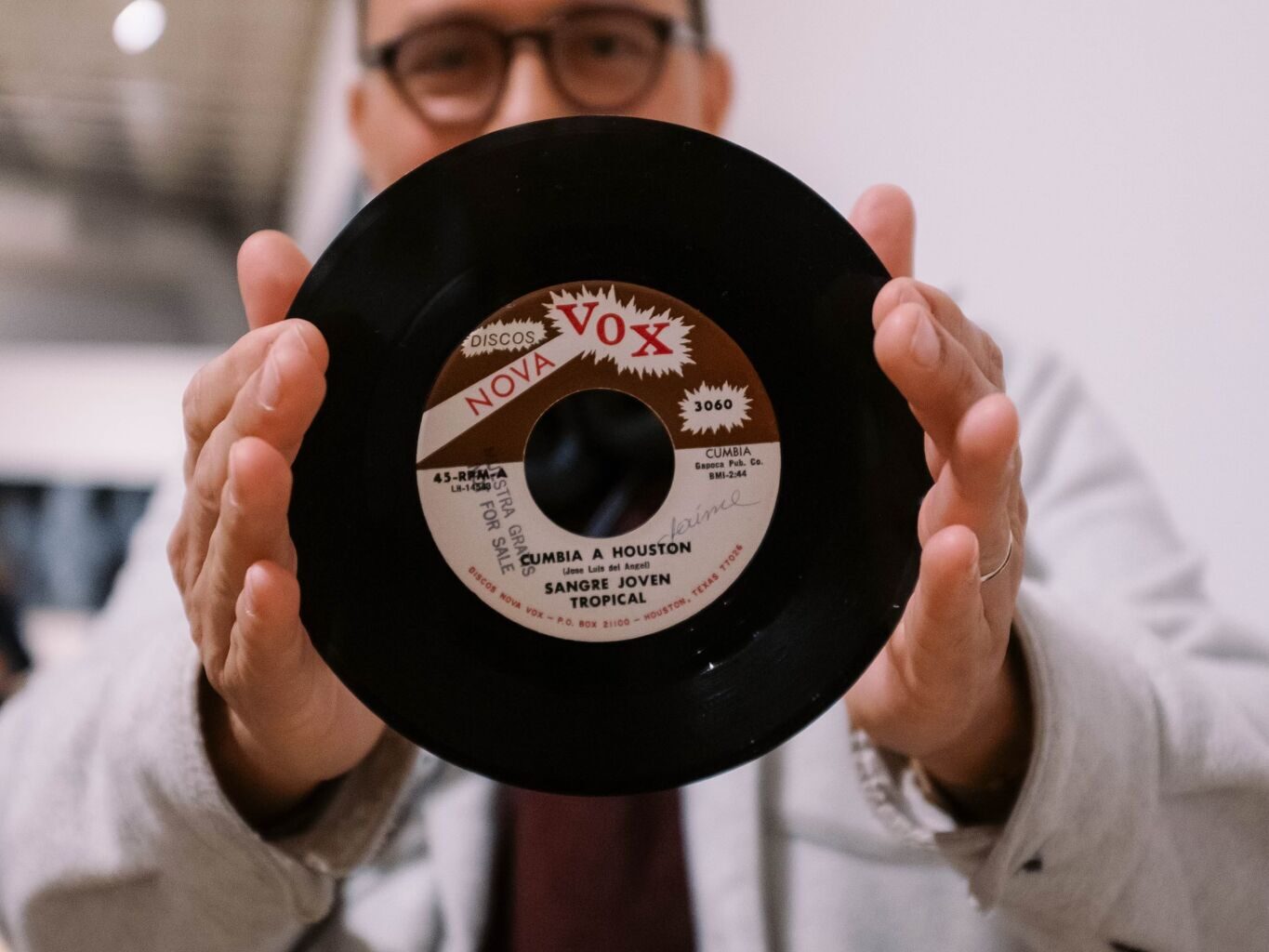
University of Houston and Houston City College music historian Alex La Rotta
Courtesy Alex La Rotta
Archie Bell (left) with Alex La Rotta
Marco Torres
Texas author Joe Nick Patoski has been a guest in Alex La Rotta’s class.
Hearst Newspapers
DJs are known to post flyers of events they’re promoting/headlining or music projects they’re dropping, especially at college campuses. For veteran vinyl player Alex La Rotta, he plastered the University of Houston with flyers for his latest project: a university course.
By day, the man who has spun retro-soul 45s for such past club gatherings as A Fistful of Soul and East End Soul Club is now teaching history and Latino studies at UH and Houston City College. (He’s also a newly-added member of the Houston Music Advisory Board.)
When: 6 p.m. Thursday
Where: Midtown Arts & Theater Center Houston (MATCH), 3400 Main St.
Details: Free with RSVP; 713-521-4533; matchouston.org
The Menil Collection Presents Sounds to Live By
When: 3 p.m. Oct. 18
Where: The Menil Collection, 1533 Sul Ross St.
Details: Free; 713-525-9400; menil.org
Ruben Molina, in conversation with Dr. Alex La Rotta
When: 3 p.m. November 7
Where: Cactus Music, 2110 Portsmouth St.
Details: Free; 713-526-9272; cactusmusictx.com
La Rotta usually calls his designer pals to create eye-catching flyers for his Latino American Popular Music course over at UH. Right on Time Design came up with this semester’s bold-and-brown flyer, bordered (we see what you did there!) with head shots of such past and present Latino stars as Ritchie Valens, Bad Bunny, and Selena.
Article continues below this ad
“I will literally post those up on campus, and the university posts it on their social media,” says the Houston-born-and-bred La Rotta, 44, on a video call from a dance-studio parking lot. (His daughters had a class.) “I post it on my social media, just as a way to spread the word. And it’s worked, you know. I have a full class.”
It’s a tradition La Rotta began when he was at Columbia University, doing postdoctoral research and teaching a class on BIPOC rock-and-roll history, in the late 2010s.
“I wanted to entice students, and I wanted to advertise it,” he says. “I mean, I want students to take the class, and the university doesn’t necessarily always advertise the class – especially if it’s an upper-division elective. It just kind of depends on how that word is spread. So, I just like to do it.”
Even though Hispanic Heritage Month wraps up on Oct. 15, La Rotta still has a busy, free-to-the-public schedule of Latino-centric events ahead of him. On Thursday, he will host a 50th anniversary screening at MATCH of “Chulas Fronteras,” Les Blank’s 1976 documentary on the stars of norteño/conjunto music and the Mexican-American migrant workers along the Texas-Mexico border who enjoy it. (He’ll also moderate a post-screening panel afterwards.)
Article continues below this ad
On Oct. 18, he’ll play a Latin jazz set at the Menil Collection’s “Sounds to Live By” outdoor listening event. And, in November, he’ll once again bring DJ/Chicano soul historian Ruben Molina to the record shelves of Cactus Music, for a discussion/signing of his latest book “The Dreamy Side: Rhythm & Blues and Chicano Culture in 1950s Los Angeles.” Later that night, La Rotta and Molina will play some Chicano soul at the Heights bar Johnny’s Gold Brick.
La Rotta is also angling to be a chronicler of Chicano music – particularly from Texas. Next April, University of Texas Press will release his first book “The West Side Sound: San Antonio and the Birth of Chicano Rock & Roll.” An on-again/off-again project he started way back in 2012, when he was a grad student at Texas State University, “Sound” will be an oral history on San Antonio’s Chicano rock scene, assembled from interviews he did with Tejano and Chicano artists from his myriad bus trips to the city.
“I’ve picked it up and dropped it over the years, just because of going to get my PhD at U of H, but I pursued this topic as my dissertation topic at U of H,” he says. “I mean, the topic of Latinos and rock and roll, of the Chicano rock and roll phenomenon, has been covered, but sparsely. And, usually, it’s focused on the West Coast… So, this is a way to think about that story of rock and roll histories and put a spotlight on this new history of rock and roll, told from the perspective of the Spanish-speaking borderlands. And San Antonio is really an epicenter for this entire culture of music, of history, of Mexican Americans creating rock and roll music.”
As a music enthusiast with Colombian roots, La Rotta makes it his mission to inform people, whether it’s those who attend his events or his very own students, of all the contributions Latinos of every shade have made to American music. And he’s always open to bringing fellow scholars and music heads in on the discussion. Recently, he had Texas writer/music historian Joe Nick Patoski join his Latino American Popular Music class via Zoom to talk about Texas tejano queen Selena, the subject of Patoski’s essential 1996 biography “Selena: Como La Flor.”
Article continues below this ad
It’s safe to say that La Rotta lives, breathes, and teaches Latino American music. “I don’t know that I am an expert on any of these topics,” he says, “But I do have what has been, I think, a lifelong interest in music and music culture that I’ve been able to hold on to and has carried me through grad school, DJing, record collecting, and writing. I care about it extensively, and I have been able to have an ear that is evolving, and I want to expand my taste and knowledge and my understanding of the histories… I hope and aspire to learn more and to be more inclusive in the way that I present those histories, and to also do this in a collaborative fashion.
“And,” he continues, “if I have any talent at all, it’s just being able to organize these things and put them out to the public.”