
Something new is crawling into the Houston Zoo’s reptile house, and one of the arrivals marks a first in the zoo’s history.
The new generation includes several species with some unusual adaptations, from built-in camouflage and deceptive “eyelashes” to armor-like scales that can make one especially difficult for predators to grab.

The Houston Zoo’s newest arrivals are now on view in a specially designed habitat. (Barbara Alicea-Aponte/Houston Zoo)
Visitors can now see the youngsters in a habitat near the reticulated pythons inside the zoo’s reptile and amphibian house.
Hosmer’s spiny-tailed skinks
Houston Zoo is celebrating its first-ever birth of Hosmer’s spiny-tailed skinks, a live-bearing species native to Australia. (Barbara Alicea-Aponte/Houston Zoo)
Among the new arrivals are the Houston Zoo’s first-ever Hosmer’s spiny-tailed skinks, making their birth the most significant of the latest additions.
Native to northern Queensland and the Northern Territory of Australia near the Gulf of Carpentaria, the stocky reptiles live in small colonies among rocky outcrops, according to Australian Reptile Park. They can grow to about 9 inches long, nearly half of that made up by their tails.
Unlike many reptiles, Hosmer’s spiny-tailed skinks give birth to live young, which emerge looking like miniature versions of their parents. Their bodies are covered in sharply ridged scales, with prominent spines along their tails.
Those spines aren’t just for show. When threatened, the skinks wedge themselves into rocky crevices and puff up their bodies, making them extremely difficult for predators to pull out.
Star tortoises
Young star tortoises are back on view at the Houston Zoo for the first time in recent years. (Barbara Alicea-Aponte/Houston Zoo)
The zoo’s baby star tortoises are also giving visitors something they haven’t been able to see there in recent years.
The tortoises take their name from the striking yellow or light-brown lines radiating across their dark shells. No two patterns are exactly alike, and the markings continue to change as the animals grow.
According to Australian Reptile Park, star tortoises can reach about 14 inches long, compared with roughly 5 inches as hatchlings.
The species lives in hot, dry scrublands across parts of India and Pakistan and on the island of Sri Lanka. Despite those harsh conditions, the tortoises can also turn up along forest edges and in coconut plantations.
Henkel’s leaf-tailed geckos
Baby Henkel’s leaf-tailed geckos are among the Houston Zoo’s newest arrivals. The Madagascar natives are known for their impressive camouflage. (Getty Images)
The zoo also has new Henkel’s leaf-tailed geckos, born from pairings recommended through the Association of Zoos and Aquariums’ Species Survival Plan.
“These births contribute to carefully managed populations of this distinctive species and demonstrate the important role accredited zoos play in maintaining genetically healthy populations of animals,” the zoo said.
Found only in Madagascar, the geckos face threats from continued deforestation on the island, according to the Smithsonian’s National Zoo and Conservation Biology Institute.
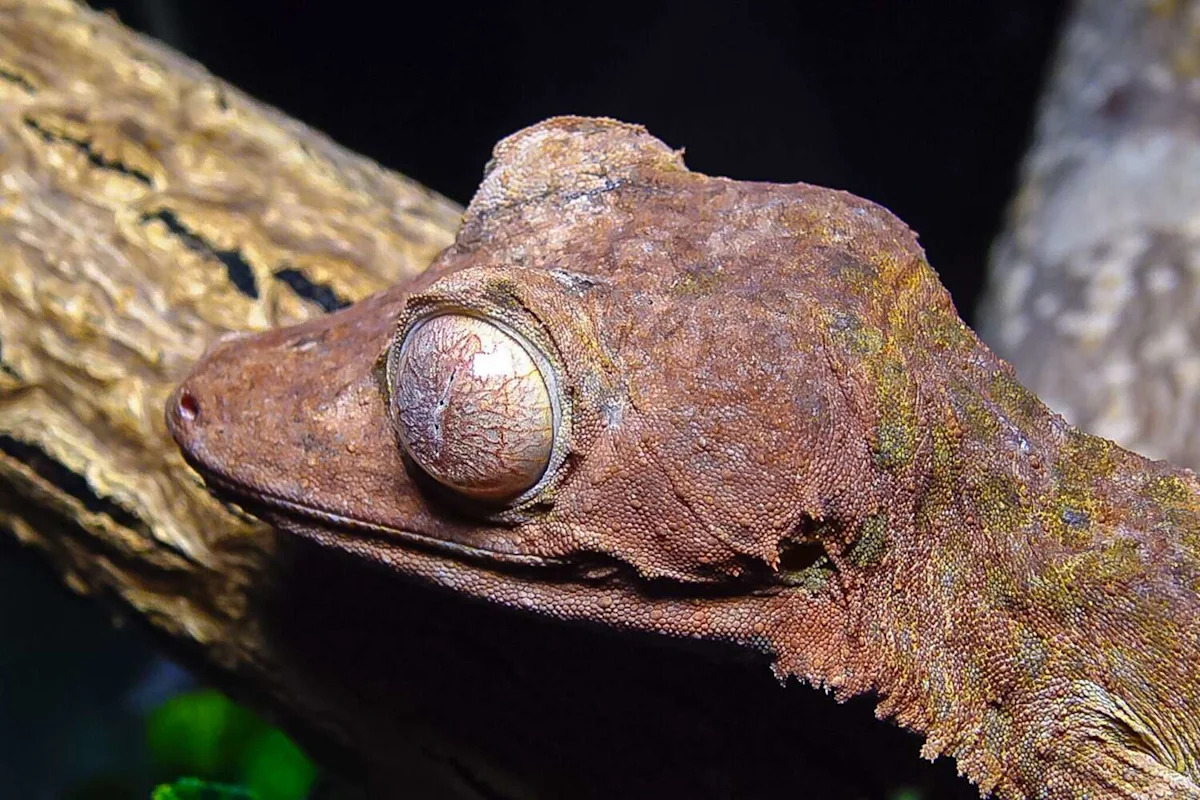
Houston Zoo calls the species “the masters of disguise.” Their flattened, leaf-like tails help them blend into their surroundings. The nocturnal climbers also have enormous eyes adapted for low-light conditions. Although they have eyelids, they can’t blink, so they use their tongues to clean their eyes.
Eyelash pit vipers
Five baby eyelash pit vipers are among the newest additions at the Houston Zoo. (Barbara Alicea-Aponte/Houston Zoo)
Five baby eyelash pit vipers are another new arrival. The small venomous snakes are found from southern Mexico through Central America and into parts of Colombia, Ecuador and western Venezuela, according to the Smithsonian. They typically live among shrubs, tangled vines and low tree branches in humid forests.
Despite their intimidating name, eyelash vipers reach only about 2.5 feet long. Their colors can range from yellow and green to pinkish shades depending on where they live.
Their signature “eyelashes” aren’t hairs at all but modified scales above the eyes. Like skinks, eyelash vipers give birth to live young. The babies arrive fully independent, already equipped with functional fangs and venom.
More Parks & Wildlife
Lists | Best Texas campgrounds ranked among America’s top camping spots
Views | Austin birder spots rare leucistic grackle with eye-catching look
Discoveries | Texas Tech study traces bat origins to Europe 65 million years ago
Parks | Massive mammoth tooth discovered at Waco Mammoth National Monument
For the latest and best from Chron, sign up for our daily newsletter here.
This article originally published at Houston Zoo welcomes rare new arrivals, including a major first.