
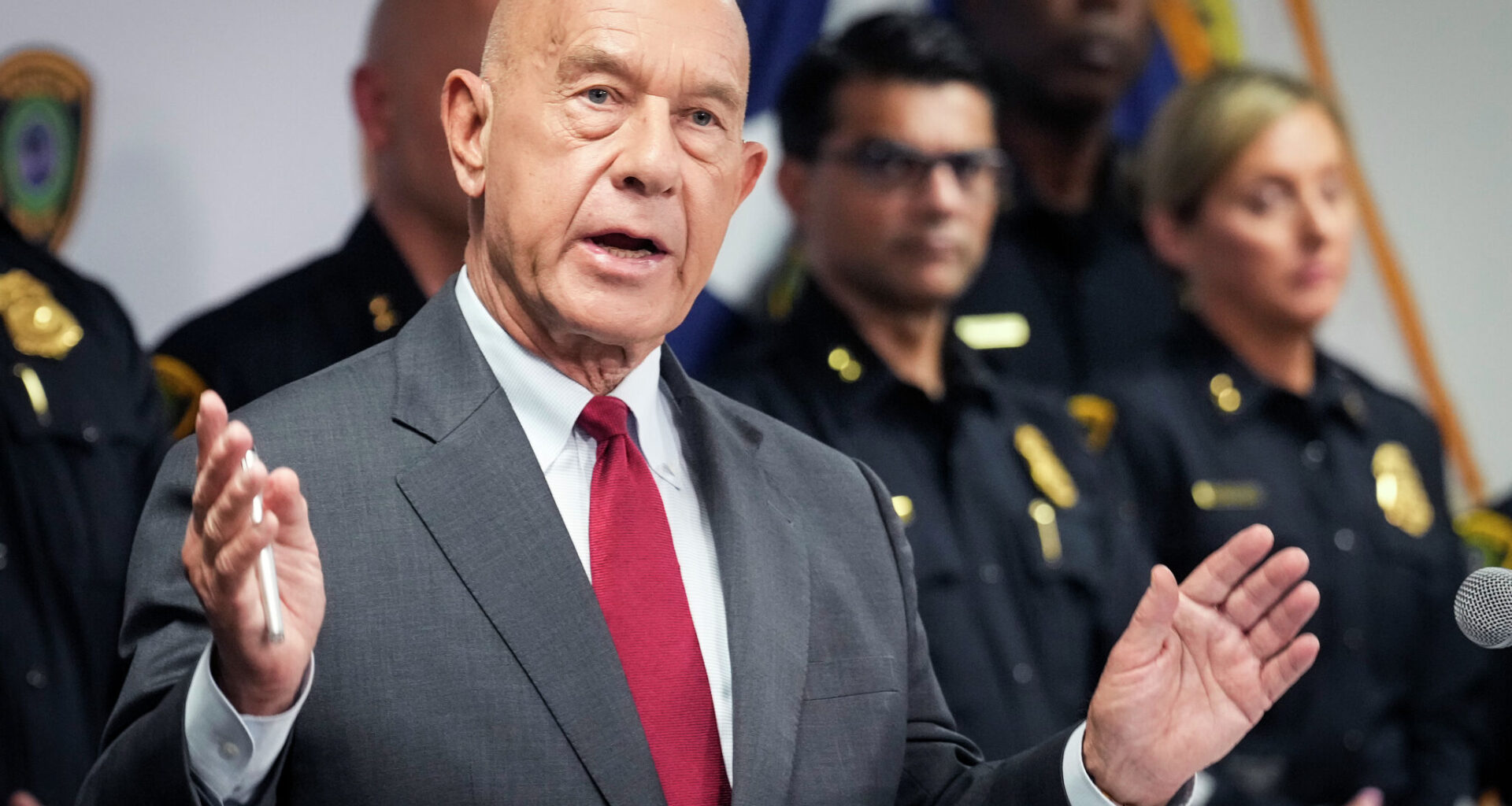
Mayor John Whitmire speaks to the media about the city’s immigration policies after reports that at least two officers violated policy by transporting people direct to ICE agents in March 2026.
Brett Coomer/Houston Chronicle
Mayor John Whitmire’s administration applied for a $150 million grant from a controversial federal program last month, unbeknownst to city council members and residents who have raised concerns that the funding might force the city to more closely cooperate with federal immigration authorities.
Houston’s bid for the Model Cities Initiative, run by the U.S. Department of Justice, was pulled twice from the council agenda last month as Whitmire said his office was pressing the DOJ to clarify the program’s guidelines. The council already has spent months this year debating the role Houston police play in U.S. Immigration and Customs Enforcement actions.
But the grant application had been submitted weeks before.
Article continues below this ad
READ MORE: New report reveals how often Houston police turned people over to ICE
Council Member Amy Peck, who chairs the city’s public safety committee, said the mayor’s staff told her the city had applied and would seek council approval if the funding comes through.
At least three other council members said they were unaware of the city’s submission. Two said they thought the Whitmire administration had backtracked on applying, especially after his office told Houston Public Media last week that the city was “not taking any action… at this time” on the grant.
The mayor’s office confirmed the submission Monday, saying officials did so to comply with the DOJ’s Sept.1 application deadline.
Article continues below this ad
“We applied in partnership with several nonprofit agencies and other governmental agencies with the purpose of supporting our homelessness efforts, reducing violent crime, and other important issues like domestic violence,” Whitmire said in a statement.
“If the grant imposes conditions that entail enforcement of immigration laws as part of this funding,” Whitmire added, “the city may decline such funding and withdraw the application.”
DOJ officials, who unveiled the program in June as part of President Donald Trump’s “Make America Safe Again” agenda, said they expected to select two to four cities to “supercharge” local police efforts and tamp down violent crime.
READ MORE: Houston vowed to curb ICE cooperation. Police still waited hours for agents.
The city has applied for federal grants without council approval in the past. But the prospect of inviting more scrutiny on the city’s relationship with ICE has driven unusual concern over the Model Cities program.
Article continues below this ad
Council Member Joaquin Martinez said he was “definitely a no” if the funding is granted and reaches a council vote, in part informed by the city’s experience earlier this year, when Gov. Greg Abbott responded to the council limiting HPD’s cooperation with the ICE by threatening to pull state grant funding, leading the council to repeal the policy.
“This would be giving the federal government a hold on us,” Martinez said.
Read more: Inside the collapse of Houston’s ICE policy
“A modern law and order model”
Discussion of the Model Cities program has dominated the council’s weekly public comment sessions since the program first appeared on the Sept. 15 agenda, with most speakers in opposition.
Article continues below this ad
The item was pulled from that meeting as well as the subsequent one as the city awaited answers from the DOJ, though Whitmire expressed confidence that the program would require “not anything more than what we’re doing now.”
The DOJ’s program rules state that applicants “must ensure that their initiatives align” with various federal priorities such as “directly supporting law enforcement operations (including immigration law enforcement operations).”
HPD policy currently requires officers to contact ICE when they encounter someone with a civil immigration warrant, then wait a “reasonable amount of time” for federal agents to arrive. From April through June, Houston police encountered 103 people with civil immigration warrants, mostly during traffic stops. Nineteen of them were taken into ICE custody.
Read more: ICE arrests witness in active Houston Police Department shooting investigation
Houston’s chances of receiving a grant from the program, which has a total $300 million in funding, are still unclear. Two other cities – Jackson, Mississippi and Pueblo, Colorado — were notified last week that they had moved on to “round two” of their applications for $125 million and $100 million, respectively.
Article continues below this ad
Program documents cite federal efforts in Memphis, Tenn., and Washington, D.C. as models of success, though it is not clear whether the grant funding would replicate the surges of National Guard troops deployed in those two cities.
Houston’s request for $150 million would be split among more than a dozen agencies and local groups, including Harris County, HPD, Metro and the city health department, according to an overview of the application. Described as “a modern law and order model,” the strategy would include both beefing up law enforcement operations as well as services for the homeless, youth, and people released from prison.
Dallas and Louisiana’s East Baton Rouge Parish also submitted applications. Other governments, including New Orleans and Montgomery, Alabama, have publicly declined to seek the funding, citing concerns with federal oversight.