
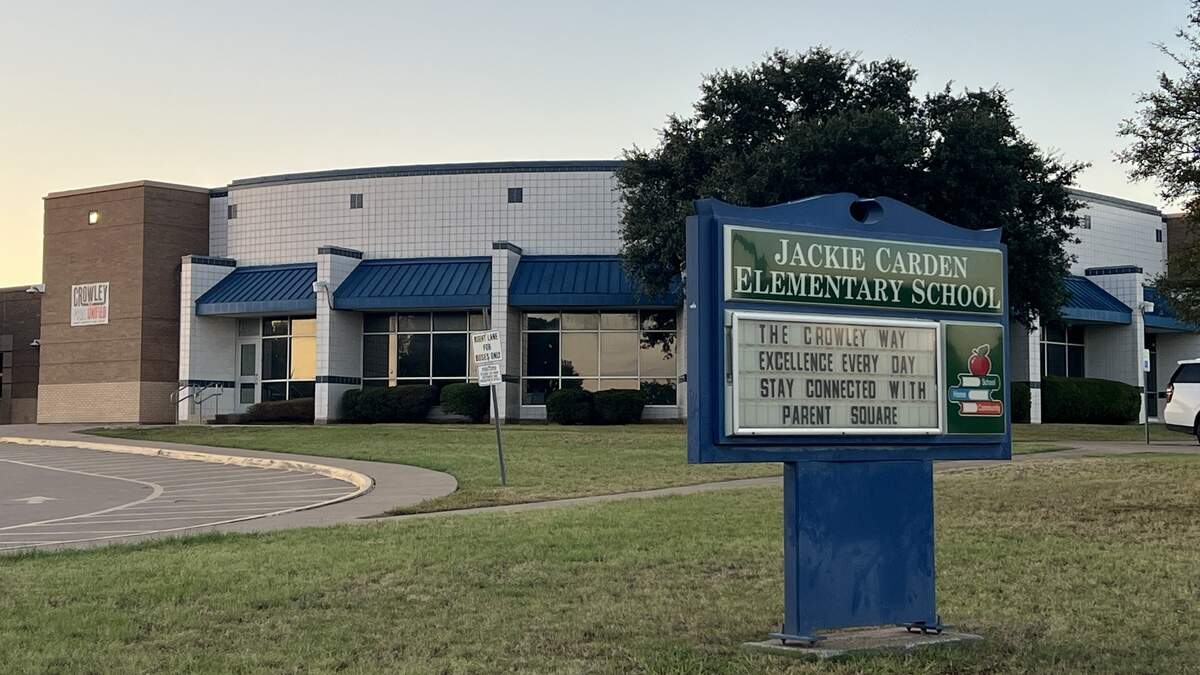
Crowley ISD’s Jackie Carden Elementary School is pictured in Fort Worth on Oct. 5, 2026.
Lina Ruiz
lruiz@star-telegram.com
Elementary students at four Crowley ISD schools returned to class for the 2026-27 school year while the summer heat still baked the region with record-breaking temperatures. Although time will tell whether academic gains will follow these additional school days, attendance percentages offer a glimpse of how many students were in the classroom during this time.
Mary Harris, J.A. Hargrave, Jackie Carden and Sycamore elementary schools — known as Breakthrough Schools — started school on July 13 with a new instructional model aimed at boosting academic performance. The goal is for these campuses to earn an A or B in the state’s annual A-F accountability ratings in 2027 while reducing summer learning loss. Research shows additional instruction time can improve academic achievement, but in order to reap the benefits, several factors are at play including attendance.
In the context of a traditional school year, district leaders statewide have been grappling with chronic absenteeism following COVID-19. Students who are chronically absent are missing at least 10% of a 180-day school year, or about 18 school days, which puts them at risk of falling behind their peers and struggling academically. In the 2024-25 school year, almost 25% of Crowley ISD students were chronically absent compared to 18% of students statewide, according to Texas Education Agency data.
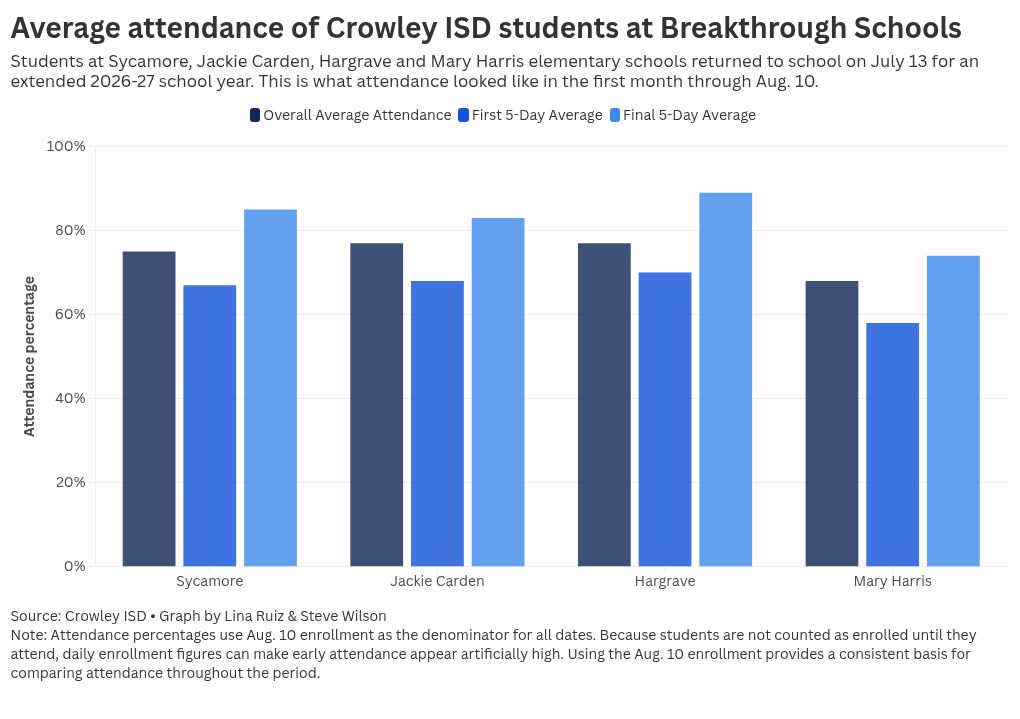
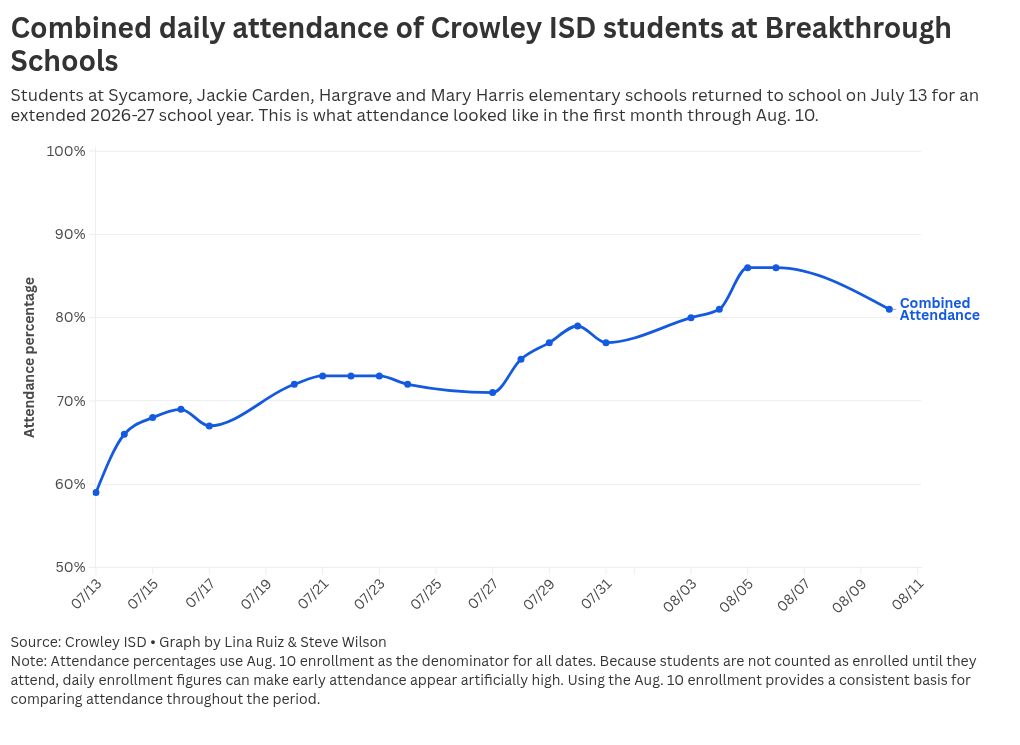
A Star-Telegram analysis of the first month of school at Crowley ISD’s Breakthrough Schools, which spanned from July 13 to Aug. 10, shows combined attendance slowly improved across the four-week period at all campuses, but the average attendance remained under 90% and peaked at 86% on Aug. 5. Across all campuses, there were just two days out of the 20 total days when attendance reached 90% or higher. Hargrave Elementary reached these thresholds at 90% on Aug. 5 and 92% on Aug. 6.
When looking at individual schools, Jackie Carden Elementary had the highest average attendance rate at about 77%, although Hargrave Elementary trailed by a tenth of a percentage point. Mary Harris Elementary’s attendance rate struggled in comparison with an average attendance of 68%.
Crowley ISD did not respond to requests for comment when asked how the extended school year impacted students at Breakthrough Schools and how attendance rates came into play with those impacts.
 What do academics and research say about attendance?
School attendance matters because it correlates to a student being engaged in their academics and in their relationships with their peers and teachers, said Joshua Childs, an associate professor of educational leadership and policy at the University of Texas at Austin. It also matters because schools can act as a safety hub that also provides meals and services to families.
“Attendance matters because students who attend school more frequently and regularly often achieve higher on academic tests and academic assessments and so on and so forth,” Childs said. “That’s important when we’re thinking about the culture and the engagement of the school.”
The research behind extended school years is a mixed bag, Childs said. An additional number of days doesn’t automatically mean students’ attendance will improve or academic outcomes will improve unless there are targeted changes paired with those added school days. Childs points to changes in the time and quality of instruction as examples.
“What are the supports put in place so that we can disrupt or sort of mitigate burnout?” Childs also noted.
Crowley ISD increased instructional time, compensated high-performing teachers and provided more individualized support for students with the implementation of its extended school year.
The district’s decision to add a month of instruction to the beginning of the school year, rather than the end of the school year, appears to be a new approach compared to surrounding districts in North Texas implementing extended calendars. In Dallas ISD, students at 13 elementary schools returned early to class on July 28, but it was two weeks ahead of the regular first day of school. In Fort Worth ISD, 15 elementary campuses are attending class for an additional month through June 29, 2027, this school year.
In a recent study on summer programs conducted across five urban school districts, including Dallas, researchers found “strong evidence” that voluntary summer learning programs can yield short-term gains in math, among other academic benefits.
“We also found promising evidence that, after two consecutive summers, students with high attendance (20 or more days per summer) outperformed their peers in mathematics and English language arts and displayed stronger social-emotional competencies,” the report by research organization RAND states.
These researchers also named consistent attendance among the factors of successful programs that they studied.
“The successful summer programs we observed delivered several sound educational and youth development practices: teachers with content knowledge using rigorous academic curricula, high-quality enrichment experiences, a high level of engagement between adults and students even during transitions and time outside of class, and an emphasis on consistent attendance,” they noted.
Related Stories from Fort Worth Star-Telegram

Fort Worth Star-Telegram
Lina Ruiz covers early childhood education in Tarrant County and North Texas for the Fort Worth Star-Telegram. A University of Florida graduate, she previously wrote about local government in South Florida for TCPalm and Treasure Coast Newspapers.